
Introduction
Most contractors don't need more advertising.
They need better advertising.
There is a big difference.
A campaign can generate:
- Thousands of impressions
- Hundreds of clicks
- Dozens of leads
and still produce very little profitable business.
That's because successful contractor advertising isn't about reaching the most people.
It's about reaching the right homeowner at the right moment with the right message, then turning that attention into:
Lead → Estimate → Customer → Revenue
Contractors have more advertising options than ever:
- Google Ads
- Local Services
- Facebook and Instagram
- Retargeting
- Direct mail
- Yard signs
- Local sponsorships
- Referral programs
- SEO
- Google Business Profile
The mistake is assuming you need all of them.
From our experience, most contractors are better served by building a smaller number of channels that work together and can be measured properly.
What Is Contractor Advertising?
Contractor advertising is the process of paying for or deliberately creating visibility that helps potential customers discover your business.
For example:
A homeowner searches:
“Roofing contractor near me.”
They see your Google ad.
Or:
A homeowner scrolls Facebook and sees a dramatic kitchen remodeling transformation.
Or:
Someone drives past one of your active projects and sees your yard sign.
All three are advertising.
But they represent very different levels of customer intent.
That's why the channel matters less than understanding where the customer is in the buying process.
Advertising vs. Marketing
These terms are often used interchangeably, but they're not identical.
Advertising
Usually refers to paid or promotional exposure.
Examples:
- Google Ads
- Facebook Ads
- Direct mail
- Billboards
- Sponsored placements
Marketing
Is the larger system.
It can include:
- Advertising
- SEO
- Reviews
- Website
- Referral programs
- Branding
- Follow-up
- Customer experience
Advertising gets attention.
Marketing turns that attention into customers.
Your advertising becomes much more valuable when the rest of the system is strong.
1. Define the Customer You Actually Want
Before spending one dollar, answer:
What type of customer do we want more of?
For example:
A roofer might want:
Full residential roof replacements
A painter:
Whole-home interior repaints
A remodeler:
Kitchen and bathroom remodeling projects
An epoxy contractor:
Residential garage coatings
Now define:
- Service
- Location
- Minimum project value
- Ideal property type
- Timeline
- Customer type
Advertising becomes much easier once you know who you're trying to attract.
Real-Life Example
Suppose your average replacement roof is worth $15,000.
Your advertising produces:
40 small repair leads
but only:
5 replacement opportunities.
The campaign may generate plenty of activity while still attracting the wrong work.
2. Know Your Customer Acquisition Economics
Before setting a budget, know what a customer is worth.
Start with:
Average Project Value
Then understand:
Gross Margin
Lead-to-Estimate Rate
Estimate-to-Customer Close Rate
Acceptable Customer Acquisition Cost
Imagine:
Average project:
$12,000
Gross profit:
$4,000
If acquiring that customer costs:
$800
the economics may be attractive.
If customer acquisition costs:
$3,500
the picture changes.
You can't determine whether advertising is expensive without understanding what a customer is worth to your business.
3. Use Google Ads to Capture Existing Demand
Google Search Ads are powerful because they can appear when someone is actively searching for your service.
Examples:
“Kitchen remodeling contractor near me”
“House painter Dallas”
“Roof replacement contractor”
“Epoxy flooring installer near me”
The homeowner has already identified the need.
You're not trying to convince them that they need a contractor.
You're competing to become the contractor they contact.
That makes Google especially useful for high-intent services.
4. Focus Google Ads on Commercial Intent
Not every search deserves your advertising budget.
Compare:
“How long does a roof last?”
with:
“Roof replacement company near me.”
The first person is researching.
The second is much closer to hiring.
Depending on your strategy, strong contractor keywords may include:
- Contractor near me
- [Service] contractor near me
- [Service] company
- [Service] in [city]
- [Service] estimate
- [Service] contractor
Prioritize buying intent.
Educational searches are often better suited to SEO content than expensive search advertising.
5. Use Negative Keywords
One of the easiest ways to waste contractor ad spend is paying for irrelevant searches.
A roofer may receive searches related to:
- Roofing jobs
- Roofing salary
- Roofing materials
- DIY roofing
A painter may receive:
- Painting jobs
- Painting classes
- Art painting
- Paint supplies
Those searches contain relevant words but represent the wrong intent.
Use negative keywords and regularly review search terms.
Pro Tip
Don't assume the campaign manager can predict every irrelevant search before launch.
Search-term analysis should be an ongoing part of Google Ads management.
6. Target the Right Geographic Areas
Contractors are local businesses.
Your advertising should reflect that.
Don't automatically target:
50-mile radius
because your crews technically can drive that far.
Review:
- Existing customers
- Average project values
- Close rates
- Drive times
- Crew efficiency
- Competition
Example
Area A:
30 leads → 3 customers
Area B:
20 leads → 8 customers
Area A generates more leads.
Area B generates more business.
Advertising should follow profitability, not just lead volume.
7. Build Dedicated Landing Pages
One of the most common contractor advertising mistakes is:
Specific Search → Relevant Ad → Generic Homepage
Suppose someone searches:
“Cabinet painting contractor near me.”
They shouldn't land on a homepage covering:
- Exterior painting
- Commercial painting
- Interior painting
- Drywall
- Deck staining
- Company history
Instead:
Cabinet Painting Search
↓
Cabinet Painting Ad
↓
Cabinet Painting Landing Page
↓
Estimate Request
The message remains consistent.
That makes the experience easier for the homeowner.
8. Make Landing Pages Conversion-Focused
A strong contractor landing page should quickly answer:
What service is this?
Where do you work?
Why should I trust you?
How do I contact you?
Include:
- Clear headline
- Real project photos
- Reviews
- Service area
- Trust signals
- Simple form
- Phone number
- CTA
Don't bury the conversion beneath ten sections of unnecessary company history.
The visitor clicked because they had a need.
Help them take the next step.
9. Track Conversions Properly
Google Ads provides conversion tracking specifically to measure meaningful actions such as leads and sales. (Google Support)
At minimum, track:
- Phone calls
- Form submissions
- Booked appointments where possible
But don't stop there.
The strongest tracking connects advertising with:
Qualified Lead
Estimate
Customer
Revenue
Google also provides enhanced conversions for leads and offline-conversion workflows that can help connect downstream outcomes back to advertising campaigns. (Google Support)
10. Track Cost Per Customer, Not Only Cost Per Lead
Imagine:
Campaign A
50 leads $75 CPL 3 customers
Campaign B
25 leads $140 CPL 8 customers
If you measure only CPL, Campaign A looks better.
But:
Campaign A cost:
$3,750
Cost per customer:
$1,250
Campaign B cost:
$3,500
Cost per customer:
$437.50
Which campaign would you rather scale?
That's why CPL is useful but incomplete.
Track:
CPL → Cost per Estimate → Cost per Customer
11. Use Google Business Profile Alongside Advertising
Paid advertising becomes stronger when homeowners find a credible local presence behind it.
Someone clicks your ad.
Then searches your company.
They find:
- Strong Google reviews
- Real project photos
- Professional website
- Complete Business Profile
Trust increases.
Google says local results are primarily based on relevance, distance, and prominence. (Google Support)
So even while you're paying for immediate visibility, keep building the local assets surrounding your business.
12. Build Local SEO at the Same Time
Advertising provides immediate visibility.
SEO builds long-term organic visibility.
Your contractor SEO strategy can include:
- Google Business Profile
- Service pages
- Location pages
- Project case studies
- Reviews
- Helpful content
- Local links
Google's Search guidance emphasizes helpful, reliable, people-first content rather than content created primarily to manipulate rankings. (Google for Developers)
That creates a useful combination:
Google Ads → Immediate Demand
-
Local SEO → Long-Term Visibility
Over time, your business becomes less dependent on paying for every visitor.
13. Use Facebook and Instagram for Visual Services
Not every contractor needs Facebook Ads.
But visually impressive services can have an advantage.
Examples include:
- Painting
- Kitchen remodeling
- Bathroom remodeling
- Epoxy flooring
- Deck building
- Landscaping
- Exterior renovations
Strong creative includes:
Before → After
Project Transformation
Customer Testimonial
Short Video
Finished Result
The key difference from Google is intent.
Google often captures people already searching.
Facebook and Instagram can put your company in front of homeowners before they begin searching.
14. Understand Social Media Lead Quality
Facebook can sometimes generate inexpensive leads.
Cheap doesn't necessarily mean good.
A social lead may have:
- Lower immediate intent
- Longer timeline
- More price sensitivity
- Less awareness of your company
That doesn't make the lead bad.
It means your process may require more:
Qualification
Follow-Up
Nurturing
Compare social advertising based on customer acquisition economics, not simply form cost.
15. Use Retargeting
Many homeowners visit a contractor website and don't contact the company immediately.
They may still be:
- Comparing contractors
- Discussing the project
- Reviewing budget
- Waiting for timing
- Researching materials
Retargeting can keep your company visible afterward.
For example:
Someone visits your kitchen remodeling page.
Later, they see:
Before-and-after kitchen transformation
with:
Planning Your Kitchen Remodel? See More Recent Projects.
You're continuing the conversation.
16. Use Real Project Photography
One of the strongest advertising assets contractors have is something they're already producing:
Completed work.
Document:
- Before
- Process
- After
Then use those assets across:
- Google Ads landing pages
- Website
- Google Business Profile
- Retargeting
From Our Experience
Many contractors don't have a content problem.
They have a documentation problem.
Crews complete excellent work every week, but nobody consistently captures it.
Fix that and your advertising library becomes much stronger.
17. Use Reviews in Advertising
Customer testimonials can strengthen your ads and landing pages.
For example:
A homeowner clicks an exterior painting ad.
The landing page includes a review saying:
“The crew protected everything carefully, communicated every day, and finished exactly when promised.”
That testimonial answers real customer concerns.
Use relevant reviews whenever possible.
Roofing review on roofing page.
Kitchen remodeling review on kitchen page.
Match the proof to the service.
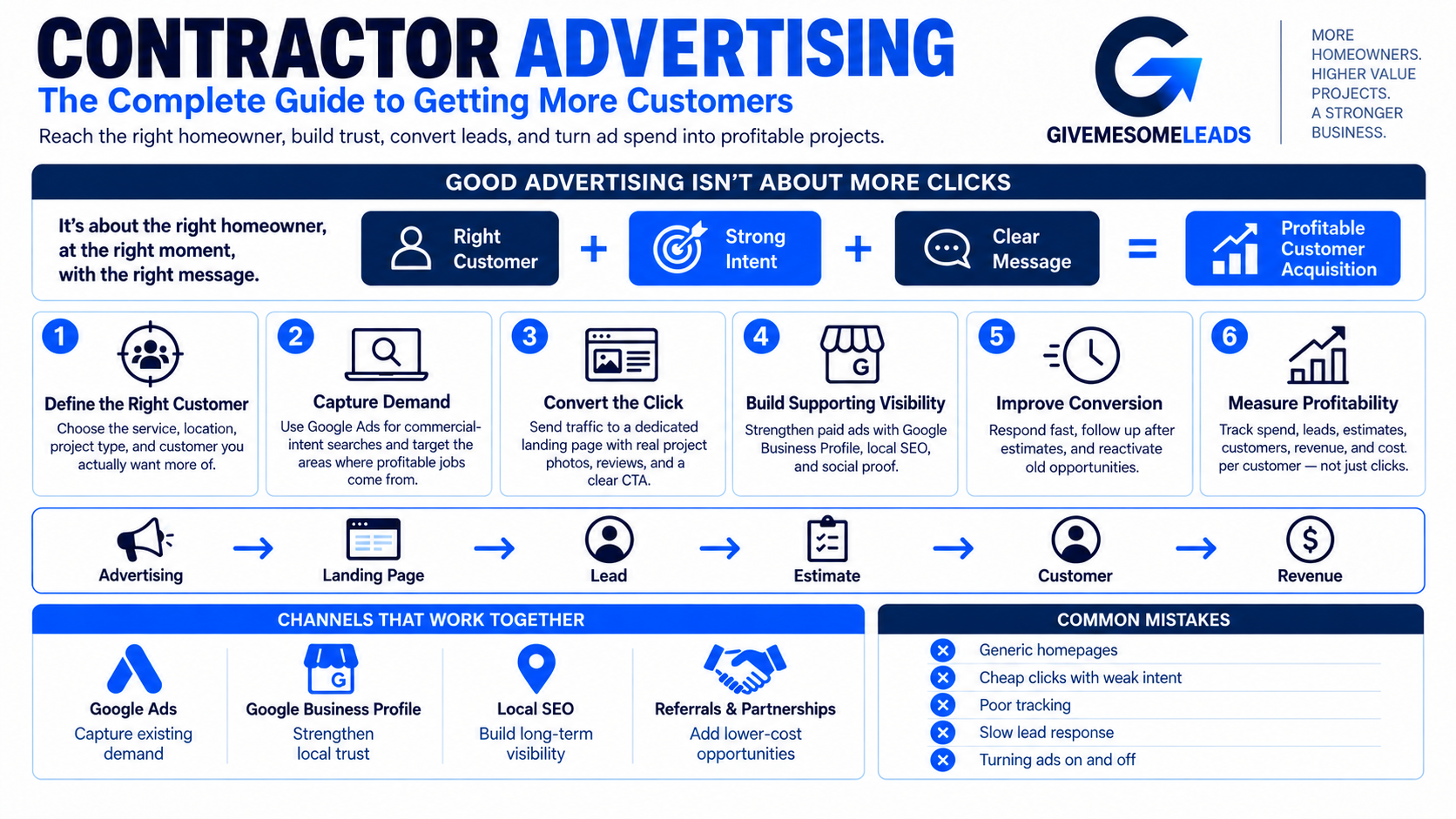
📊 Click the diagram to view a larger version. After opening it, turn your phone sideways for the best viewing experience.
18. Use Direct Mail Selectively
Digital advertising isn't the only option.
Direct mail can work particularly well when your targeting is specific.
For example:
- Older neighborhoods
- High-value homes
- Areas around completed projects
- Specific property types
A generic postcard sent to 50,000 homes may waste money.
A targeted campaign around:
Neighborhood + Relevant Service + Strong Project
can be more compelling.
Example
Your crew completes a major exterior repaint.
Send surrounding homes:
We Recently Completed an Exterior Painting Project in Your Neighborhood
Include:
- Before-and-after photo
- Company name
- Reviews
- Estimate CTA
Now the advertising has local context.
19. Use Yard Signs
For many contractors, the jobsite itself is advertising.
Where permitted and with customer approval, use professional yard signs.
Keep them simple:
Company Name
Primary Service
Phone
Website
A homeowner driving past has seconds to understand the message.
Don't put your entire service catalog on the sign.
20. Use Branded Vehicles
Your trucks move through your service area every day.
Use them.
Vehicle graphics should quickly communicate:
- Brand
- Service
- Phone
- Website
Avoid overcrowding.
A vehicle doesn't need 14 bullet points.
Someone passing at 40 mph isn't reading them.
21. Market Around Active Projects
This is especially useful for:
- Roofing
- Exterior painting
- Siding
- Windows
- Decks
- Landscaping
One job can generate additional neighborhood awareness.
Where appropriate:
- Yard sign
- Door hangers
- Neighbor introductions
- Direct mail
- Social posts
The finished project becomes evidence.
Real-Life Example
You're replacing a roof in a neighborhood where most homes were built around the same period.
Nearby homeowners may be facing similar roofing decisions.
Your active project creates naturally relevant advertising.
22. Use Referral Marketing
Not all advertising requires paying a platform.
A happy customer recommending you can be one of your most powerful forms of promotion.
Build a process:
Project Complete
↓
Customer Happy
↓
Google Review
↓
Referral Request
↓
Stay in Touch
Referrals shouldn't depend completely on luck.
Make it easy for customers to share your company information.
23. Build Professional Referral Partnerships
Contractors can also generate work through relationships with:
- Realtors
- Home inspectors
- General contractors
- Designers
- Property managers
- Suppliers
- Complementary trades
Don't approach these people saying:
“Send me leads.”
Become useful.
Respond quickly.
Refer appropriate business back.
Take excellent care of introductions.
Strong professional relationships can produce repeat opportunities.
24. Improve Lead Response
Advertising can't fix bad follow-up.
Suppose you spend $150 generating a lead.
The homeowner submits the form at 10:00 a.m.
Your office calls at 4:00 p.m. the following day.
By then, they may already have several estimates scheduled.
Create:
Lead Arrives
↓
Call Quickly
↓
No Answer
↓
Text
↓
Follow Up
Sometimes contractors don't need more advertising.
They need to stop wasting the leads they already paid for.
25. Follow Up After Estimates
Advertising gets you into the conversation.
The estimate doesn't automatically close the project.
Homeowners may still be:
- Comparing contractors
- Reviewing financing
- Discussing with spouse
- Evaluating materials
Follow up professionally.
Instead of:
“Have you decided?”
try:
“I wanted to make sure you received the proposal and see if you had any questions about the scope we recommended.”
Helpful follow-up can increase the value of your advertising without generating another lead.
26. Reactivate Old Leads
Your next customer might already exist in your CRM.
Review:
- Old inquiries
- Unclosed estimates
- Postponed projects
- Previous customers
A simple message can reopen a conversation:
“We provided an estimate for your project previously and wanted to see whether it's still something you're considering. We'd be happy to answer any questions or update the proposal if needed.”
You already spent money to generate that opportunity.
Use it.
27. Don't Compete Only on Price
Advertising:
CHEAPEST CONTRACTOR IN TOWN!
may generate attention.
It may also attract exactly the customers you don't want.
Homeowners evaluate more than price.
They also care about:
- Reputation
- Workmanship
- Communication
- Warranty
- Process
- Reliability
- Reviews
Your advertising should communicate your value.
If you advertise only price, don't be surprised when customers choose primarily on price.
28. Match the Message to the Service
A good contractor advertisement is specific.
Weak:
Quality Home Improvement Services
Stronger:
Need Your Roof Replaced? See Recent Local Roofing Projects and Request an Estimate.
Weak:
Transform Your Home Today
Stronger:
Planning a Kitchen Remodel? See What Our Remodeling Process Includes.
Specificity helps attract the right customer.
29. Test Advertising Creatives and Offers
Don't assume the first advertisement will be your best.
Test variations in:
- Headline
- Project photo
- Before-and-after
- Testimonial
- CTA
- Offer
- Landing page
For example:
Ad A
Company-focused:
ABC Painting, Serving Dallas Since 2005
Ad B
Customer-focused:
Thinking About Repainting Your Home? See Recent Dallas Projects
Let actual performance determine what works.
30. Track Revenue by Advertising Source
Your CRM should eventually tell you:
| Source | Leads | Customers | Revenue |
|---|---|---|---|
| Google Ads | 40 | 7 | $105,000 |
| Facebook Ads | 55 | 6 | $72,000 |
| Google Maps | 25 | 8 | $128,000 |
| Referrals | 15 | 9 | $140,000 |
These numbers are illustrative.
The important lesson is that the source generating the most leads isn't necessarily generating the most business.
Track:
Source → Lead → Estimate → Customer → Revenue
That's how advertising becomes measurable.
31. Calculate Customer Acquisition Cost
Suppose you invest:
$6,000
into advertising and management.
You acquire:
6 customers.
Customer acquisition cost:
$1,000
Now compare that against:
- Average job value
- Gross profit
- Sales commissions
- Overhead
CAC is much more useful than simply knowing:
“We paid $80 per lead.”
32. Don't Turn Advertising Off Every Time You're Busy
This is a common contractor cycle:
Slow
↓
Start Advertising
↓
Get Busy
↓
Stop Advertising
↓
Pipeline Empties
↓
Slow
Then repeat.
Advertising usually works better as a consistent system.
You can adjust budgets based on capacity.
But don't treat marketing like an emergency lever you pull only when the schedule becomes empty.
33. Don't Depend on One Advertising Channel
Imagine 90% of your customers come from one platform.
Then:
- Prices increase
- Algorithm changes
- Competition grows
- Platform rules change
Your business becomes vulnerable.
A stronger system may combine:
Google Ads
-
Local SEO
-
Google Business Profile
-
Referrals
-
Professional Partnerships
You don't need 15 channels.
You need several reliable ones.
34. Build Assets You Own
Paid advertising is valuable.
But continue building:
- Website
- Google Business Profile
- Reviews
- SEO
- Customer database
- Project portfolio
- Referral network
- Brand
These assets strengthen your company regardless of which advertising platform is currently generating leads.
Google's current Search guidance continues to emphasize unique, helpful, expert-led content and strong foundational SEO practices. (Google for Developers)
That means your real projects, customer knowledge, and genuine experience can become long-term marketing advantages.
Real-Life Example: Evaluating Contractor Advertising Properly
Imagine a contractor spends:
$5,000 on ads
plus:
$1,500 in management and landing-page costs
Total:
$6,500
The campaign produces:
50 leads
Raw cost per lead:
$130
Now continue.
50 Leads
↓
32 Qualified
↓
20 Estimates
↓
7 Customers
Customer acquisition cost:
$928
Suppose those seven projects produce:
$105,000 in revenue
Now the contractor can compare:
$6,500 marketing investment
against:
Revenue and gross profit generated
The figures are illustrative.
But this is the correct framework.
Not:
“Are $130 leads expensive?”
Instead:
“Can we profitably acquire customers for approximately $928?”
A Simple Contractor Advertising Strategy
If we were building a contractor advertising system from scratch, we'd structure it roughly like this:
Stage 1 — Foundation
Website + Google Business Profile + Reviews + Tracking
Stage 2 — Capture Demand
Google Ads + Strong Landing Pages
Stage 3 — Build Long-Term Visibility
Local SEO + Service Pages + Project Content
Stage 4 — Expand
Facebook / Instagram + Retargeting where appropriate
Stage 5 — Increase Conversion
Fast Response + Qualification + Estimate Follow-Up
Stage 6 — Build Additional Sources
Referrals + Partnerships + Neighborhood Marketing
Stage 7 — Measure
Spend → Lead → Estimate → Customer → Revenue → Profit
That's a customer acquisition system.
Not simply an ad campaign.
Common Contractor Advertising Mistakes
Avoid:
- Advertising every service equally
- Targeting areas you don't really want
- Chasing cheap clicks
- Sending paid traffic to generic homepages
- Ignoring negative keywords
- Using only stock photography
- Weak landing pages
- No Google reviews
- Slow lead response
- No estimate follow-up
- Measuring impressions instead of customers
- Not tracking offline sales
- Competing only on price
- Turning advertising on and off constantly
- Depending entirely on one channel
Most contractors don't need another marketing trick.
They need a better system around the channels they're already using.
Frequently Asked Questions
1. What is the best advertising for contractors?
There isn't one universal answer. Google Search Ads are often strong for capturing active demand, while Facebook and Instagram can work well for visual services and awareness. Local SEO, referrals, and Google Business Profile should also support the overall system.
2. Does Google Ads work for contractors?
Yes, it can. Google Ads allows contractors to reach people actively searching for services. Results depend on search intent, competition, geographic targeting, landing pages, tracking, and the company's sales process.
3. Should contractors use Facebook Ads?
They can work particularly well for visually compelling services such as remodeling, painting, flooring, and outdoor improvements. Social leads may require more qualification and follow-up than high-intent Search leads.
4. How much should contractors spend on advertising?
There is no universal amount. Work backward from your desired number of customers, average project value, margins, close rate, and acceptable customer acquisition cost.
5. What metrics should contractor advertising track?
At minimum: Spend → Leads → Qualified Leads → Estimates → Customers → Revenue Google Ads supports conversion tracking for lead actions, and advertisers can also use offline and enhanced lead-conversion measurement to connect later customer outcomes to advertising. (Google Support)
6. Is cost per lead important?
Yes, but it's not enough. A low CPL campaign can still be unprofitable if few leads become customers. Cost per customer and profitability are ultimately more important.
7. Should contractors advertise when they're already busy?
Often yes, although budgets can be adjusted to capacity. Completely stopping advertising whenever schedules fill can create future pipeline gaps.
8. Is SEO considered advertising?
SEO is usually considered an organic marketing strategy rather than paid advertising. However, combining SEO with advertising can give contractors both immediate and longer-term visibility.
9. Should contractors send ad traffic to their homepage?
Not always. For high-intent campaigns, dedicated landing pages aligned with the exact service being advertised often create a clearer path to conversion.
10. How do I know whether my contractor advertising works?
Track the entire customer journey: Advertising → Lead → Qualified Lead → Estimate → Customer → Revenue → Profit If you can't connect campaigns to customers, your measurement is incomplete.
Final Thoughts
Contractor advertising isn't about buying the most clicks.
It's about building a system that consistently turns marketing investment into profitable customers.
Start with the right customer.
Reach them when intent is strong.
Send them to a page that matches what they need.
Show real projects.
Build trust with reviews.
Respond quickly.
Follow up.
Track what becomes revenue.
Then reinvest in the channels producing the best business results.
At the same time, keep building the assets your company owns:
Website.
Reviews.
Google presence.
SEO.
Customer database.
Project portfolio.
Referral network.
That's how advertising becomes more than a monthly expense.
It becomes part of a larger customer acquisition system.
Advertise for customers today. Build marketing assets that help you acquire customers tomorrow.
Ready to Build a More Profitable Contractor Advertising System?
GiveMeSomeLeads helps contractors combine Google Ads, high-converting landing pages, Local SEO, Google Business Profile, call tracking, form tracking, and revenue attribution into one measurable customer acquisition system.