
Introduction
PPC, or pay per click advertising, is a form of online advertising where you pay when someone clicks your ad. For contractors, PPC can be one of the fastest ways to generate new opportunities.
But it can also burn through a marketing budget surprisingly quickly.
The difference usually comes down to strategy.
A contractor doesn't need:
- More clicks
- More impressions
- Cheaper traffic
They need:
More qualified leads that become profitable customers.
That's what contractor PPC should be built around.
From our experience, one of the biggest mistakes contractors make is evaluating PPC at the wrong level.
They look at:
Cost per click
or:
Cost per lead
when the real objective is:
Cost per customer + Revenue + Profit
A campaign generating $40 leads can be terrible if almost none become estimates.
Another generating $150 leads can be excellent if those leads consistently become $10,000, $30,000 projects.
What Is PPC for Contractors?
PPC stands for pay-per-click advertising .
In the classic model, your business pays when someone clicks your advertisement.
Google Ads is the most common example for contractors because Search campaigns can place your company in front of people actively searching for services such as:
- Roofing contractor near me
- House painter Dallas
- Kitchen remodeling contractor
- Epoxy flooring installer
- Masonry repair company
- Window replacement contractor
The customer journey looks like:
Customer Searches
↓
Your Ad Appears
↓
Customer Clicks
↓
Landing Page
↓
Lead
↓
Estimate
↓
Customer
The click is only the beginning.
Why PPC Works Well for Contractors
Contractor PPC works best when customers are already actively searching for what you provide.
Consider these two situations.
Social Media
A homeowner is scrolling through vacation photos.
You interrupt them with an ad for roof replacement.
Maybe they're interested.
Maybe they're not.
Google Search
The homeowner types:
“Roof replacement contractor near me.”
They've already identified the need.
You're entering the conversation much later in the buying journey.
That's the major advantage of Search advertising:
Intent.
1. Start With the Services You Actually Want
Don't advertise every service simply because your company offers it.
Start with your ideal projects.
For example, a roofing company may provide:
- Repairs
- Replacement
- Gutters
- Metal roofing
- Commercial roofing
But maybe full roof replacements generate the best margins.
Your PPC strategy should reflect that.
The same applies to other contractors.
Painter
Maybe you want:
Whole-home interior repaints
instead of:
Single-room touch-ups
Remodeler
Maybe you want:
Kitchen remodeling
instead of:
Small handyman projects
Epoxy Contractor
Maybe:
Garage floor systems
produce the strongest economics.
2. Define Your Geographic Targeting
Contractor businesses are local.
Your PPC campaigns should be too.
Don't automatically target a giant radius simply because your crews can technically drive that far.
Analyze:
- Previous customers
- Average project value
- Close rate
- Drive time
- Crew efficiency
- Competition
- Profitability
Example
Suppose:
Area A
30 leads 4 customers
Area B
20 leads 8 customers
Area A produces more leads.
Area B produces twice as many customers.
Lead volume alone could push you toward the wrong market.
3. Choose High-Intent Keywords
Keyword selection matters because not all searches represent the same buying intent.
Compare:
“How long does exterior paint last?”
with:
“Exterior painting contractor near me.”
The first person is researching.
The second may be ready to request estimates.
For contractor PPC, high-intent keywords often include combinations such as:
- [service] contractor
- [service] company
- [service] near me
- [service] in [city]
- [service] estimate
- [service] installer
Examples:
roof replacement company
kitchen remodeler near me
house painter Dallas
epoxy flooring contractor
Google Ads supports different keyword match options, and Google specifically recommends using appropriate match types and monitoring actual search terms to improve relevance. ( Google Help )
4. Understand Keyword Match Types
Google Ads currently supports several keyword match options.
At a high level:
Broad Match
Provides the greatest reach.
Google may match your ads to searches related to the meaning of your keyword.
Phrase Match
Provides more control around the meaning of the phrase.
Exact Match
Provides the tightest relationship to the keyword's meaning or intent.
Google's current documentation emphasizes that match types work around meaning rather than simply matching identical strings. ( Google Help )
The right mix depends on:
- Campaign maturity
- Conversion data
- Budget
- Market size
- Bidding strategy
Don't assume:
Exact always good. Broad always bad.
The correct answer depends on the account.
5. Use Negative Keywords Aggressively
Negative keywords help stop your ads from appearing for irrelevant searches.
For contractors, common negatives might include:
- Jobs
- Salary
- Career
- Training
- Course
- DIY
- Wholesale
- Supplies
- Materials
- Free
Google specifically recommends monitoring the search terms report and adding negative keywords to prevent ads from showing for irrelevant searches. ( Google Help )
Example
You advertise:
Painting contractor
but receive searches for:
painting jobs near me
painting classes
art painting supplies
Those clicks may be completely useless.
Negative keywords help reduce wasted spend.
Pro Tip
Negative keywords are not a one-time setup.
Review search terms continuously.
New irrelevant patterns will appear.
6. Separate Campaigns by Service
Don't dump every service into one campaign.
A contractor offering:
- Roofing
- Siding
- Gutters
shouldn't necessarily run everything inside one generic setup.
Create tighter campaign structures.
For example:
Campaign 1
Roof Replacement
Campaign 2
Roof Repair
Campaign 3
Metal Roofing
That gives you better control over:
- Budget
- Keywords
- Ads
- Landing pages
- Performance
The same principle applies across contractor niches.
7. Write Ads Around the Searcher's Problem
Weak ad:
ABC Construction , Quality Work Since 1998
Better:
Need a Roof Replacement? Local Roofing Experts , Request an Estimate
The second ad speaks directly to intent.
Your ads should clarify:
- Service
- Location
- Value
- Next step
Avoid generic messaging whenever possible.
Specificity attracts more relevant clicks.
8. Match the Ad to the Landing Page
This is one of the most important principles in PPC.
The journey should look like:
Search
↓
Ad
↓
Landing Page
with a consistent message.
For example:
Search
Kitchen remodeling contractor near me
Ad
Professional Kitchen Remodeling
Landing Page
Kitchen Remodeling in Dallas
Everything feels connected.
Google's own optimization guidance emphasizes relevance between keywords, ads, and landing pages. ( Google Help )
9. Don't Send PPC Traffic to a Generic Homepage
Your homepage is designed to introduce the whole company.
That's useful for general visitors.
It's often not ideal for paid traffic.
Imagine someone searches:
“Cabinet painting contractor.”
Your homepage discusses:
- Exterior painting
- Interior painting
- Commercial painting
- Deck staining
- Company history
- Careers
That's unnecessary friction.
Instead:
Cabinet Painting Search
↓
Cabinet Painting Ad
↓
Cabinet Painting Landing Page
↓
Estimate
The page should stay focused on the reason the visitor clicked.
10. Build High-Converting Landing Pages
A strong contractor landing page should include:
- Clear headline
- Service area
- Real project photos
- Reviews
- Trust signals
- Simple form
- Phone number
- CTA
It should quickly answer:
Do you provide what I need?
Do you work here?
Can I trust you?
How do I contact you?
Don't add unnecessary complexity.
11. Use Real Project Photography
Contractor PPC gives you a major creative advantage.
You already have visual proof.
Use:
- Before photos
- Finished projects
- Crew photos
- Installation details
- Before-and-after transformations
A stock photo says:
“This is what a roof looks like.”
A real photo says:
“We installed this roof.”
That's a very different trust signal.
12. Use Reviews on Landing Pages
Paid traffic still needs trust.
Someone clicking your ad may never have heard of your company before.
Reviews help reduce uncertainty.
Use relevant testimonials near:
- Hero section
- Project examples
- Estimate form
- Final CTA
Match the review to the service where possible.
For example:
Roof replacement ad → Roof replacement testimonial
Not:
Roof replacement ad → Random gutter review
Specific proof works better.
13. Make the Form Easy to Complete
Don't force a high-intent homeowner to complete a mortgage application.
A practical form might ask:
- Name
- Phone
- ZIP code
- Service
- Short project description
You can qualify further afterward.
Pro Tip
Ask:
“Do we genuinely need this information before calling them?”
If not, consider removing the field.
14. Use Phone Calls as a Primary Conversion
Many contractor customers still prefer calling.
Your phone number should be:
- Visible
- Clickable on mobile
- Repeated near CTAs
Don't force everyone into a form.
Some high-intent prospects simply want:
“Can someone come look at this?”
Give them that option.
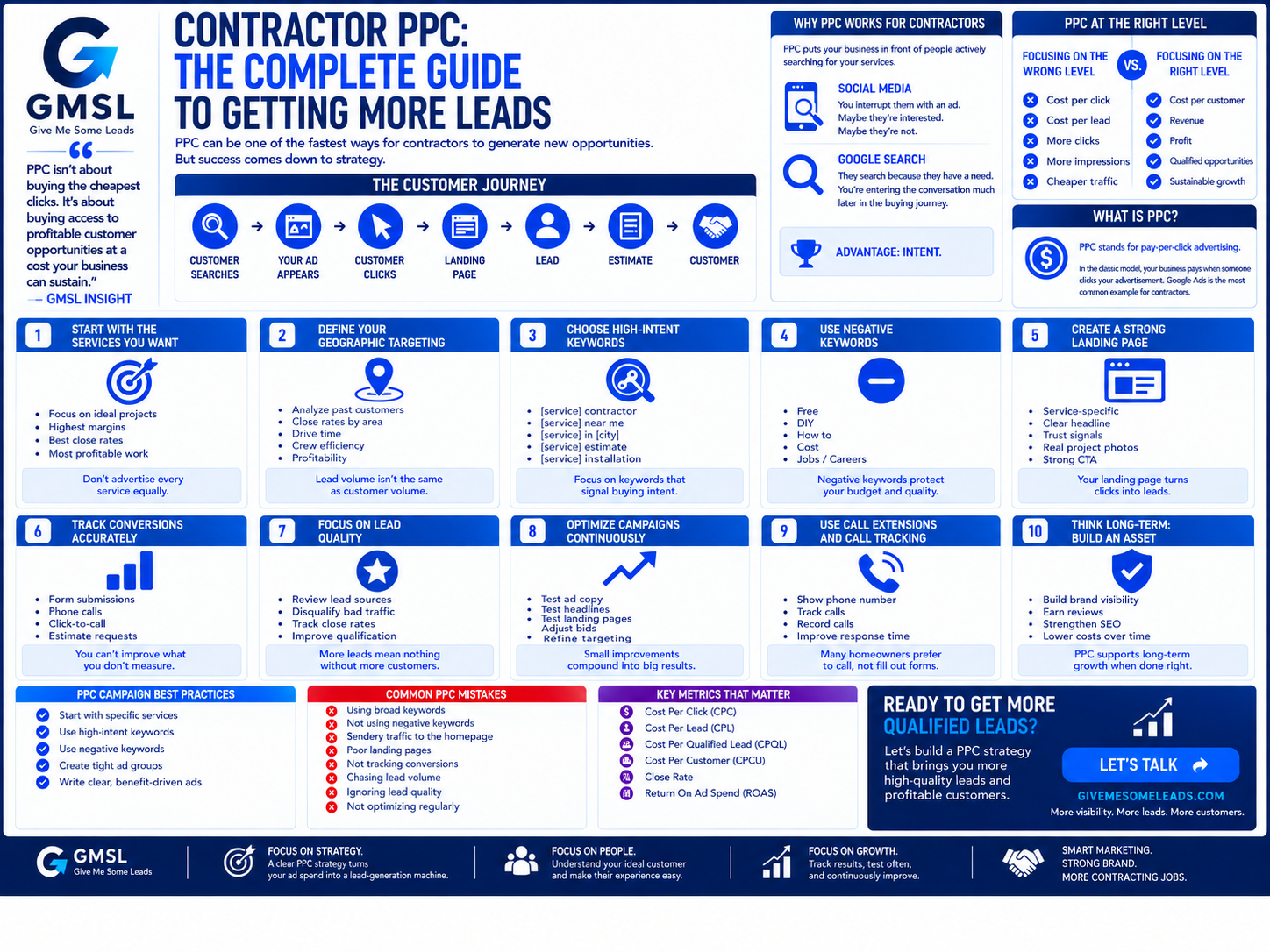
📊 Click the diagram to view a larger version. After opening it, turn your phone sideways for the best viewing experience.
15. Track Every Important Conversion
PPC without conversion tracking is guesswork.
At minimum, track:
- Forms
- Phone calls
- Appointment actions where appropriate
Google provides conversion measurement specifically so advertisers can understand what happens after someone interacts with an ad. ( Google Help )
But for contractors, that's only the beginning.
You eventually want:
Click → Lead → Qualified Lead → Estimate → Customer → Revenue
16. Import Offline Sales Data
This is where contractor PPC can become much smarter.
Suppose Google sees:
50 form submissions
It might assume all 50 have similar value.
But your CRM knows:
20 were qualified
10 became estimates
4 became customers
If that downstream information is connected back to advertising, optimization can become much more aligned with actual business outcomes.
Google currently recommends enhanced conversions for leads as an upgraded approach to offline conversion imports, using first-party lead information to improve attribution and measurement. ( Google Help )
GMSL Insight
Don't teach Google which leads filled out a form. Teach your system which leads became customers.
17. Track Cost Per Qualified Lead
Raw cost per lead can be misleading.
Imagine:
Campaign A
40 leads $60 CPL
Total spend:
$2,400
But only:
10 qualified
Cost per qualified lead:
$240
Campaign B
25 leads $100 CPL
Total spend:
$2,500
But:
20 qualified
Cost per qualified lead:
$125
Campaign B looks expensive at the lead level.
It's much better at producing real opportunities.
18. Track Cost Per Estimate
Continue the measurement.
Suppose Campaign B produces:
12 completed estimates
from:
$2,500
Cost per estimate:
$208
Now we're getting closer to the sales process.
This is often more meaningful than CPL.
19. Track Cost Per Customer
Suppose those 12 estimates produce:
5 customers
Customer acquisition cost:
$500
Now compare that with:
- Average project value
- Gross profit
- Sales commissions
- Overhead
This is the metric that ultimately determines whether PPC is sustainable.
20. Don't Obsess Over Cost Per Click
Contractors frequently say:
“Clicks are too expensive.”
Maybe.
But CPC alone doesn't determine profitability.
Imagine:
Keyword A
$8 clicks
No customers.
Keyword B
$35 clicks
Produces a $20,000 project regularly.
Which click is actually expensive?
You don't know until you follow the customer journey.
21. Use Ad Scheduling Carefully
Some contractors only run ads during office hours.
Others run campaigns longer because homeowners search after work.
There's no universal perfect schedule.
Look at your own data.
Ask:
- When do leads arrive?
- When can someone respond?
- Which hours generate qualified customers?
Don't automatically run campaigns 24/7.
Don't automatically restrict them either.
Test and measure.
22. Respond Quickly to PPC Leads
Paid leads can be expensive.
Don't waste them with slow response.
Your process should look like:
Lead Arrives
↓
Call
↓
No Answer
↓
Text
↓
Follow Up
A homeowner searching Google may contact several companies within minutes.
Speed matters.
From Our Experience
Sometimes improving response time creates a better return than increasing the PPC budget.
Because the company converts more of the opportunities it's already paying for.
23. Qualify PPC Leads
Not every Google lead is a good fit.
Before sending an estimator, understand:
- Location
- Service
- Project scope
- Timeline
- Decision-maker
- Basic project fit
Qualification gives you better data too.
If one campaign generates mostly weak opportunities, marketing needs to know.
Without sales feedback, PPC optimization stops at:
Form submission
instead of:
Good customer
24. Follow Up After the Estimate
PPC generated the opportunity.
You paid for it.
Don't let the opportunity disappear after one estimate.
Follow up.
A homeowner may be:
- Comparing companies
- Reviewing finances
- Discussing the project
- Waiting on timing
Instead of:
“Did you decide?”
try:
“I wanted to make sure you received the proposal and see whether you had any questions about the scope or recommendations.”
Better follow-up can increase PPC ROI without buying another click.
25. Use Remarketing Where Appropriate
Not every visitor converts during the first visit.
They may:
- Research competitors
- Review budget
- Delay the project
- Discuss it with their spouse
Remarketing can help keep your company visible afterward.
For example:
Someone visits your kitchen remodeling page.
Later they see:
Recent Kitchen Transformation
with:
Planning Your Remodel? See More Recent Projects.
You're continuing the conversation.
26. Don't Compete Only on Price
Advertising:
CHEAPEST ROOFER IN DALLAS
may attract leads.
It may also attract the type of customer you least want.
Instead, communicate value through:
- Reviews
- Workmanship
- Experience
- Process
- Warranty
- Communication
- Project quality
If your ad only talks about cheap prices, expect customers to compare you primarily on price.
27. Test Ads Instead of Assuming
Your first ad doesn't need to be perfect.
Test:
- Headlines
- Descriptions
- Offers
- CTAs
- Benefits
- Project angles
For example:
Ad A
Experienced Exterior Painters
Ad B
Transform Your Home's Exterior , Request an Estimate
Then compare actual outcomes.
Don't choose because one sounds better internally.
Use data.
28. Test Landing Pages Too
Ads aren't the only variable.
Test landing page elements such as:
- Headline
- Hero image
- CTA
- Form length
- Testimonial placement
- Project examples
- Service explanation
Small improvements can compound.
Imagine your campaign generates:
1,000 visitors
5% Conversion Rate
50 leads
8% Conversion Rate
80 leads
Same traffic.
30 additional leads.
That's why landing page optimization matters so much.
Real-Life Example: Evaluating Contractor PPC Correctly
Imagine a remodeling contractor spends:
$6,000 on Google Ads
plus:
$1,500 on campaign management and landing pages
Total marketing investment:
$7,500
The campaign generates:
45 leads
Raw CPL:
$167
That might sound expensive.
But continue.
45 Leads
↓
30 Qualified
↓
18 Estimates
↓
6 Customers
Customer acquisition cost:
$1,250
Suppose those six remodeling projects produce:
$150,000 in revenue
Now compare the $7,500 customer acquisition investment against the project's gross profit.
The numbers are illustrative.
But that's the framework contractors should use.
Not:
“Are $167 leads expensive?”
Instead:
“Can we profitably acquire customers for $1,250?”
PPC vs. SEO for Contractors
These strategies shouldn't necessarily compete.
PPC
Advantages:
- Faster
- Controllable
- Easy to target
- Good for immediate demand
Disadvantages:
- Ongoing ad spend
- Traffic drops when spending stops
SEO
Advantages:
- Builds long-term visibility
- Creates owned marketing assets
- Can generate leads without paying for every click
Disadvantages:
- Takes longer
- Less direct control
For many contractors:
PPC generates customers now.
SEO helps build customer acquisition for later.
PPC vs. Buying Shared Leads
There's another important distinction.
Shared Lead Company
Someone else generates the homeowner.
The lead may be distributed to multiple contractors.
PPC
The homeowner searches Google.
Clicks your ad .
Visits your landing page .
Contacts your company .
That gives you greater control over:
- Branding
- Messaging
- Qualification
- Customer journey
- Tracking
The tradeoff?
You assume the advertising risk.
If the campaign is poorly managed, you can waste substantial money.
How Much Should Contractors Spend on PPC?
There is no universal budget.
Don't start with:
“What does everyone else spend?”
Instead ask:
“How many customers do we want?”
Then work backward.
Suppose:
Desired customers:
5 per month
Close rate from qualified leads:
25%
You need approximately:
20 qualified leads
If a qualified lead costs:
$200
you may need around:
$4,000 in media spend
before management or other marketing costs.
These figures are illustrative.
Your actual numbers depend on:
- Market
- Service
- Competition
- Average project value
- Close rate
- Landing page
- Reputation
When Contractor PPC Makes Sense
PPC tends to make more sense when:
- Customers actively search for your service
- Project values support paid acquisition
- You have capacity
- Your website or landing page is strong
- You can respond quickly
- You track conversions
- You understand your sales numbers
It can be especially valuable for:
- Roofing
- Remodeling
- Painting
- Epoxy flooring
- Masonry
- Windows
- Siding
- Flooring
When PPC May Not Make Sense
Be cautious if:
- Your project values are extremely low
- Margins are weak
- Nobody answers leads
- You don't track customers
- Your website is poor
- You can't serve the market consistently
- You're already at maximum capacity
- Your service has little search demand
PPC isn't a solution to every business problem.
A campaign can't fix:
Weak margins
Bad reputation
Poor sales process
No operational capacity
A Simple Contractor PPC System
Step 1 , Define
Choose profitable services and markets.
Step 2 , Research
Identify strong-intent keywords.
Step 3 , Build
Create campaigns by service.
Step 4 , Exclude
Add negative keywords.
Step 5 , Match
Align search, ad, and landing page.
Step 6 , Convert
Use strong landing pages.
Step 7 , Track
Measure calls and forms.
Step 8 , Connect
Import qualified leads and customers where possible.
Step 9 , Follow Up
Improve sales response.
Step 10 , Optimize
Move budget toward profitable customers.
Then repeat.
Common Contractor PPC Mistakes
Avoid:
- Targeting every service equally
- Using weak geographic targeting
- Ignoring search intent
- No negative keywords
- Sending everything to the homepage
- Using generic ads
- Weak landing pages
- No real project photos
- No reviews
- Complicated forms
- Poor mobile experience
- Slow lead response
- Tracking forms but not customers
- Optimizing only for CPL
- Obsessing over CPC
- Setting campaigns and never improving them
PPC isn't:
Launch → Wait
It's:
Launch → Measure → Learn → Improve
Frequently Asked Questions
1. What is contractor PPC?
Contractor PPC is paid digital advertising where contractors use platforms such as Google Ads to generate traffic and leads, often paying when someone clicks an ad.
2. Does PPC work for contractors?
It can work very well when customers actively search for the service, project economics support paid acquisition, and the campaign has strong targeting, landing pages, tracking, and follow-up.
3. Is Google Ads the best PPC platform for contractors?
Google Search Ads are often especially relevant because they can reach people actively searching for contractor services. The best platform still depends on your market and service.
4. How much should contractors spend on PPC?
There is no universal amount. Work backward from desired customers, close rate, qualified lead cost, margins, and customer acquisition targets.
5. What's a good contractor PPC cost per lead?
There isn't one universal CPL. A more expensive lead can be better if it has a higher qualification and close rate. Track cost per qualified lead and cost per customer.
6. Are negative keywords important?
Yes. Google recommends monitoring search terms and using negative keywords to prevent ads from showing for irrelevant searches. ( Google Help )
7. Should PPC traffic go to the homepage?
Usually not for highly specific campaigns. Dedicated landing pages can provide a clearer experience aligned with the exact service being advertised.
8. Should contractors track offline sales?
Yes. Google supports enhanced conversions for leads and offline conversion workflows that can help connect later sales outcomes back to campaigns. ( Google Help )
9. What should contractors measure?
Track: Spend → Clicks → Leads → Qualified Leads → Estimates → Customers → Revenue → Profit That's how you know whether PPC actually works.
Final Thoughts
Contractor PPC isn't about finding the cheapest keyword.
It's about building a system that turns search demand into profitable projects.
Start with:
The right service.
The right market.
The right keywords.
The right exclusions.
Then connect:
Search → Ad → Landing Page → Lead → Qualification → Estimate → Customer
Track all the way to revenue.
And keep improving.
Google's own guidance reinforces the importance of relevant keyword structures, search-term monitoring, negative keywords, and relevant landing pages, while its enhanced-conversion tools increasingly make it possible to connect lead generation back to real offline customer outcomes. ( Google Help )
That's where PPC becomes much more than paying for clicks.
It becomes a measurable customer acquisition channel.
Pay for clicks only when the system behind those clicks is designed to turn them into customers.
Ready to Build a Contractor PPC System That Produces Profitable Customers?
GiveMeSomeLeads helps contractors combine Google Ads, high-converting landing pages, call tracking, form tracking, Google Analytics 4, Google Tag Manager, enhanced lead measurement, and revenue attribution into one measurable customer acquisition system.
- Google Ads built around high-intent services and markets
- Landing pages, call tracking, form tracking, and offline outcomes
- Qualified lead, estimate, customer, CPA, revenue, and profit optimization