Introduction
AI is starting to show up in construction in a very practical way.
Not because contractors are trying to become tech companies.
Because there are a lot of repetitive tasks in a contracting business that take time.
Writing estimates.
Following up with leads.
Answering customer questions.
Creating job descriptions.
Writing social posts.
Organizing notes.
Building checklists.
Explaining project scopes.
And tools like ChatGPT are making some of that work faster.
The biggest opportunity is not replacing people.
It is helping contractors spend less time on repetitive office work and more time on the parts of the business that actually require judgment, experience, and relationships.
This guide breaks down some of the most practical ways contractors are using ChatGPT and AI in construction today.
What Is ChatGPT for Contractors?
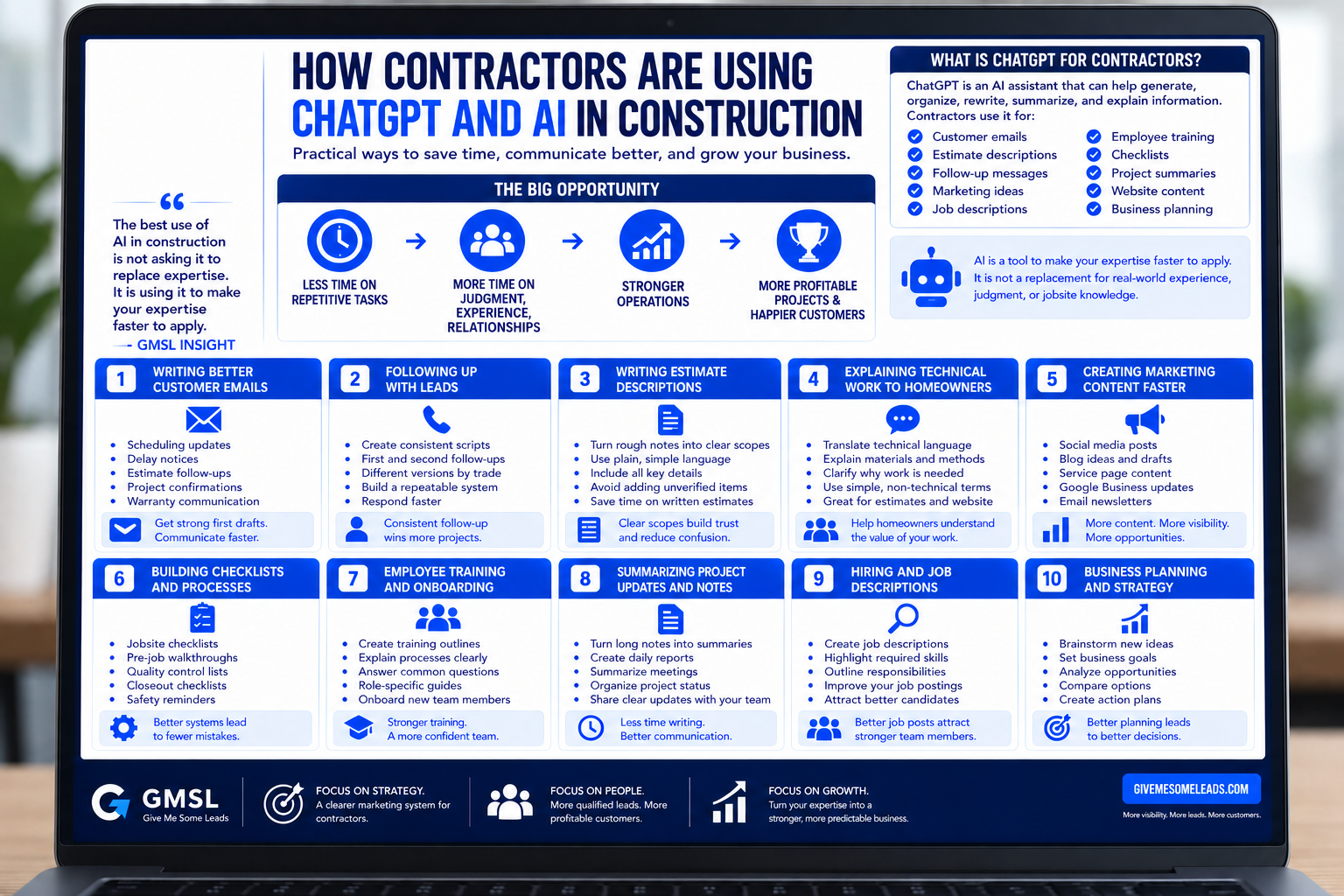
ChatGPT is an AI assistant that can help generate, organize, rewrite, summarize, and explain information.
For contractors, that can mean using it to help with:
- Customer emails
- Estimate descriptions
- Follow-up messages
- Marketing ideas
- Job descriptions
- Employee training
- Checklists
- Project summaries
- Website content
- Business planning
The key is understanding what AI is good at.
AI is good at:
Drafting
Organizing
Rewriting
Summarizing
Brainstorming
Explaining
It is not automatically good at knowing what is true about your specific project, customer, code requirements, pricing, or jobsite.
That still requires human judgment.
GMSL Insight: The best use of AI in construction is not asking it to replace expertise. It is using it to make your expertise faster to apply.
1. Writing Better Customer Emails
One of the easiest ways contractors can use ChatGPT is for customer communication.
For example, instead of spending 15 minutes writing an email explaining a delay, you can give ChatGPT the situation:
“Write a professional email to a homeowner explaining that heavy rain delayed the exterior painting project by two days. Keep it short and reassuring.”
Then edit the result so it sounds like you.
This can help with:
- Scheduling updates
- Delay notices
- Estimate follow-ups
- Project confirmations
- Material changes
- Warranty communication
- Final walkthrough messages
The goal is not to send robotic AI emails.
The goal is to get a strong first draft quickly.
2. Following Up With Leads
A lot of contractor leads are lost simply because follow-up is inconsistent.
ChatGPT can help create reusable follow-up scripts.
For example:
First missed call
“Hi John, this is Mike from ABC Roofing. I saw your request about a roof replacement and wanted to reach out. Give me a call when you have a minute.”
Second follow-up
“Hi John, just following up on your roofing request. Happy to answer any questions or schedule a time to take a look.”
You can use AI to create different versions for:
- Roofing
- Painting
- Remodeling
- Flooring
- Masonry
- Windows
- Siding
That makes it easier to build a repeatable lead follow-up system.
3. Writing Estimate Descriptions
Contractors often know exactly what they are doing but struggle to explain it clearly in writing.
That matters.
A vague estimate might say:
“Replace the roof for $14,500.”
A stronger scope explains:
- Tear-off
- Underlayment
- Flashing
- Ventilation
- Shingle system
- Cleanup
- Disposal
- Warranty
You can give ChatGPT rough notes and ask it to turn them into a clearer scope of work.
For example:
“Rewrite this roofing scope in plain English for a homeowner. Keep it professional and do not add anything that is not in my notes.”
That last part is important.
AI should organize your scope.
It should not invent one.
4. Explaining Technical Work to Homeowners
Contractors often understand technical issues that homeowners do not.
ChatGPT can help translate technical language into something easier to understand.
For example:
“Explain ice and water shield to a homeowner in simple language.”
or:
“Explain why a kitchen remodel may require electrical updates without sounding alarmist.”
or:
“Explain the difference between epoxy and polyaspartic garage coatings in plain English.”
This can be useful for:
- Estimates
- Website content
- Sales conversations
- Customer handouts
- FAQs
Good communication builds trust.
5. Creating Jobsite Checklists
AI can also help contractors organize processes.
For example:
“Create a pre-job checklist for an exterior painting crew.”
It might help structure categories like:
- Materials
- Site protection
- Customer communication
- Equipment
- Safety
- Photos
- Final walkthrough
Then you customize it based on how your company actually operates.
This can be useful for:
- Pre-job setup
- Project closeout
- Quality control
- Safety
- Material ordering
- Vehicle inspections
- Customer handoff
AI is especially useful when you already know the process but want help turning it into a document.
6. Building Standard Operating Procedures
A lot of small contractor businesses operate from memory.
One person knows how things are done.
Then that person is unavailable and everyone starts asking questions.
AI can help turn informal knowledge into simple SOPs.
For example:
“Turn these notes into a step-by-step SOP for handling a new website lead.”
Your notes might be:
Call within 10 minutes.
If no answer, text.
Call again later.
Qualify service area.
Book estimate.
Update CRM.
ChatGPT can organize that into a clean process.
That helps make the business less dependent on one person remembering everything.
7. Writing Job Descriptions
Hiring takes time.
AI can help create first drafts for:
- Painter
- Roofer
- Estimator
- Project manager
- Office administrator
- Sales representative
- Crew leader
- Installer
You can tell ChatGPT:
“Write a job description for a residential painting estimator. We want someone professional, organized, comfortable talking to homeowners, and experienced with estimating.”
Then customize:
- Pay
- Location
- Requirements
- Schedule
- Benefits
- Company culture
Again, AI handles the first draft.
You provide the reality.
8. Creating Interview Questions
ChatGPT can also help contractors prepare better interviews.
Instead of asking only:
“Tell me about yourself.”
you can generate role-specific questions.
For a project manager:
- How do you handle an upset homeowner?
- What do you do when a crew falls behind schedule?
- How do you document change orders?
- How do you communicate delays?
- How do you inspect completed work?
You can also ask AI to create:
Good answer indicators
and:
Red flags
That can help make hiring more structured.
9. Training Employees
AI can help turn company knowledge into training material.
For example:
“Create a 30-minute training outline for new roofing sales reps on how to explain our estimate process.”
Or:
“Create a quiz for painters on jobsite cleanup standards.”
Or:
“Turn this warranty document into a simple training summary for employees.”
This can be particularly useful when onboarding new people.
10. Writing Social Media Posts
Contractors already have content.
They just do not always know what to say about it.
A completed project can become:
- Facebook post
- Instagram caption
- Google Business Profile update
- Before-and-after post
- Educational post
- Customer story
Give ChatGPT the project details:
“We repainted a 2,400-square-foot house in Tampa. The old paint was heavily faded. We repaired several cracks, primed damaged areas, and used Sherwin-Williams Duration. Write a short Facebook post.”
That is much better than asking:
“Write me a painting post.”
Specific input produces better output.
11. Creating Video Scripts
This is another strong use.
Contractors can turn one idea into a short video.
For example:
“Write a 45-second video script explaining why homeowners should not always choose the cheapest roofing estimate. Use short sentences.”
That might become:
Hook
“Cheapest roof quote doesn’t always mean cheapest roof.”
Explanation
“One contractor may include better underlayment, flashing, ventilation, and cleanup.”
Lesson
“Compare the scope, not just the number.”
This makes it easier to start recording educational content without staring at a blank page.
12. Creating Blog Content
AI can help contractors create educational website content.
But this is where quality matters.
Do not ask:
“Write 100 roofing blogs.”
That usually creates generic content.
A better process is:
1. Pick a real customer question. 2. Add your actual experience. 3. Use AI to organize it. 4. Review everything. 5. Add real photos and examples.
For example:
“Write an article about how long exterior paint lasts in Florida. Include these observations from our projects…”
Now the content is based on real experience.
That is much stronger.
13. Creating Website Pages
AI can help create first drafts for:
- Service pages
- Location pages
- About pages
- FAQs
- Contact pages
- Landing pages
For example:
“Write a service page for cabinet painting in Dallas. Focus on preparation, process, finishes, timelines, project photos, and estimate requests.”
Then customize it with:
- Your actual services
- Your process
- Your prices
- Your projects
- Your reviews
AI can speed up writing.
It cannot replace real proof.
14. Brainstorming Marketing Ideas
Sometimes the problem is not execution.
It is figuring out what to do next.
You can ask:
“Give me 20 marketing ideas for a masonry contractor that do not involve buying shared leads.”
Or:
“Give me 10 ways a painting company can generate referrals from existing customers.”
Or:
“What local partnerships could generate roofing leads?”
Then evaluate the ideas based on your market.
AI is useful for expanding options.
You still choose which ones make sense.
15. Reviewing Marketing Campaigns
If you give ChatGPT actual campaign information, it can help you think through performance.
For example:
Spend: $4,000 Leads: 40 Qualified: 22 Estimates: 12 Customers: 3 Revenue: $36,000
You can ask:
“Calculate cost per lead, qualified lead, estimate, and customer. Tell me where the biggest drop-off is.”
That can help contractors move beyond:
“My leads are expensive.”
and start looking at the whole system.
📊 Click the diagram to view a larger version. After opening it, turn your phone sideways for the best viewing experience.
16. Analyzing Reviews
Customer reviews contain useful information.
You can copy a group of reviews into ChatGPT and ask:
“What themes come up most often?”
You may find customers repeatedly mention:
- Cleanliness
- Communication
- Speed
- Professionalism
- Workmanship
Those can become selling points.
You can also identify recurring complaints.
That turns reviews into customer research.
17. Preparing Sales Conversations
AI can help contractors practice common objections.
For example:
“Act like a homeowner who thinks my roofing estimate is too expensive. Ask me questions and challenge me.”
Then practice answering.
You can also ask:
“Give me 10 common objections homeowners have after receiving a kitchen remodeling estimate.”
This can help newer salespeople become more comfortable.
18. Comparing Products and Materials
Contractors can use AI to organize comparisons.
For example:
“Create a simple homeowner-friendly comparison between architectural shingles and metal roofing.”
or:
“Compare epoxy and polyaspartic garage flooring.”
But this comes with an important warning.
Verify technical information.
AI can make mistakes.
Manufacturer specifications, installation instructions, building codes, warranties, and technical documentation should always be checked against authoritative sources.
19. Summarizing Long Documents
Contractors deal with plenty of long documents:
- Manufacturer manuals
- Insurance documents
- Contracts
- Product specifications
- Warranty information
- Bid requests
- Project notes
AI can help summarize them.
For example:
“Summarize this document and identify anything related to installation requirements.”
That can save time.
But for legal, contractual, safety, or code-related decisions, always review the original material and involve the appropriate professional when necessary.
20. Organizing Project Notes
Imagine an estimator returns from a project with messy notes:
Kitchen. Remove wall. Electrical panel maybe needs upgrade. Customer wants island. Quartz. Wants project before Thanksgiving. Budget around 70k.
AI can turn that into:
Customer Goals
- Open kitchen layout
- New island
- Quartz countertops
Potential Scope
- Wall removal
- Electrical evaluation
- Cabinet replacement
- Countertops
Timeline
- Completion requested before Thanksgiving
Budget
- Approximately $70,000
That makes information easier for the office, estimator, designer, and project manager to use.
21. Creating Meeting Summaries
If you have notes or transcripts from meetings, AI can organize them into:
- Decisions
- Action items
- Deadlines
- Questions
- Responsibilities
That can help with:
- Production meetings
- Sales meetings
- Client meetings
- Project handoffs
- Weekly management meetings
Instead of everyone leaving with a different interpretation, you have a cleaner summary.
22. Writing Policies and Internal Documents
Contractors can use AI to help structure internal documents such as:
- Vehicle policies
- Cellphone policies
- Customer communication standards
- Review request procedures
- Lead response standards
- Photo documentation requirements
- Jobsite cleanup expectations
These should still be reviewed carefully, especially where employment law or legal obligations are involved.
But AI can make the drafting process much faster.
23. Creating Templates
One of the best uses of ChatGPT is turning repeated work into templates.
For example:
Estimate follow-up template
Project-delay email
Review request
Referral request
Job-completion message
New-lead text
Employee onboarding checklist
Once you create a good template, your team can reuse it.
That is where AI starts becoming part of the system instead of something you randomly open when you need help.
24. Researching Customer Questions
Contractors often hear the same questions:
“How long will this take?”
“Why is this estimate higher?”
“Do I need to replace everything?”
“What happens if it rains?”
“Which material is better?”
You can use ChatGPT to brainstorm common questions around your service.
Then answer them based on your actual experience.
Those answers can become:
- Website FAQs
- Sales material
- Videos
- Blog posts
- Social posts
One customer question can become several pieces of useful content.
25. Translating Customer Communication
For contractors operating in multilingual markets, AI can help translate:
- Emails
- Website pages
- Instructions
- Follow-up messages
- Customer information
But translation should still be reviewed by someone fluent when accuracy matters.
Construction terminology can be very regional.
What sounds natural in Quebec may sound strange in France.
What works in Texas may not be the wording used somewhere else.
Context matters.
26. Helping With Scheduling and Planning
AI can help organize scheduling information.
For example:
“We have three crews, five projects, and these estimated durations. Create a simple schedule.”
It can also help think through:
- Crew allocation
- Material timing
- Project sequences
- Follow-up schedules
- Content calendars
But it should not replace proper project-management software for complex operations.
Use it as an assistant.
Not as your entire scheduling system.
27. Creating Daily or Weekly Business Checklists
Owners often have too much happening at once.
ChatGPT can help build simple routines.
For example:
Monday
Check new leads Review estimates Review ad performance Schedule project photos
Wednesday
Follow up open estimates Check reviews Review job progress
Friday
Review sales Review cash flow Ask completed customers for reviews Plan next week's marketing
The point is not that AI invented the perfect routine.
The value is turning your priorities into something repeatable.
28. Practicing Difficult Conversations
Contractors deal with uncomfortable conversations.
Price objections.
Delays.
Change orders.
Complaints.
Employee issues.
AI can help you practice.
For example:
“Pretend you are an upset homeowner because the project is three days behind schedule.”
Then respond.
Ask AI to critique your answer.
This can be useful training for owners, estimators, and project managers.
29. Turning One Idea Into Multiple Pieces of Content
This may be one of the highest-leverage uses for contractors doing their own marketing.
Suppose you create one article:
Why Roofers Lose Leads
AI can help turn it into:
Facebook carousel
45-second video
Google Business Profile post
FAQ
Sales training note
Checklist
One idea becomes multiple marketing assets.
That makes content creation much easier.
30. Using AI as a Second Set of Eyes
Sometimes the best use is simply:
“What am I missing?”
Give AI:
- Proposal
- Website copy
- Marketing plan
- Checklist
- Job description
- Follow-up process
Then ask:
“What is unclear?”
or:
“What questions would a homeowner have after reading this?”
or:
“What information is missing?”
It may catch something useful.
You do not have to accept every suggestion.
Think of it as another perspective.
Where Contractors Should Be Careful With AI
AI can save a lot of time.
But contractors should not blindly trust it.
Be especially careful with:
Building Codes
Always verify against current local codes and authorities.
Engineering
Do not rely on ChatGPT for structural decisions.
Safety
Verify with official safety requirements and qualified professionals.
Legal Contracts
AI can help organize language, but legal agreements should be reviewed appropriately.
Taxes and Accounting
Use qualified accounting professionals for important decisions.
Product Specifications
Verify manufacturer documentation.
Estimates
AI does not know your labor costs, overhead, production rates, material pricing, or market unless you provide accurate information.
Customer Information
Do not casually paste sensitive customer, employee, financial, or confidential business information into AI tools without understanding the privacy implications.
GMSL Insight: Use AI where mistakes are cheap. Add human review where mistakes are expensive.
AI Will Not Fix a Bad Business System
This is worth emphasizing.
ChatGPT cannot fix:
- Poor workmanship
- Slow lead response
- Bad reviews
- Weak margins
- Bad estimating
- Poor communication
- No follow-up
- Unreliable crews
It can help improve the systems around those problems.
But if the underlying process is broken, adding AI simply helps you operate the broken process faster.
The order should be:
Build Good Process
↓
Document It
↓
Use AI to Make It Faster
Not:
Install AI → Hope Everything Improves
A Simple AI Setup for a Contractor
You do not need 25 different AI tools.
Start simple.
ChatGPT or Claude
Use for:
- Writing
- Brainstorming
- Research
- Documents
- Analysis
- Communication
Your CRM
Keep customer and lead information organized.
Project Management Software
Keep jobs and schedules organized.
AI Where It Actually Saves Time
Add tools only when they solve a real problem.
Don't build a complicated “AI stack” because someone on YouTube told you to.
For many small contracting businesses, getting good at one general-purpose AI assistant will create more value than subscribing to ten different AI products.
How to Get Better Results From ChatGPT
The quality of the answer depends heavily on the quality of the instruction.
Weak prompt:
“Write a roofing email.”
Better:
“Write a short follow-up email to a homeowner who received our roof replacement estimate three days ago. Keep it friendly, professional, and not pushy. Ask whether they have questions about the scope. Do not offer a discount.”
Even better:
Add:
- Customer situation
- Service
- Tone
- Goal
- Constraints
- Company process
Think:
Context + Task + Desired Result
The more clearly you explain what you need, the more useful AI becomes.
Real-Life Example
Imagine a painting contractor receives a new lead.
Before AI:
Lead arrives
↓
Owner writes a text manually.
↓
Estimate is completed.
↓
Owner writes follow-up manually.
↓
Project closes.
↓
Nobody remembers to ask for a review.
↓
Nobody posts the project.
Now imagine the business has simple AI-assisted templates.
Lead arrives
↓
Prepared text template
↓
Estimate scope generated from estimator notes
↓
Follow-up template
↓
Project-completion checklist
↓
Review request
↓
Project photos turned into Facebook post
↓
Website case study drafted
The contractor still controls everything.
AI simply reduces the amount of repetitive writing and organizing required.
That is where the value comes from.
The Contractor AI Workflow
A practical system might look like:
Customer Question
↓
Contractor Knowledge
↓
AI Helps Organize It
↓
Human Reviews It
↓
Use It
That last part is important.
Do not reverse the process into:
AI Invents Answer
↓
Contractor Assumes It's Correct
The contractor's experience should remain at the center.
What AI Means for Small Contractors
Large construction companies have historically had advantages:
- Bigger marketing departments
- HR teams
- Administrative staff
- Training departments
- Analysts
- Content teams
AI can reduce some of that gap.
A small contractor can now get help drafting:
Marketing
Training
Processes
Communication
Analysis
without having a dedicated employee for every function.
That does not make a five-person contractor equivalent to a 500-person company.
But it does give smaller businesses access to tools that were much harder to replicate before.
Frequently Asked Questions
How are contractors using ChatGPT?
Common uses include customer communication, follow-up messages, estimate descriptions, marketing content, SOPs, training, hiring, checklists, research, and organizing project information.
Can ChatGPT create estimates?
It can help organize and write estimate descriptions, but contractors should provide and verify all project quantities, prices, labor requirements, materials, scope, and terms themselves.
Can contractors use AI for marketing?
Yes. AI can help create social posts, videos, website content, email campaigns, FAQs, and marketing ideas. The best results come when contractors provide real projects and real experience.
Can ChatGPT replace office staff?
Not completely. AI can automate or accelerate certain repetitive tasks, but customer service, judgment, relationships, sales, project management, and problem-solving still require people.
Can contractors use ChatGPT for building codes?
It can help explain concepts, but contractors should never rely solely on AI for code compliance. Always verify with current local codes and qualified authorities.
Is ChatGPT useful for small contractors?
Potentially very useful. Small contractors often have limited administrative resources, so saving time on writing, organization, communication, and training can be valuable.
Should contractors use AI-generated website content?
AI can help with drafts, but the content should be reviewed and improved with real project experience, original photos, local information, and accurate business details.
Can AI help contractors get more leads?
Indirectly, yes. It can help improve marketing, follow-up, content, websites, communication, and sales processes. AI itself does not guarantee leads.
Is AI going to replace contractors?
AI can automate information-based tasks, but physical construction work, craftsmanship, project management, customer relationships, judgment, and onsite problem-solving remain highly human.
Final Thoughts
AI in construction does not have to mean robots building houses.
For most contractors, the practical opportunity is much simpler.
Use AI to help with the work that happens around the actual work.
Writing.
Following up.
Organizing.
Training.
Marketing.
Communicating.
Analyzing.
Documenting.
Your experience still matters.
Your judgment still matters.
Your craftsmanship still matters.
AI simply gives you another tool.
And like any tool, the value depends on how you use it.
GMSL Insight: The contractors who benefit most from AI probably won't be the ones trying to automate everything. They'll be the ones who identify repetitive work, build a good process, and use AI to make that process faster.
Use AI to save time on the repetitive work so you can spend more time on the work that actually requires you.
Ready to Build a Smarter Contractor Customer Acquisition System?
GiveMeSomeLeads helps contractors combine Google Ads, high converting landing pages, Local SEO, Google Business Profile, reviews, tracking, and practical automation so marketing is measured by profitable customers rather than vanity metrics.
- Google Ads and high-converting landing pages
- Local SEO, reviews, and Google Business Profile
- Lead, estimate, customer, CPA, revenue, and profit tracking