
A homeowner searches for a painting contractor near them.
Several companies appear. Before calling anyone, the homeowner starts comparing reviews, recent customer feedback, project details, and signs that each company can be trusted.
Strong reviews give people more evidence before they contact you.
The contractor with the most reviews is not automatically the best painter. But a strong review profile gives homeowners something important before they contact you.
For painting contractors, reviews are valuable because they support both trust and local visibility. A homeowner may like your website, but reviews show what real customers experienced after hiring your company.
That matters because many great painters are not short on satisfied customers. They are short on consistent review requests.
They finish the project, collect payment, shake hands, and leave. The customer may be satisfied, but the review never happens because nobody made the next step easy.
This guide will show you how to build a simple review system that helps more customers share their genuine experience.
You already did the hardest part when you earned a real customer experience worth sharing. The next step is making it easy for that customer to share it.
Why Google Reviews Matter for Painting Contractors
Painting is a trust based service.
Homeowners may invite your crew into bedrooms, kitchens, living rooms, offices, and other personal areas of their home. Before they hire you, they want to know if your team shows up, protects the property, communicates clearly, respects the home, cleans up properly, and delivers the result they promised.
Your website can say your company is professional.
Your reviews show what actual customers experienced.
That is why Google reviews can have such a strong impact. They help homeowners feel more confident before calling, and they can also support your local presence when people are comparing painters online.
One customer can help your business twice.
Their project creates revenue today. Their review can help future customers trust you tomorrow.
Do not treat reviews like a bonus. Treat the review request like part of the project completion process.
Reviews turn private customer satisfaction into public proof.
A homeowner is choosing between three painting companies.
The first company has a nice website but only a few old reviews.
The second company has more reviews, but most are short and vague.
The third company has recent reviews mentioning clean work, clear communication, careful prep, color advice, and a smooth final walkthrough.
The third company feels easier to trust because the reviews answer the questions the homeowner already has.
Create an Experience Worth Reviewing
The review starts before you ask for it.
Homeowners do not only judge the paint coverage or the final color. They judge the entire experience around the project.
They notice if your crew arrives on time, protects furniture and floors, communicates clearly, keeps the space clean, solves problems professionally, and completes a final walkthrough.
This matters because customers often review how the project felt, not only how the walls look.
A great finish is important, but the experience is what gives the customer a story to share. When the homeowner feels respected, informed, and taken care of, leaving a positive review becomes much more natural.
Protect floors, furniture, and work areas.
Confirm schedule and progress clearly.
Keep the home clean and organized.
Complete a clear final walkthrough.
Explain the project process before the work begins. Let the customer know what to expect with preparation, arrival times, cleanup, communication, and the final walkthrough.
Customers review the experience around the paint almost as much as the paint itself.
Two painting contractors produce equally good walls.
Painter A leaves drop cloths everywhere, rarely communicates, and makes the customer wonder when the crew is coming back.
Painter B confirms the schedule, protects the home carefully, communicates progress, cleans daily, and finishes with a final walkthrough.
Both companies painted the room. Only one created the kind of experience that makes a customer want to write that the experience was amazing from start to finish.
Actually Ask Customers for the Review
This is one of the simplest strategies, but many painting companies still miss it.
Do not assume that customers will automatically leave a review. Some will, but many will forget because they are busy, distracted, or do not realize how much it helps your business.
Ask customers for honest feedback in a simple and natural way after the project is complete. Do not filter requests only to people you expect will leave a positive rating.
The goal is not to force the customer. The goal is to make the next step easy while the experience is still fresh.
We are really glad the project is complete. If you have a minute, we would appreciate you sharing your honest experience on Google. I can text you the direct link.
Ask consistently after completed projects instead of only asking customers you expect will leave a positive review.
A customer may be willing to review you, but they often need a clear and easy next step.
A homeowner says the house looks amazing and they are happy with how everything turned out.
The project manager thanks them and says the office will send a direct Google review link so they can share their experience if they choose.
The request is simple, respectful, and does not tell the customer what rating or wording to use.
Ask at the Right Moment
Timing matters.
For many painting businesses, the final walkthrough is a strong time to ask because the project is complete, the transformation is visible, and the details of the experience are still fresh.
If you wait months, the customer may still remember the company, but the emotion and project details can fade.
Make the review request part of the normal closeout process so the timing is consistent.
Make the review request part of the final walkthrough process, not something you remember weeks later.
The best review request usually happens when the project experience is still fresh.
A crew finishes an exterior repaint.
The homeowner steps outside, sees the completed home, and says the color looks exactly how they hoped.
The company thanks them, confirms the project is complete, and sends the review link that day.
Send a Direct Google Review Link
Do not make customers work harder than necessary.
Telling someone to search your company on Google and leave a review adds extra steps. They may get distracted, find the wrong profile, or forget completely.
Instead, send a direct Google review link.
The customer receives the link, clicks it, and can leave their feedback.
Save the review link where your team can easily find it. Put it in your CRM, office templates, estimator phone, project management software, text templates, and email templates.
The easier it is for your team to send the link, the more consistently customers will receive it.
Everyone responsible for closing out a painting project should know exactly where the review link is.
A review system only works if it is easy for both the customer and your team.
Company A asks customers to search for the business and leave a review when they have time.
Company B sends a direct review link right after the final walkthrough.
Company B removes friction, and that simple difference can lead to more reviews over time.
Use Text Messages
Painting contractors often already communicate with homeowners by text.
That makes text one of the easiest ways to request a review.
A short message feels natural because it continues the same conversation the customer already had with your company during the project.
Keep it simple and human.
Avoid sending a long message that sounds like it came from a corporate marketing department. The best review request should feel like a natural final message after a completed project.
Keep the message short, personal, and easy to act on.
The best review request often feels like the natural final step in a good customer experience, not a separate marketing campaign.
Follow Up by Email
Some customers respond better to email than text.
That is why email can be a good second option for review requests, especially if your painting company already sends invoices, project updates, or completion messages by email.
The message does not need to be long. It should thank the customer, remind them of the finished project, and make it easy for them to leave a review.
The goal is not to pressure the customer. The goal is to make the next step clear and easy while the project is still fresh.
Thanks again for choosing us for your painting project. We appreciate your business and hope you are enjoying the finished space.
If you have a minute, we would appreciate you sharing your honest experience on Google. Your feedback helps other homeowners understand what it is like to work with our team.
Leave a Google ReviewSend the review email shortly after the project is complete. Waiting too long usually makes the customer less likely to respond.
A good review email should feel like a natural thank you message, not a marketing blast.
A painting contractor finishes an interior repaint and sends the final invoice by email.
Instead of only sending the invoice, they include a short thank you message and a clear review link.
The customer already expects the email, so the review request feels natural and easy to follow.
Use a QR Code
A QR code can make review requests even easier.
This can work well for painting companies that provide completion paperwork, thank you cards, leave behind sheets, or printed project folders.
The customer scans the code and goes directly to the review page.
This removes the need to search for your company, find the right profile, or type anything manually.
Use the QR code at the end of the customer journey, after the work is complete and the customer has had a genuine experience with your company.
Place the real Google review QR code on completion materials, thank you cards, or final paperwork.
Put the QR code on a thank you card, final invoice, or completion sheet. Test the code before using it with customers.
The easier the review process feels, the more likely customers are to follow through.
A painting company leaves a small thank you card after every completed project.
The card thanks the homeowner, includes the company name, and has a QR code that opens the Google review page.
When the customer has a few minutes later, they can scan it and leave feedback without searching for anything.
Make the Review Request Part of Your Process
If you only ask for reviews when the owner remembers, the system will eventually fail.
That is why the review request should become part of your normal project completion process.
Assign responsibility.
For example, the project manager can complete the final walkthrough and close the project. Then the office can send the review text or email. Your CRM can track whether the review was requested, whether a reminder was sent, and whether the review was received.
This makes the process visible.
Now you are not guessing. You can see if the problem is low customer response or if the team is simply not asking.
Add review requested, reminder sent, and review received to your project completion checklist or CRM.
If reviews are important to your marketing, treat the review request like invoicing. It should be a normal part of completed projects.
A painting company completes 40 projects in one month and receives only 5 new reviews.
After checking the process, they realize only 12 customers were actually asked.
The first opportunity is not better persuasion. The first opportunity is making the process consistent.
Do Not Tell Customers What to Write
You can ask customers for a review, but you should not write the review for them.
Avoid telling customers exactly what to say.
Do not ask them to mention specific keywords, call you the best painter, or copy a prepared message.
Instead, ask for honest feedback about their experience.
Then let the customer describe what stood out.
Maybe they mention the prep work, communication, color guidance, cleanliness, crew professionalism, or finished result.
Those details are much more believable because they came naturally from the customer.
Please say we are the best painters in Dallas and mention interior painting.
If you are comfortable leaving feedback, we would appreciate you sharing your honest experience with the project and our team.
Ask for honest feedback, not a scripted review. Natural details are more trustworthy than forced keywords.
The best reviews sound real because they are real.
One company asks a customer to copy a keyword heavy review.
Another company simply asks the customer to share their honest experience.
The second customer writes about how the crew protected the floors, helped with color questions, arrived on time, and left the home clean.
The second review feels much more believable because it sounds like a real homeowner.
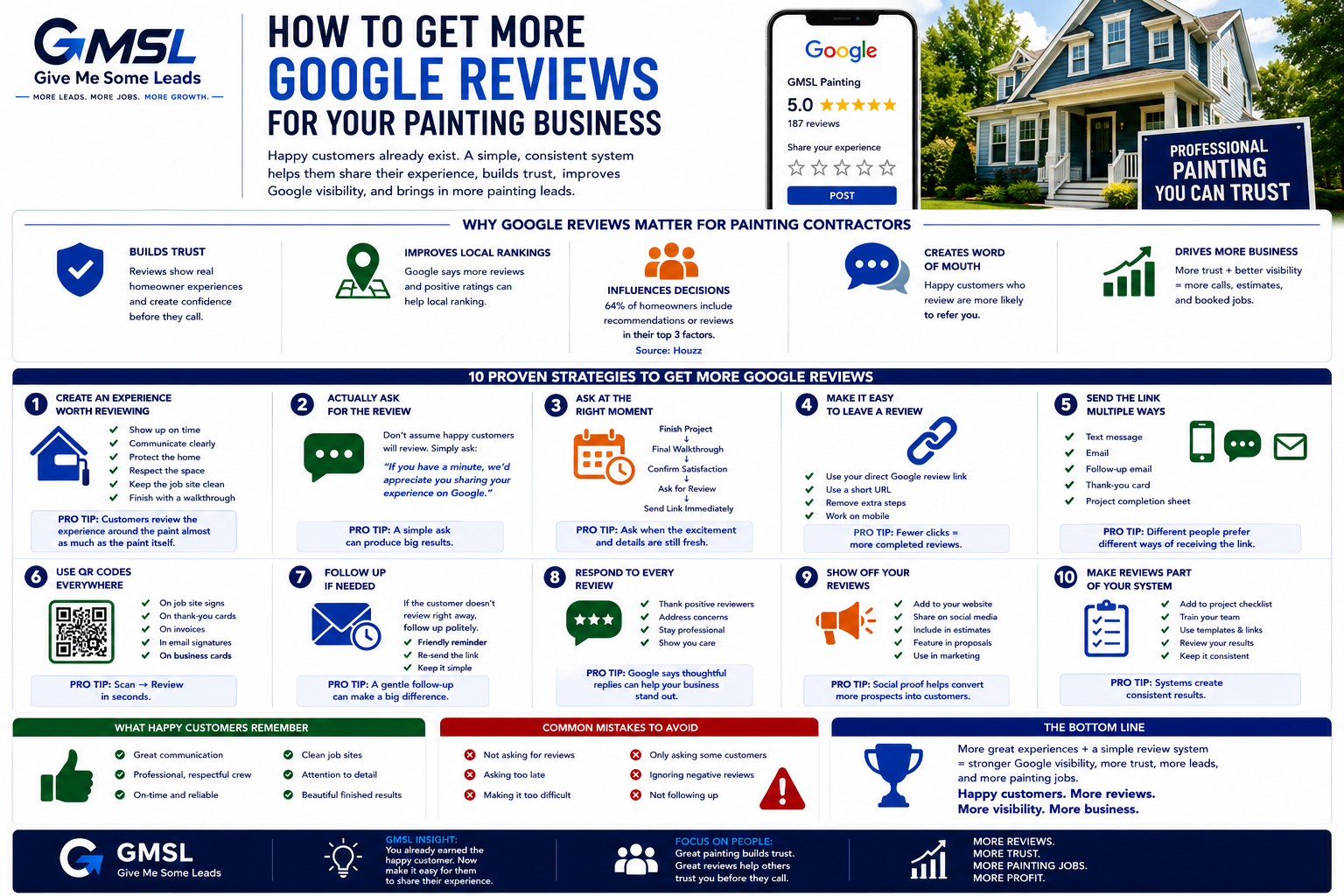
📊 Click the diagram to view a larger version. After opening it, turn your phone sideways for the best viewing experience.
Never Buy Fake Reviews
Do not buy fake reviews.
Do not pay for a package that promises a batch of five star reviews.
Do not ask employees to pretend to be customers.
Do not hire a company that uses fake accounts to make your profile look better.
Fake reviews damage the exact thing you are trying to build.
Trust.
Real reviews take more time, but that is also why they matter.
They come from actual customers who experienced your work, communication, crew, and finished result.
Reviews should represent genuine customer experiences. Paid, fabricated, or manipulated reviews can create policy problems and weaken trust.
Build a real review process instead of chasing shortcuts. Ask consistently, make the process easy, and let real customers share their experience.
Fake reviews may look like a shortcut, but they weaken the trust your business is supposed to be building.
A painting company buys fake reviews to make the profile look stronger.
At first, the rating looks better, but the reviews sound generic, mention no real project details, and do not match the actual customer experience.
Another company grows reviews more slowly, but every review comes from a real customer and mentions real things like communication, prep work, cleanup, and the finished result.
The second company builds stronger long term trust.
Do Not Offer Rewards for Google Reviews
Do not offer rewards in exchange for Google reviews.
Avoid discounts, gift cards, free services, or contest entries tied to posting, changing, or removing a review.
Reviews should come from real customers sharing genuine feedback about their experience, not from people trying to receive a reward.
Instead, build your review process around great service and a simple request.
The goal is not to buy praise.
The goal is to make it easier for customers to speak honestly.
Do not exchange discounts, gifts, free services, or contest entries for reviews.
Ask customers for honest feedback without offering an incentive and without influencing the rating or wording.
The value of reviews comes from trust. Once reviews feel purchased, that trust becomes weaker.
A painting company offers a discount in exchange for reviews and gets several quick responses.
Another company focuses on project communication, final walkthroughs, simple review requests, and genuine customer feedback.
The second company builds stronger long term trust because the reviews feel earned, not purchased.
Respond to Reviews
Review collection is not finished when the customer posts.
You should respond.
A review response shows that your painting company pays attention and appreciates customer feedback. It also gives future homeowners another chance to see how your business communicates.
Avoid giving every customer the same generic response.
A simple thank you is better than nothing, but a more specific response feels more human.
When future customers read it, they see a company that is active, professional, and engaged.
Thank you, Mike. We appreciate you trusting our team with the exterior repaint. We are glad you are happy with the color and finished result.
Mention the project type when it feels natural. Interior painting, exterior painting, cabinet painting, prep work, color help, and cleanup are useful details.
Review responses are public communication. Future customers are reading how you treat past customers.
A homeowner leaves a review saying the crew was clean, careful, and finished the bedroom painting on time.
A strong response thanks them for trusting the company with the bedroom painting and mentions that the team is glad they are happy with the finished space.
That feels more personal than the same copied response used on every review.
Handle Negative Reviews Professionally
No established painting business should expect perfect feedback forever.
At some point, a customer may be unhappy. The important part is how your company responds.
Do not argue publicly.
Do not insult the customer.
Do not write an emotional response.
Stay calm, professional, and focused on the issue. If the concern is legitimate, acknowledge it, explain what happened when appropriate, and offer to discuss the situation privately.
Future customers are not only reading the negative review. They are also reading your response.
A professional response can sometimes build more trust than pretending every project is perfect.
Before responding to a negative review, wait until you can write calmly. A defensive response can make the business look worse than the review itself.
How you respond to criticism shows future customers what kind of company they may be hiring.
A customer complains that communication was not clear during the project.
A weak response argues with the customer and blames them publicly.
A stronger response thanks them for the feedback, acknowledges the concern, and offers to discuss the situation directly.
The second response protects the company reputation because it shows professionalism under pressure.
Use Great Reviews on Your Website
A strong Google review does not need to stay only on Google.
You can use genuine customer feedback throughout your marketing where it makes sense.
For example, an interior painting review can support your interior painting page. An exterior painting review can support your exterior painting page. A review about clean crews can support a landing page. A review connected to a finished project can support a project page or case study.
Specific proof is more persuasive than generic claims.
Reviews become stronger when they are placed near the service they support.
Match reviews to the right pages. Put interior painting reviews on interior pages, exterior painting reviews on exterior pages, and project specific reviews near related project photos.
Reviews work best when they support the exact service the homeowner is considering.
A homeowner visits an exterior painting page.
The page explains the process, shows before and after photos, and includes a review from a customer who hired the company for an exterior repaint.
That review is more powerful there than on a random testimonial page because it matches the homeowner intent.
Combine Reviews With Before and After Projects
Painting contractors have a major advantage.
The transformation is visual.
A strong painting project can give you before photos, finished photos, and a customer review. When you combine those pieces, the proof becomes much stronger.
The customer is not only reading praise.
They can see the project connected to it.
This gives future homeowners context. They can see the problem, the process, the result, and the feedback.
Show the room, cabinets, trim, or exterior before work begins.
Show the transformation clearly from a similar angle.
Add genuine feedback from the same project when available.
When a customer leaves a strong review, check whether you have photos from that project. If you do, use them together where appropriate.
A review tells the story. Project photos prove there was a story worth telling.
A painting company completes a cabinet painting project.
They have before photos showing outdated cabinets, after photos showing the finished look, and a customer review mentioning communication, prep work, and the final result.
Together, those assets can become a strong project page, social post, Google Business Profile update, and proof section on the cabinet painting page.
Ask Consistently, Not Occasionally
This is where the long term advantage is created.
Many painting companies ask for reviews once in a while, but not as part of a real process.
They may ask after a few projects, forget for the next few weeks, then ask again when they notice competitors have more reviews.
That approach makes review growth unpredictable.
The goal is not to pressure customers or chase a fake number.
The goal is to give customers a consistent opportunity to share their genuine experience.
Do not selectively ask only customers you expect will leave a positive review. Build a consistent request process around completed projects.
Same amount of customer work
Inconsistent process leaves most opportunities untouched
A consistent process creates more opportunities for genuine feedback
Make the review request part of every completed project closeout. The more consistent the process, the more predictable your review activity becomes.
Review growth usually comes from consistency, not from asking harder.
A painting company completes 150 projects over two years.
If only 30 customers are asked for a review, the company is leaving most opportunities untouched.
If 120 customers are asked in a simple and respectful way, review growth becomes much more realistic.
The quality of the work may be the same. The difference is the process.
Follow Up Once When Appropriate
Sometimes a customer intends to leave a review, then forgets.
That is normal.
People are busy. The message gets buried. The customer has good intentions, but life moves on.
A polite follow up can help.
Do not send five reminders.
Do not make the customer feel pressured.
One follow up is usually enough. If they still do not leave a review, move on and keep the relationship positive.
Follow up once when appropriate. A reminder should feel helpful, not pushy.
The goal is to make the review easier, not force it.
A customer says they plan to leave a review later that night.
A few days pass and nothing happens.
The company sends one friendly reminder with the direct link.
The customer sees it, remembers, and leaves a review. Without the reminder, the review may never have happened.
Track Your Review Requests
If you want more reviews, you need to know what is actually happening.
Many painting companies assume customers are not leaving reviews, but the real problem is often simpler.
The team is not asking consistently.
That is why basic tracking matters.
Add a few simple fields to your CRM, spreadsheet, or project checklist.
Track whether the project was completed, whether the review was requested, whether a reminder was sent, and whether the review was received.
Now you can find the real issue.
Review your process once per month. If you completed 40 projects but only 12 customers received review requests, your first opportunity is improving the request rate.
Tracking helps you see whether the problem is customer behavior or your own process.
A painting company completes 40 projects in one month and receives 6 reviews.
At first, the owner thinks customers do not want to leave reviews.
After checking the tracker, they realize only 14 customers were actually asked.
The biggest improvement is not writing a better message. It is making sure the review request happens consistently.
Use Reviews as Customer Research
Reviews are not only marketing content.
They are also customer research.
When you read your reviews carefully, you can see what customers value most about your painting company.
Maybe they keep mentioning clean crews.
Maybe they talk about communication.
Maybe they appreciated color guidance.
Maybe they noticed fast scheduling.
Maybe they were impressed by preparation, protection, or the final walkthrough.
Those details matter because they show what customers actually remember.
You can use those patterns in your website, service pages, ads, social media, and sales conversations.
Also pay attention to repeated criticism. If several customers mention late arrival, poor communication, messy cleanup, or confusion about the schedule, that is useful information too.
Every month, look for repeated words or themes in your reviews. The things customers mention most often may be your strongest selling points.
Reviews are not only proof. They are a free source of feedback about how your company actually performs.
A painting company notices that many reviews mention how clean and respectful the crew was inside the home.
That becomes a real differentiator.
Instead of only saying quality painting, the company can show that customers consistently mention clean crews, careful protection, and respectful service.
That message feels stronger because it comes from real customer feedback.
Connect Reviews to Local SEO
Reviews should not be treated as a separate marketing strategy.
They support your broader local presence.
Google Business Profile, real painting photos, service pages, location pages, project case studies, website content, and reviews all work together.
A review can help a homeowner trust you.
A project photo can show the result.
A service page can explain the work.
A location page can show where you operate.
Your Google Business Profile can bring those signals together when people search locally.
Google says local results are mainly based on relevance, distance, and prominence, and that more reviews and positive ratings can help local ranking.
Each successful painting customer can create another piece of evidence around your business.
Do not let reviews sit by themselves. Connect them to your service pages, project photos, Google Business Profile, and local content.
Strong reviews make your entire online presence more believable.
A homeowner searches for exterior painting in their city.
They find a company with strong reviews, recent exterior painting photos, a clear exterior painting page, and a project example from a nearby neighborhood.
Everything supports the same message.
The company feels active, local, and trustworthy.
A Simple Google Review System for Painting Contractors
A Google review system does not need to be complicated.
The goal is to make review requests a normal part of finishing a painting project and to keep the process genuine, consistent, and easy to follow.
Keep the system simple enough that your team can actually follow it after every project.
Review growth comes from making the right action happen consistently, not from waiting for customers to remember on their own.
A painting company completes a project and closes it out with the homeowner.
The project manager explains that the office will send a Google review link if the homeowner wants to share their experience.
The office sends the link that same day. The customer leaves a review, the company responds, and later that review is used on the matching service page.
One customer now supports reputation, local visibility, website trust, and future sales conversations.
Common Google Review Mistakes Painters Make
Many painting companies lose review opportunities because the process is inconsistent or creates too much friction.
Most customers are busy. A simple request makes the next step clearer.
The project details are easier to remember soon after completion.
Send the direct Google review link instead.
Do not exchange discounts, gifts, or services for reviews.
Ask for genuine feedback without influencing the rating or wording.
Fake engagement weakens trust and creates policy risk.
Respond professionally and show that feedback matters.
Stay calm and move detailed resolution conversations private.
Build the request into normal project closeout.
You cannot improve a process you cannot see.
Start by fixing the simplest problem first. Make sure completed projects move through the same review request process.
Most review problems are caused by missed opportunities and inconsistent follow up, not by a lack of customer experiences worth sharing.
A painting company completes 100 projects in a year.
If only 20 customers are asked for reviews, the company is depending heavily on luck.
If the company consistently gives customers the opportunity to share genuine feedback after completed projects, it creates far more chances to grow its review profile.
The difference is not pressure. The difference is consistency.
Frequently Asked Questions
1. How can painting contractors get more Google reviews?
Build a repeatable process around completed projects. Make the review request easy, share Google’s direct review link or QR code, ask for genuine feedback without influencing the rating or wording, and respond when reviews arrive. Google’s own review guidance explains the basic review request best practices. Read Google’s tips to get more reviews.
2. When should painters ask for a review?
For many painting businesses, project closeout or the final walkthrough is a practical time because the work is complete and the experience is fresh. That timing is a recommendation from this guide, not a Google rule. See the timing section above.
3. Do Google reviews help painting companies rank higher?
They can contribute. Google says local results are mainly based on relevance, distance, and prominence, and that more reviews and positive ratings can help local ranking. Read Google’s local ranking guidance.
4. Can I text customers a Google review link?
Yes. Google provides a direct review link that businesses can share with customers. The dedicated help page explains how to create and share the link. Create a Google review link.
5. Can painters use a Google review QR code?
Yes. Google provides a QR code option for requesting reviews from customers. The same dedicated help page explains how to access and download it. See Google’s review QR code instructions.
6. Can I give customers a discount or gift for leaving a Google review?
No. Google’s Maps policy prohibits incentives such as payment, discounts, free goods, or services in exchange for posting, changing, or removing a review. Read Google’s fake engagement and rating manipulation policy.
7. Should painting companies respond to reviews?
Responding is a strong reputation practice. Google says replying shows customers that you value their feedback, and its review management page explains how to read and reply to reviews. Read Google’s review management guidance.
8. Can I remove a negative Google review?
You can report a review if it violates Google’s policies. Google says reviews are not removed simply because a business disagrees with them. Its reporting page explains the removal and appeal process. Read Google’s review reporting guidance.
9. How many Google reviews should a painting company have?
There is no universal number that every painting company needs. Review growth should be measured against your market, project volume, competitors, recency, and the consistency of your customer process. Focus on genuine review activity instead of chasing an arbitrary target. See the consistency section above.
10. Can I tell customers what to mention in their review?
You should not request specific review content or pressure customers to leave a particular rating. Google’s Maps policy says merchants should not request that specific content be included in reviews. Read Google’s review content policy.
Final Thoughts
Getting more Google reviews for your painting business does not need to be complicated.
The bigger opportunity is what happens over time.
One painting project can create revenue, before and after photos, a genuine customer review, a website case study, and stronger proof around your business.
That review can then be seen by homeowners who have never met you. It helps them evaluate your professionalism before they make contact.
The project should leave your painting company with a stronger reputation than it had before.
So, as we have seen in this guide, the goal is to stay authentic, make it easy for happy customers to leave a review, and create a simple process that happens after every completed project.
You can also automate part of the process by sending a direct review link and one or two polite reminders after the project is finished. Over time, the effort you put into creating a great customer experience can turn into more reviews, stronger trust, and even more future bookings.
Great painting earns customer satisfaction. A consistent review system turns genuine customer feedback into visible proof that can help win the next project.
Ready to Build a Better Review and Lead Generation System for Your Painting Business?
GiveMeSomeLeads helps painting contractors improve Google Business Profile visibility, Local SEO, review systems, service pages, websites, landing pages, and conversion tracking.