
Roofing contractors often assume that getting more jobs means buying more leads.
Need more roof replacements?
Buy more leads.
Need to fill next month's schedule?
Increase the lead budget.
Need more estimates?
Purchase another batch of homeowner information.
Buying leads can absolutely generate business, and there are situations where lead marketplaces or paid acquisition make sense. The problem begins when purchasing the next opportunity becomes the only way your roofing company knows how to grow.
There is another approach.
Build marketing assets, relationships, and systems that cause homeowners to find and contact your company directly.
That might happen because a homeowner finds your roofing company in Google Maps, discovers one of your service pages through organic search, receives your name from a neighbor, sees your yard sign beside an active roofing project, remembers one of your branded trucks, reads one of your articles, or comes back three years after you completed their previous roof.
This is especially relevant because homeowners are already using several of these channels.
Roofing Contractor's 2026 homeowner research found that 74% of homeowners were likely to find a roofing contractor through word of mouth recommendations, 62% would contact a roofer they had worked with previously, and 54% used internet search engines. Social media accounted for 25%, while AI search was already being used by 11% of respondents.
That is exactly why a roofing company should not think about lead generation as one platform.
Your reputation, previous customers, website, Local SEO, Google Business Profile, referrals, project documentation, follow up, professional relationships, and neighborhood visibility can all contribute to the same customer acquisition system.
GMSL Insight: The objective is not to stop spending money on marketing. The objective is to invest more of that money into assets and relationships that continue strengthening your roofing company instead of depending entirely on someone else to sell you the next opportunity.
What Does “Getting Leads Without Buying Them” Actually Mean?
There is an important distinction.
Getting roofing leads without purchasing them from a marketplace does not mean marketing becomes free.
You may still invest in SEO, website development, Google Business Profile optimization, photography, content, CRM software, referral systems, branded vehicles, sales processes, and other marketing infrastructure.
The difference is where that investment goes.
With a purchased lead, the process might look like:
Lead Marketplace → Homeowner Information → Roofing Contractor
You are purchasing access to demand another company generated.
With an owned customer acquisition system, it might look like:
Google Search → Your Website → Homeowner Contacts You
or:
Past Customer → Referral → Homeowner Contacts You
or:
Neighbor Sees Your Roofing Project → Searches Your Company → Requests Estimate
The second group of channels strengthens the value and visibility of your own roofing company.
Purchased leads can still complement the system.
They simply should not have to be the entire system.
Build a Strong Google Business Profile
If you want roofing leads coming directly to your company, Google Business Profile should be one of the first assets you strengthen.
A homeowner searching for “roofing contractor near me,” “roof repair near me,” “roofer in Dallas,” or “roof replacement company” may encounter local roofing businesses directly inside Google Search or Maps.
Your profile should accurately communicate who you are and what you do.
Make sure your business name, primary and secondary categories, roofing services, service areas, phone number, website, business hours, reviews, and project photos are accurate and current.
Do not treat the profile like something you created five years ago and never touched again.
Every completed roof can potentially provide something new.
A new project photo.
A new review.
A new before and after transformation.
A new example of the type of roofing system you install.
A new piece of evidence that your company is active in the market.
Pro Tip: Create a simple post project checklist for whoever manages your marketing.
After completing a strong roofing project, collect the best photos, request an honest customer review, save the project information, and decide whether the job should also become a Google Business Profile update, website case study, social post, or location page example.
One project can feed several marketing channels.
Invest in Local SEO
Google Ads can place your roofing company in front of homeowners quickly.
Local SEO works differently.
Instead of paying for every advertising click, you invest in making your website and local presence more useful, relevant, and authoritative so your company can earn visibility when homeowners search organically.
That can include roofing service pages, location pages, Google Business Profile optimization, legitimate reviews, local project pages, useful homeowner articles, strong internal linking, technical SEO, and local authority.
The goal is not simply:
“Rank number one.”
The goal is:
Homeowner Searches → Finds Your Company → Trusts What They See → Requests Estimate → Becomes Customer
Ranking without conversion does not pay your crews.
Traffic without qualified homeowners does not replace revenue.
Local SEO should therefore be connected to the rest of the customer acquisition system.
GMSL Insight: SEO is not free traffic. It is traffic produced by marketing assets you invested in building.
That distinction matters because a strong roofing page may continue helping your company generate opportunities long after the original cost of creating it.
Build Dedicated Roofing Service Pages
Do not expect one generic homepage to rank and convert for every roofing service you provide.
A homeowner needing an emergency roof repair has a different problem from someone researching a complete metal roof replacement.
Create dedicated pages for important services that generate meaningful revenue.
Depending on your company, those might include roof replacement, roof repair, metal roofing, commercial roofing, flat roofing, storm damage repair, asphalt shingle roofing, or other specialties.
Each page should answer the questions a homeowner actually has.
What problems do you solve?
What roofing systems do you install?
What does the process look like?
What preparation or inspection happens?
Where do you provide the service?
What warranties apply?
Can they see real projects?
What have previous customers said?
How do they request an estimate?
Do not build thin pages consisting of a city name, three generic paragraphs, and a button.
Make the page useful.
GMSL Insight: A service page should not exist because SEO software told you to target a keyword. It should exist because a homeowner researching that service deserves a complete page that helps them decide whether your company is the right fit.
Create Location Pages for Your Best Markets
If your roofing company serves several important cities, dedicated location pages can help strengthen your relevance in those markets.
For example:
Roofing Contractor in Dallas
Roofing Contractor in Plano
Roofing Contractor in Frisco
But do not automatically create 75 nearly identical city pages because your trucks are technically capable of driving there.
Prioritize the markets you actually want.
A strong location page can include projects completed nearby, original photographs, local customer testimonials, services offered in that market, neighborhoods served, common local roofing concerns, and relevant questions homeowners frequently ask.
It should feel useful to someone living there.
Not like you replaced Dallas with Plano in the same template.
Your SEO strategy should follow your business strategy.
If one market consistently generates larger projects, better close rates, stronger margins, and easier scheduling, that market may deserve more attention than an area at the extreme edge of your service territory.
Get More Google Reviews
Reviews are one of the strongest trust assets a roofing contractor can accumulate.
Roofr surveyed 292 U.S. homeowners who had roofing work completed during the previous two years. According to its Homeowner Perspective Report, 82% checked online reviews before hiring a roofer. The same research found that 86% said they would leave a review when explicitly asked, while only 39% would leave one without being asked.
That gap is important.
Many roofing companies may not have a customer satisfaction problem.
They have a review request problem.
Build a simple process:
Roof Completed → Final Walkthrough → Confirm Satisfaction → Request Honest Review → Send Direct Link → Respond
Do not make satisfied homeowners search Google for your company and figure out how to leave feedback.
Send them the direct link.
And do it consistently.
GMSL Insight: Every completed roof can strengthen the trust surrounding your next estimate.
The customer paid you for one project, but their review may influence homeowners you have not even met yet.
Turn Every Roofing Project Into Marketing Content
Roofing contractors frequently say:
“We don't know what to post.”
But your company produces content every day.
It is called your work.
Document the existing roof condition.
Photograph the tear off.
Show damaged decking when relevant.
Document repairs.
Photograph underlayment.
Show flashing details.
Capture material delivery.
Photograph installation.
Take strong final photographs from appropriate angles.
If you use drones, follow applicable aviation, safety, privacy, and local requirements.
Then organize those assets rather than allowing 3,000 jobsite photos to disappear into employees' phones.
Use them across your website, Google Business Profile, project pages, service pages, social media, estimates, sales presentations, and future educational content.
A homeowner would generally rather see an actual roof your company installed than another stock photograph of someone wearing a perfectly clean hard hat while pointing at shingles.
GMSL Insight: Many roofing companies do not have a content shortage.
They have a documentation shortage.
The work is already happening. The marketing system needs to capture it.
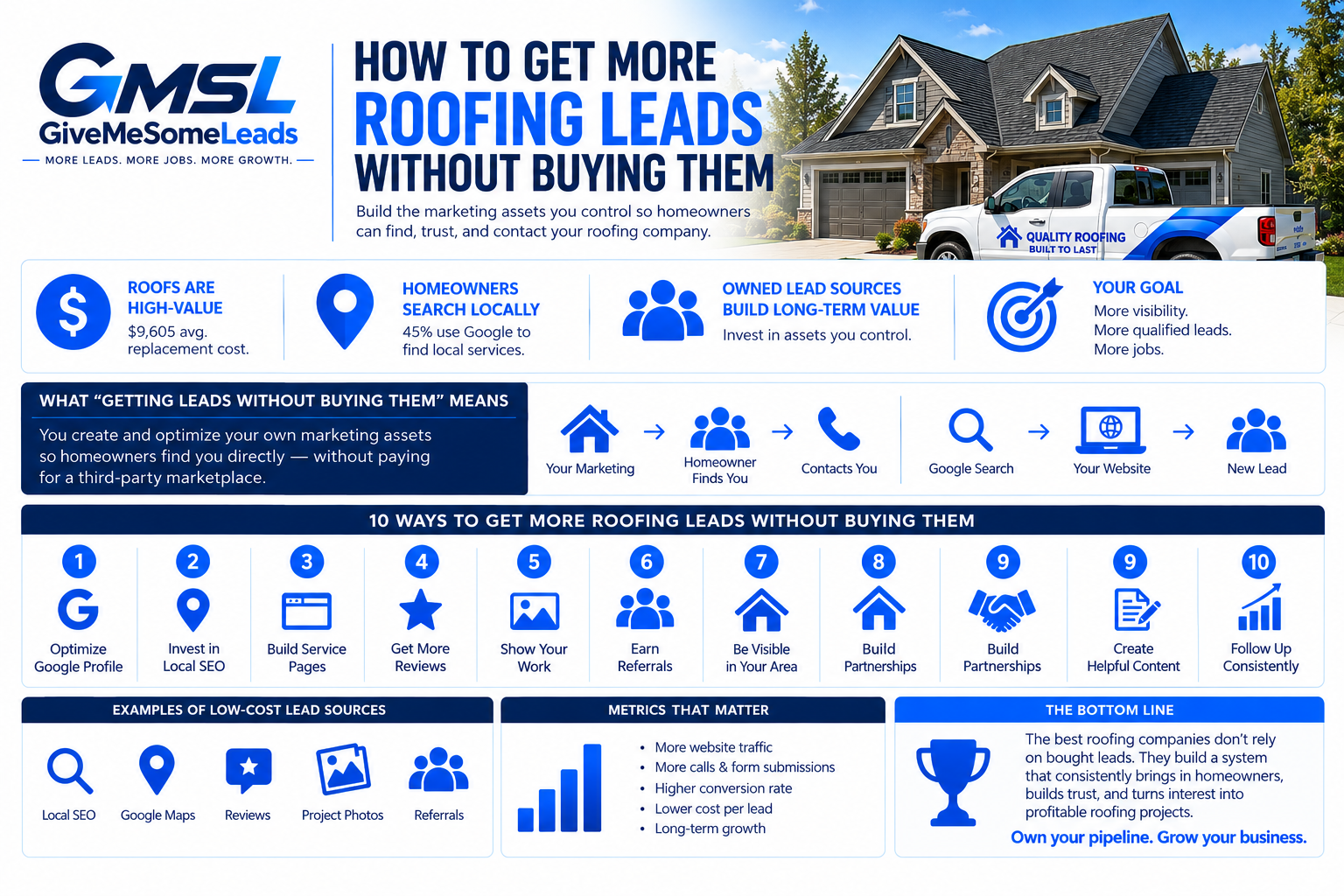
📊 Click the diagram to view a larger version. After opening it, turn your phone sideways for the best viewing experience.
Create Roofing Project Pages
Do not put every project photograph into one giant gallery and consider the job finished.
Turn your strongest roofing projects into individual case studies.
For example:
Roof Replacement in Tampa
Explain the initial problem.
Perhaps the existing asphalt shingle roof showed substantial deterioration and recurring leaks.
Explain what your company found during the inspection.
Show the existing condition.
Describe the scope.
Explain the tear off, decking repairs where necessary, underlayment, flashing, ventilation considerations, and new roofing system.
Then show the result.
Include before and after photographs, installation photos, relevant product information, and an honest customer testimonial when available.
Now one page demonstrates:
Service + Location + Experience + Process + Proof
That can be useful for both homeowners and search engines.
It can also strengthen another service page.
A homeowner reading about roof replacement does not have to take your word for it when you say:
“We provide quality roof replacements.”
They can see an actual one.
Build a Customer Referral System
Some of the strongest roofing leads begin with one sentence:
“Call the company that did our roof.”
That introduction comes with trust you did not have to manufacture from scratch.
Roofing Contractor's 2026 homeowner survey found that 74% of respondents identified word of mouth and recommendations as a way they find roofing contractors, making it the leading source reported in the study.
Do not leave that opportunity entirely to chance.
After a successful installation, confirm the customer is happy, thank them, request an honest review, mention that referrals are appreciated, and make your contact information easy to share.
You do not necessarily need a complicated reward program.
Sometimes simply making customers aware that your company appreciates referrals can increase how often they remember to recommend you.
Pro Tip: Give customers something easy to send.
That might be your website, digital contact card, Google Business Profile, referral page, or a simple message containing your phone number.
Do not make the customer search for your information while standing in their neighbor's driveway.
Stay in Touch With Past Customers
The homeowner who hired you three years ago might know someone who needs a roof today.
Roofing Contractor's 2026 research found that 62% of homeowners said they would contact a roofing company they had used previously.
That is an important number because it shows why the relationship should not necessarily end when the final invoice is paid.
Stay in touch appropriately.
Send genuinely useful storm information when severe weather affects the area.
Share maintenance information.
Provide seasonal inspection reminders where appropriate.
Send relevant company updates.
Check in after major weather events.
Your communication should have a purpose.
Do not email someone every Thursday asking:
“Need another roof yet?”
A roof is not a weekly purchase.
Stay useful enough that your company remains remembered when the need eventually appears.
GMSL Insight: A satisfied homeowner cannot refer you or hire you again if they remember the new roof but forget the company that installed it.
Use Yard Signs Strategically
Roofing has a marketing advantage many businesses do not.
Your work is highly visible.
When you replace a roof, surrounding homeowners may see your crew, vehicles, materials, equipment, cleanup process, and finished installation.
Where local regulations and homeowner permission allow, a professional yard sign can connect that visible work with your company's name.
Keep it simple.
Your logo.
Roofing service.
Phone number.
Website.
Do not attempt to fit your entire service catalog, mission statement, warranty language, email address, six social media icons, and a 40 word slogan onto one small sign.
People are driving past it.
Make the important information readable.
Make Your Trucks Work for You
Your vehicles travel through your service area constantly.
They also sit outside active projects for hours at a time.
Professional vehicle branding turns some of that movement into local brand exposure.
Again, simplicity matters.
Brand + Roofing + Contact Information
Someone should be able to understand what your company does without staring at the truck for 45 seconds.
Vehicle branding is particularly useful because it supports other marketing rather than operating entirely on its own.
A homeowner may see your truck repeatedly, receive your name from a neighbor several weeks later, and recognize the company because they have already encountered the brand.
That familiarity can strengthen the referral.
Market Around Active Roofing Projects
When your company is replacing one roof, the surrounding neighborhood becomes a natural audience.
Nearby homes may have been built around the same period.
They may use similar materials.
They may have experienced the same storms.
Some homeowners may already be wondering how much life remains in their roof.
Your active project gives them a reason to notice your company.
Where appropriate and respectful, you can introduce your company to nearby homeowners, use yard signs, leave professional information, or simply make sure interested neighbors know who is completing the project.
But remember that the jobsite itself is marketing.
Clean crews matter.
Organized materials matter.
Respectful behavior matters.
Professional vehicles matter.
Protection of neighboring property matters.
Cleanup matters.
Your crew can either make neighbors think:
“We should call those roofers.”
or:
“I definitely don't want that happening at my house.”
Build Relationships With Real Estate Agents
Real estate professionals regularly encounter roofing issues during transactions.
Potential opportunities can include inspection findings, pre sale repairs, insurance concerns, roof replacements before listing, buyer requests, and repairs negotiated before closing.
Do not approach Realtors with:
“Send me all your roofing leads.”
Become useful.
Respond quickly.
Provide clear inspections and estimates.
Communicate what the issue actually is.
Avoid exaggerating damage to manufacture a larger project.
Respect the client's timeline.
Do not make the Realtor chase you for the report.
When a real estate professional trusts your company to treat their clients properly, that relationship can create opportunities repeatedly.
Build Relationships With Home Inspectors
Home inspectors encounter roofing concerns constantly.
They may identify visible deterioration, flashing issues, damaged shingles, suspected leaks, ventilation concerns, or conditions requiring evaluation by a roofing professional.
Introduce your company professionally.
Explain your service area, roofing systems, inspection or estimate process, typical response time, and the type of work you actually want.
Do not immediately treat the inspector like an ATM dispensing roofing leads.
Become useful first.
If they need a roofing contractor they can confidently mention to a homeowner, your objective is to become one of the companies that comes to mind.
Network With General Contractors and Builders
General contractors can need roofing subcontractors for additions, renovations, new construction, commercial projects, restoration work, and larger property improvements.
Prepare a professional subcontractor qualification package.
Include your company overview, appropriate insurance documentation, services, project examples, service area, relevant licenses where required, references, and contact information.
Then ask about the process for becoming an approved subcontractor or being included on appropriate bid lists.
Do not send a message that simply says:
“Hey, got any roofing work?”
Present your company like a business another professional contractor could confidently put on a project.
Build Relationships With Complementary Trades
Roofing intersects with several other home improvement services.
Potential professional referral partners can include gutter contractors, siding companies, solar installers, restoration contractors, chimney contractors, general contractors, painters, insulation companies, and other businesses serving the same homeowner.
The strongest relationships are reciprocal.
A siding contractor encounters a homeowner who also needs roof work.
They recommend you.
Several weeks later, your roofing customer asks whether you know anyone reliable for new siding.
You recommend them.
Both companies become more useful to their customers.
GMSL Insight: Professional referral relationships work best when both businesses are protecting the customer's interests, not merely trying to extract leads from each other.
Publish Helpful Roofing Content
Not every homeowner searching about roofing is ready to request an estimate today.
Some are still researching.
They might search:
How much does a roof replacement cost?
Should I repair or replace my roof?
How long does an asphalt shingle roof last?
What are the signs I need a new roof?
Metal roofing vs asphalt shingles
How long does roof replacement take?
What causes roof leaks?
Create genuinely useful articles around the questions homeowners ask before hiring.
Do not write 1,500 words simply to repeat:
“Contact ABC Roofing for all your roofing needs.”
Help them understand the problem.
Explain what factors affect the answer.
Use project examples.
Explain when professional inspection is warranted.
Then provide a clear next step for homeowners who are ready to speak with your company.
Content gives your roofing company an opportunity to appear earlier in the customer journey.
Prepare for AI Search Alongside Traditional Search
Traditional Google search still matters enormously, but homeowner discovery is beginning to expand.
Roofing Contractor's 2026 survey found that 11% of homeowners already reported using AI search services when finding roofing contractors.
Roofr's separate homeowner survey found an even higher figure, with 30% of its 292 respondents reporting using AI tools while finding roofers. Because the studies used different samples and methodologies, the percentages should not be treated as directly interchangeable, but both indicate that AI assisted discovery has entered the roofing customer journey.
That does not mean abandoning Google SEO and chasing every new AI platform.
It reinforces the value of building clear online information about your company.
Strong service pages.
Real project examples.
Consistent business information.
Helpful content.
Reviews.
Clear service areas.
Relevant local authority.
The same high quality marketing assets that help homeowners understand your company can also make your business easier for search systems to understand.
Make Your Website Convert More Visitors
Generating organic traffic, referrals, Google Business Profile visits, and branded searches accomplishes very little if your website wastes the opportunity.
A roofing homeowner should quickly understand:
What do you do?
Where do you work?
Why should I trust you?
How do I request an estimate?
Your website should use real roofing photography, clear service pages, service areas, customer reviews, project examples, warranties, manufacturer certifications where legitimate and relevant, company information, visible phone numbers, strong calls to action, and simple estimate forms.
Trust matters especially in roofing.
Roofr's homeowner study found that only 11% ranked lowest price as their number one consideration, while 74% said responsiveness and communication mattered more than price. The study also found that 66% ranked a professional proposal or estimate as a major trust factor.
That should influence how your website and sales process are built.
Do not compete only by shouting:
FREE ESTIMATE! LOW PRICE!
Show homeowners why your company is credible.
GMSL Insight: Your website does not generate value simply because someone visits it.
It generates value when the right homeowner understands your company, trusts what they see, and takes the next step.
Give Homeowners Useful Pricing Context
Roofing companies are often hesitant to discuss pricing online.
There are legitimate reasons.
Roof size, pitch, access, material, tear off requirements, decking condition, flashing, ventilation, geographic market, disposal, labor, and other variables can dramatically affect project costs.
That does not mean your website has to say nothing.
Roofing Contractor's 2026 homeowner survey found that 65% of respondents said they were more likely to call a roofing contractor that provided pricing information on its website. At the same time, about one third of contractors surveyed did not provide pricing information online.
You do not have to promise every roof costs $12,000.
Explain the factors.
Provide ranges where appropriate and where you can do so accurately.
Show homeowners what increases or decreases cost.
Explain what an estimate includes.
Help them understand why two roofs of the same square footage can have different prices.
Transparency can build trust without forcing you into a fixed price that does not reflect the actual project.
Improve Your Follow Up
One of the least expensive ways to generate more roofing business is to stop wasting opportunities you already paid or worked to generate.
A lead arrives.
Call.
No answer?
Leave an appropriate voicemail.
Send a text when appropriate and permitted.
Follow up again.
When an estimate has been completed, continue the process.
Confirm the homeowner received the proposal.
Answer questions.
Clarify options.
Follow up professionally.
Do not assume:
“They would call if they wanted us.”
Roofing decisions can involve significant money, insurance questions, financing, spouses, multiple estimates, scheduling concerns, and uncertainty.
A homeowner can be interested and still need follow up.
GMSL Insight: Sometimes a roofing company does not need 50 more leads.
It needs to stop losing the 20 opportunities already sitting inside its CRM.
Make Your Proposal Part of the Marketing System
The website is not the final conversion point.
Your proposal is another major trust moment.
Roofr found that 70% of homeowners surveyed preferred receiving estimates and proposals digitally, while 66% considered a professional proposal or estimate a major trust factor.
A professional roofing proposal should clearly explain the project.
The roofing system.
Scope.
Material.
Preparation.
Removal.
Decking assumptions where appropriate.
Underlayment.
Flashing.
Ventilation.
Cleanup.
Warranty information.
Payment terms.
Price.
Optional upgrades.
Next steps.
Do not send an $18,000 roofing estimate that says only:
“New Roof, $18,000.”
The homeowner should be able to understand what they are buying.
The proposal is part of your sales and marketing system because it helps turn a qualified opportunity into a customer.
Ask Old Estimates Again
Not every homeowner who did not hire you six months ago selected another roofer.
Some delayed the project.
Some were waiting for financing.
Some wanted to complete another renovation first.
Some were dealing with insurance.
Some simply became distracted.
Review older qualified estimates periodically.
When appropriate, send a professional message asking whether the roofing project is still being considered.
You already invested time and marketing money into generating and estimating that opportunity.
Before spending another $5,000 chasing new leads, see whether there are legitimate opportunities still sitting inside your database.
Create an Email Database You Own
A roofing company can accumulate a large number of contacts over time.
Past customers.
Previous estimates.
Inbound leads.
Property managers.
Referral partners.
Realtors.
General contractors.
With appropriate consent and compliant marketing practices, that audience can become valuable.
Useful communication can include maintenance information, storm preparation, severe weather updates, educational roofing content, seasonal reminders, relevant service announcements, and company updates.
The advantage is that the relationship exists directly between the customer and your business.
You are not paying a lead marketplace every time you want to reach someone who already knows your company.
Build a Reputation That Creates Branded Search
There is another level of roofing lead generation that many contractors overlook.
People begin searching for your company by name.
Instead of:
“Roofing contractor near me.”
they search:
“ABC Roofing.”
That can happen because they saw your truck.
Their neighbor mentioned you.
They passed one of your projects.
They saw your yard sign.
They have encountered your company repeatedly online.
Their Realtor recommended you.
They remember your content.
This is branded demand.
It takes time to develop, but it can become one of the strongest long term assets a local roofing business creates.
Every strong marketing channel contributes to it.
Create a Better Customer Experience
Lead generation is not only the marketing department's responsibility.
A great customer experience creates future marketing.
Roofr's homeowner research found that 72% said having the roofing job completed exactly as promised was important to a successful experience, 60% highlighted cleanup, and 53% pointed to communication throughout the project.
Think about what that means operationally.
Return calls.
Communicate clearly.
Protect landscaping.
Respect neighboring properties.
Keep commitments.
Maintain an organized jobsite.
Clean thoroughly.
Finish what you promised.
Handle legitimate problems professionally.
Then request the review.
Ask for the referral.
Document the project.
A roofing company's marketing performance is influenced by what happens after the sale.
GMSL Insight: A completed roof can become a marketing engine when the customer experience creates reviews, referrals, project photos, repeat business, and neighborhood visibility.
Track Where Every Roofing Lead Comes From
If you want to reduce dependence on purchased leads, you need to know which channels are replacing them.
Track meaningful sources separately.
For example:
| Lead SourceLeadsQualifiedEstimatesCustomers | ||||
|---|---|---|---|---|
| Organic Search | 30 | 24 | 18 | 7 |
| Google Maps | 22 | 19 | 15 | 8 |
| Customer Referrals | 15 | 14 | 12 | 9 |
| Yard Signs | 12 | 8 | 6 | 4 |
Those figures are illustrative.
Your tracking should follow:
Source → Lead → Qualified Lead → Estimate → Customer → Revenue → Profit
Do not stop at:
“Google Maps generated 22 leads.”
Maybe 18 became customers.
Maybe two did.
The source producing fewer raw leads could actually produce significantly more revenue.
Use call tracking, form tracking, CRM attribution, GA4, Google Business Profile data, and your sales information together where practical.
Marketing data becomes much more useful when it reaches the actual customer.
Measure More Than Lead Volume
Suppose Local SEO generates 30 leads.
A marketplace produces 75.
At first glance, the marketplace appears better.
Now look deeper.
Local SEO
30 leads.
24 qualified.
18 estimates.
9 customers.
Marketplace
75 leads.
31 qualified.
17 estimates.
5 customers.
Which channel would you rather have?
The correct answer still depends on cost, average project value, gross profit, and other economics.
But the example demonstrates why raw lead volume can mislead roofing contractors.
Track cost per qualified lead.
Cost per estimate.
Customer acquisition cost.
Revenue.
Gross profit where possible.
That is how you determine what deserves additional investment.
Reinvest in the Channels You Control
As your roofing company generates profit, reinvest part of it into stronger marketing assets.
Improve project photography.
Build better service pages.
Publish more detailed case studies.
Strengthen Local SEO.
Improve your Google Business Profile.
Build a consistent review system.
Improve your CRM.
Create better proposals.
Brand your vehicles.
Develop professional referral relationships.
Improve conversion tracking.
The strategy is not:
“Never spend money.”
The strategy is:
“Spend more of our marketing budget strengthening assets that increase the long term value of our roofing company.”
A $5,000 investment in purchased leads may produce opportunities this month.
A $5,000 investment into a high converting website, strong project documentation, Local SEO, tracking, and review systems can potentially influence customer acquisition for much longer.
The right balance depends on your business and market.
Purchased Leads vs Owned Lead Generation
| Purchased LeadsOwned Lead Generation | |
|---|---|
| Pay for access to opportunities | Invest in your own marketing assets |
| May be shared with competitors | Often generates direct inquiries |
| Provider controls much of the supply | Your business controls more of the system |
| Usually declines when purchasing stops | Assets can continue creating value |
| Can create opportunities quickly | Often takes longer to build |
| Limited brand ownership | Strengthens local brand and reputation |
| Useful for filling gaps | Strong long term foundation |
Purchased leads are not automatically bad.
They can help newer roofing companies generate opportunities.
They can fill scheduling gaps.
They can provide incremental volume.
They can work extremely well when the economics are strong.
The problem begins when your entire business depends on another company selling you access to your next customer.
GMSL Insight: The strongest position is not necessarily refusing to buy leads.
It is having enough marketing assets, referrals, visibility, reputation, and customer relationships that your roofing company is not forced to buy leads just to survive.
Build a Roofing Lead Generation Flywheel
The strongest roofing customer acquisition systems reinforce themselves.
A homeowner discovers your company through Local SEO, Google Maps, a referral, yard sign, project page, or another channel.
They visit your website.
Your website shows real roofing work, reviews, relevant services, service areas, and clear information.
They request an estimate.
Your company responds.
You qualify the opportunity.
You deliver a professional proposal.
The homeowner becomes a customer.
Your crew completes a great roof.
The customer leaves a review.
You photograph the project.
The project becomes a case study.
The yard sign creates neighborhood exposure.
The homeowner refers a friend.
Your Google Business Profile becomes stronger.
Your website gains another real project.
Your reputation improves.
Another homeowner discovers you.
Then the cycle starts again.
Think:
Local SEO + Google Maps + Referrals + Brand Exposure → Website → Estimate → Professional Follow Up → Customer → Great Roofing Project → Review + Photos + Case Study + Referral → Stronger Online Presence → More Leads
Every successful roofing project gives the system an opportunity to become stronger.
That is how dependence on purchased leads gradually decreases.
Real Life Example: Building an Owned Roofing Lead System
Imagine a roofing company currently spends $12,000 per month across several purchased lead sources.
The leads are producing projects, so eliminating them overnight would make no sense.
Instead, the contractor begins building parallel assets.
Every completed roof is professionally documented.
Every eligible customer receives a review request.
The company rebuilds its roof replacement and roof repair pages.
Strong projects become individual case studies.
Its Google Business Profile receives consistent new photos.
Referral sources are tracked.
Past customers receive appropriate follow up.
The company improves its estimate process.
Lead sources are tracked through customers and revenue.
After a year, the company discovers that Google Maps, organic search, referrals, past customers, and branded searches now contribute a much larger percentage of its qualified opportunities.
It can then decide whether some of the purchased lead budget should be reduced and reinvested into channels producing better economics.
The numbers are illustrative.
The important part is the transition.
Do not switch off a profitable lead source because an article told you that owned marketing sounds better.
Build the alternative.
Track it.
Prove it works.
Then reallocate your budget based on data.
Common Mistakes Roofing Contractors Make
One common mistake is assuming referrals will happen automatically simply because the company performs good work. Excellent workmanship helps, but customers still need to remember your company and know that recommendations are appreciated.
Another is treating Google Business Profile as a one time setup rather than an active reputation and discovery asset.
Roofing contractors also lose opportunities by never requesting reviews, publishing weak service pages, relying heavily on stock photography, failing to document real projects, ignoring old estimates, responding slowly, treating previous customers as completed transactions, overlooking neighborhood visibility, building no professional referral network, and tracking leads without tracking which sources actually become customers.
Another major mistake is expecting SEO to produce results instantly.
Owned lead generation usually takes time.
That is why the objective is not to recklessly cancel every paid channel tomorrow.
Build the system while the business continues operating.
Measure what improves.
Then invest more heavily in the channels producing qualified opportunities, profitable customers, and long term business value.
Frequently Asked Questions
1. Can roofing contractors generate leads without buying them?
Yes. Local SEO, Google Business Profile, referrals, reviews, project content, past customers, neighborhood marketing, and professional partnerships can all generate direct roofing opportunities.
2. What is the best free source of roofing leads?
There is no universal source. Customer referrals and organic or local Google visibility can be extremely valuable, but both require a strong reputation and consistent effort to develop.
3. Does Google Business Profile generate roofing leads?
It can. Homeowners can discover roofing businesses through Google Search and Maps, making a strong local profile an important discovery and trust asset.
4. Do reviews help roofing companies get more leads?
They can support trust and local visibility by giving homeowners more evidence to evaluate before contacting your company.
5. Should roofers stop buying leads completely?
Not necessarily. Purchased leads can still make economic sense if they produce profitable customers. The goal is usually to reduce dependence on them by building lead sources your company controls.
6. How can roofers get more referrals?
Deliver excellent work, ask satisfied customers directly, make your information easy to share, stay in touch with past customers, and build relationships with complementary professionals.
7. Is SEO really cheaper than buying leads?
Not automatically. SEO requires investment in strategy, content, websites, project documentation, reviews, and optimization. The advantage is that much of that investment goes toward building digital assets your company owns.
8. How long does Local SEO take?
There is no guaranteed timeline. Competition, location, website quality, reviews, existing authority, content, and other factors all affect results.
9. What should roofing contractors track?
Track Lead Source → Qualified Lead → Estimate → Customer → Revenue. This allows you to see which owned lead sources actually contribute profitable roofing projects.
Final GMSL Insight
Getting more roofing leads without buying them does not mean generating business without investing. It means changing what you invest in. Instead of relying entirely on a platform that sells you access to the next homeowner, build a roofing company that homeowners can discover, research, trust, remember, and recommend directly.
That means strengthening your Google Business Profile and Local SEO, creating useful roofing service pages, documenting completed projects, earning genuine reviews, turning strong jobs into case studies, building referral relationships, staying connected with past customers, improving your website and proposals, following up consistently, and tracking each channel through qualified leads, estimates, customers, revenue, and profit.
Keep paid acquisition when it makes financial sense, but continue investing in marketing assets and customer relationships that belong to your business and can keep creating value over time. The objective is not zero marketing spend. The objective is stronger marketing ownership.
Ready to Build a Stronger Roofing Lead Generation System?
GiveMeSomeLeads helps roofing contractors strengthen Local SEO, Google Business Profile visibility, service pages, project content, reviews, referrals, websites, and conversion tracking so more homeowners contact your company directly.