
Facebook Groups can be an overlooked source of painting leads.
Every day, homeowners ask questions like:
Can anyone recommend a good painter?
Looking for someone to paint our house next month.
Who does cabinet painting around here?
Need an exterior painter, any recommendations?
These conversations are valuable because the homeowner is not being interrupted by an ad. They are already asking for help.
For painting contractors, that creates a real opportunity. But the goal is not to join every neighborhood group and start posting FREE ESTIMATES every morning. That usually makes the business look desperate and can quickly annoy people.
The better approach is to become a useful and recognizable local business. Show up where it makes sense, answer real questions, respond when homeowners are genuinely looking for help, and let your reputation support the conversation.
From our experience, the contractors who get the most value from Facebook Groups do not treat them like free advertising boards. They build familiarity, respond quickly when real opportunities appear, and make sure their website, reviews, project photos, and follow up are strong enough to support the introduction.
Do not think of Facebook Groups as a place to spam promotions. Think of them as local conversations where your company can be helpful, visible, and ready when someone actually needs a painter.
The goal is not to advertise to everyone in a Facebook Group. The goal is to be visible when someone actually needs a painter.
A homeowner posts in a local group:
Looking for someone to repaint our main floor. Any recommendations?
Three contractors comment with phone numbers.
One past customer tags a painting company and says they did a clean job, showed up on time, and communicated well.
That recommendation is much stronger than a contractor promoting themselves because it comes from someone with a real experience.
Imagine a local Facebook Group has 8,000 members.
A painter does not need all 8,000 people to become leads.
If only 10 homeowners per month ask about painting, and the contractor responds well to the right conversations, even 2 or 3 serious estimate requests can make the group worth paying attention to.
The value is not the size of the group.
The value is being present when the right homeowner is ready.
Why Facebook Groups Can Work for Painting Contractors
Painting is naturally local.
Most painting contractors serve a defined area. They may work in certain cities, neighborhoods, communities, or service zones. That makes Facebook Groups relevant because many groups are built around those same local communities.
Depending on your market, you may find groups for cities, neighborhoods, homeowners associations, local recommendations, home improvement, real estate, small businesses, and community discussions.
When someone posts Looking for an interior painter in Scottsdale, that is not random social media traffic.
That person may be showing real buying intent.
They are already asking for help, and other people in the community may start recommending contractors they have personally used. That is what makes Facebook Groups different from cold advertising.
The conversation already has trust built into it.
Your job is to enter that conversation professionally.
Focus on groups where homeowners actually ask for recommendations, not only groups filled with business owners promoting themselves.
Facebook Groups work best when they connect your painting company to real local conversations, not random attention.
A painter joins a large regional group with 150,000 members, but most people are outside the company’s service area.
They get attention, but very few useful leads.
Another painter joins 4 smaller neighborhood groups where homeowners regularly ask for painter recommendations.
Those groups are smaller, but the leads are more relevant because they are closer to the contractor’s actual service area.
Find the Right Facebook Groups
Do not join every group you can find.
Focus on communities inside your real service area. A group with 5,000 local homeowners may be more useful than a huge group filled with people too far away for your crews to serve profitably.
Search Facebook for terms related to your city, neighborhoods, recommendations, homeowners, residents, home improvement, small business, and contractors.
For example, a painter serving Tampa might search for groups like Tampa recommendations, South Tampa community, Tampa Bay homeowners, Tampa home improvement, or local neighborhood resident groups.
The goal is relevance.
You want groups where homeowners in your target area are actually asking about painting, remodeling, home maintenance, and local service recommendations.
Do not waste time chasing every group just because it has a large member count.
A group is only valuable if the people inside it match the customers you want.
Prioritize relevance over group size. You do not need 200,000 members. You need homeowners located where your crews actually work.
The right group is not always the biggest group. It is the group where local homeowners ask real questions that match your services.
Group A has 80,000 members, but most are outside your service area.
Group B has 6,000 members, but most are homeowners in neighborhoods where you already work.
Group B may create better opportunities because the audience is more relevant.
For painting contractors, local fit matters more than vanity numbers.
Read the Group Rules Before Posting
Every Facebook Group is different.
Some groups allow local businesses to post freely. Others only allow promotional posts on certain days. Some do not allow advertising at all, but still allow businesses to respond when members ask for recommendations.
Respect those rules.
Do not assume that being a local business gives you permission to promote yourself whenever you want.
If promotional posts are not allowed, do not try to disguise an ad as helpful content. Moderators and homeowners can usually tell.
Getting removed from a valuable local group over one promotional post is not worth it.
A better strategy is to understand how each group works, participate appropriately, and respond when the rules allow it.
Before posting or commenting as a business, read the group rules and look at how other local businesses are allowed to participate.
The group belongs to the community, not your marketing department.
A painting contractor joins a neighborhood group and immediately posts:
Spring painting special. Call now for free estimates.
The post gets removed, and the contractor gets warned by the moderators.
Another contractor reads the rules first and learns that business posts are only allowed on Fridays, but businesses can reply when members ask for recommendations.
That contractor waits for real opportunities and responds professionally.
The second approach protects the company’s reputation.
Optimize Your Facebook Presence First
Before responding to homeowners in groups, make sure your online presence looks legitimate.
Someone may see your comment and click your profile, search your business name, visit your Facebook Page, check your website, or read your reviews.
If they cannot quickly understand who you are, what you do, where you work, and how to contact you, the opportunity can disappear.
Your Facebook presence should include your company name, website, phone number, service area, painting services, before and after projects, customer reviews, recent work, and clear business information.
Your website should also support the same message.
The recommendation may get the homeowner’s attention, but your online reputation helps confirm whether you are worth contacting.
This is why Facebook Groups cannot be separated from your website, Google reviews, project photos, and Local SEO.
They all support each other.
Before trying to get leads from Facebook Groups, look at your business from a homeowner’s point of view. Can they quickly see proof, services, location, reviews, and contact information?
A Facebook comment can create attention, but your online presence has to turn that attention into trust.
A homeowner asks for a cabinet painter.
You reply professionally.
They click your profile, but your page has no recent photos, no website link, no reviews, and unclear service information.
Trust drops.
Another company replies, and their profile shows cabinet painting projects, recent customer reviews, a website link, and a clear service area.
That company feels safer to contact.
Watch for High Intent Posts
Not every Facebook Group conversation deserves the same response.
Focus on posts that show real buying intent.
A high intent post might say:
Need someone to paint three bedrooms next week.
Looking for exterior painting estimates.
Can anyone recommend a cabinet painter?
Those are opportunities because the homeowner is closer to taking action.
A lower intent post may be more informational, such as someone asking what color would look good in a room. You can still help, but the response should match the situation.
Do not jump into every conversation with a sales pitch.
If someone is asking for color opinions, give helpful advice.
If someone is asking for painter recommendations, then it makes sense to mention your company where allowed.
The more relevant your response is, the more professional your business looks.
Separate posts into two groups. Some are real lead opportunities. Others are relationship building opportunities. Respond differently to each one.
High intent posts are valuable because the homeowner is already asking for help. Do not waste that opportunity with a spammy response.
A homeowner posts:
Does anyone know a good painter for exterior work this spring?
That is a strong opportunity.
A painter can respond with a short professional message, mention exterior painting experience, and share a relevant project.
Another homeowner posts:
Do you think white walls would look better than beige?
That is not the time for a hard sales pitch.
A helpful answer builds familiarity without forcing the sale.
Respond Quickly
Speed matters in Facebook Groups.
When a homeowner asks for a painter, they may receive many recommendations within the first hour. If you wait two days to respond, the best opportunity may already be gone.
You do not need to spend your entire day refreshing Facebook, but you should have a simple routine.
Check your most important groups in the morning, around lunch, and later in the afternoon. That is usually enough to catch real opportunities without turning Facebook into a full time job.
When you see a good post, respond professionally and quickly.
A fast response does not mean rushing or sounding desperate. It means being present while the homeowner is still paying attention.
Create a short list of your best groups and check those first. Do not waste time scrolling through groups that rarely create useful opportunities.
Facebook Group leads are time sensitive. The faster you respond to real opportunities, the better chance you have of turning the conversation into an estimate.
A homeowner asks for an exterior painter in a local group.
Within one hour, they receive 12 recommendations.
A painter who responds the same day may still be part of the conversation.
A painter who responds three days later is probably too late.
The lead did not disappear because Facebook Groups do not work.
It disappeared because the response came after the conversation had already moved on.
Do Not Respond Like a Spammer
When someone asks for a painter in a Facebook Group, your response matters.
You are not only speaking to the person who posted. Everyone reading the thread can see how your company presents itself.
Generic, rushed, and disconnected from the homeowner's question.
Helpful, specific, and written like a real conversation.
That is why painters should avoid aggressive comments like:
ABC Painting. Best prices. Free estimates. Call now.
That kind of response feels rushed, generic, and desperate.
A better response feels helpful and natural.
For example:
Hi Sarah, we handle exterior painting in the area and would be happy to take a look. We recently completed a similar project nearby. I can send you our information and a few examples of our work.
That response is more professional because it matches the conversation. It explains what you do, shows relevance, and opens the door without sounding pushy.
Write your response like a real person, not like an ad. Keep it helpful, specific, and easy to reply to.
In a local group, your comment is part of your reputation. A professional response can make your company look more trustworthy before the homeowner ever contacts you.
A homeowner posts that they need someone to repaint the exterior of their home.
Painter A replies with capital letters, emojis, and a phone number.
Painter B replies politely, mentions exterior painting, references a similar local project, and offers to share examples.
Painter B feels easier to trust because the response sounds human and relevant.
Let Your Work Do the Selling
Painting is visual, and that gives painting contractors a real advantage in Facebook Groups.
If someone asks for an exterior painter, show an exterior project.
If someone asks about cabinet painting, show cabinets.
If someone needs interior painting, show a similar room transformation.
The proof should match the request.
Do not send someone asking about cabinet painting a photo of a commercial warehouse. Do not send a generic stock photo when you have real work to show.
Specific examples create more credibility than generic claims.
Instead of saying we are experts in exterior painting, show a real exterior project with the before photo, preparation, and finished result.
Evidence makes the claim stronger.
Save your best project photos by service type so you can quickly share the right example when someone asks.
Real project proof is stronger than saying you do great work. Let homeowners see the quality for themselves.
A homeowner asks for cabinet painting recommendations.
One contractor responds with a general company link.
Another contractor shares a recent cabinet painting project with before and after photos and explains that the work was completed nearby.
The second contractor gives the homeowner proof that matches exactly what they need.
Answer Questions Without Immediately Selling
Some of your best opportunities will not start with someone saying they need a painter.
A homeowner may ask whether they need primer, what paint finish works best in a bathroom, whether exterior paint can be done in cooler weather, or how to choose colors before listing a home.
These questions are opportunities to be useful.
You do not need to jump straight into a sales pitch.
If someone asks whether they need to prime walls before repainting, you can explain that it depends on the surface condition, stains, repairs, existing paint, and color change.
That kind of answer helps the homeowner without pressuring them.
People notice businesses that give useful answers.
Later, when that homeowner decides they would rather hire a professional, your company may already feel familiar.
Give helpful answers first. When appropriate, you can mention that your company can take a look, but do not make every comment feel like a sales pitch.
Helpful advice builds trust before the customer is ready to buy.
A homeowner asks if they need primer before painting over a dark wall.
Painter A says:
Call us for a free estimate.
Painter B explains when primer may be needed, what problems to watch for, and says they are happy to help if the homeowner wants a professional opinion.
Painter B creates more trust because the answer actually helps.
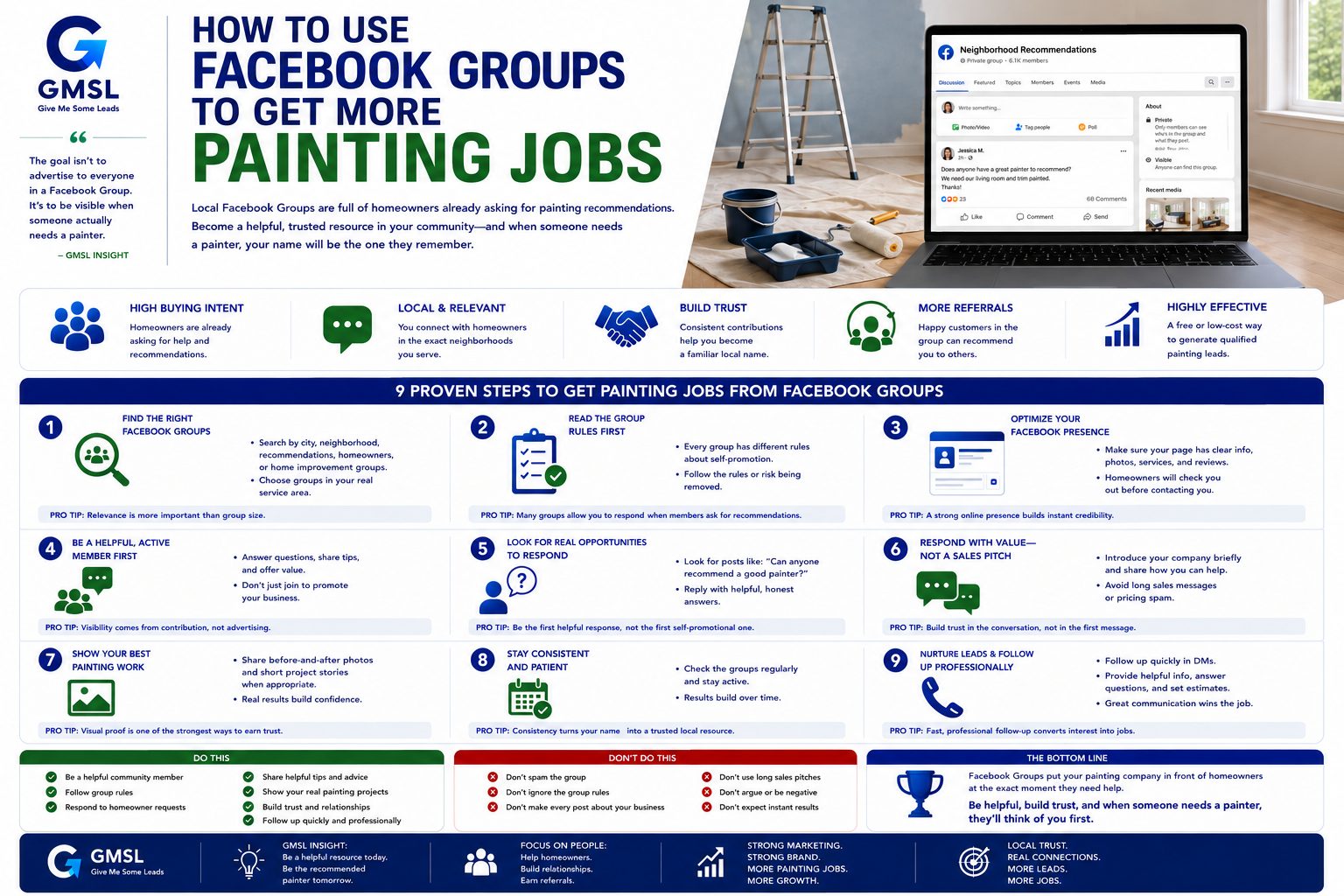
📊 Click the diagram to view a larger version. After opening it, turn your phone sideways for the best viewing experience.
Use Before and After Posts Where Allowed
If a Facebook Group allows business posts, do not only post basic promotions.
A post that says we have openings, call today can be easy to ignore.
A real project is more interesting.
For example, you can share a recent exterior transformation in a specific neighborhood or city. Explain the problem, what your crew did, and show the before and after result.
The project itself becomes the advertisement.
This works especially well for painting because homeowners can see the difference immediately.
A faded exterior, outdated cabinet color, dark room, or worn trim can become strong proof when the finished result is clear.
Keep the post simple. Show the work, explain the result, and invite questions.
Before posting in a group, make sure business posts are allowed. If they are, use real project content instead of constant promotions.
A strong before and after post feels less like advertising because the proof is built into the project.
Instead of posting:
Spring painting special. Call now.
A painter posts:
Recent exterior repaint completed in Plano. The old paint had heavy fading, so our crew handled the prep work and applied a fresh new finish. Here are the before and after results. Happy to answer questions about exterior painting.
That feels more useful and more local.
Use Local Projects to Build Recognition
Local details make your Facebook content more relevant.
Instead of saying another beautiful exterior project, mention where the work was completed.
For example:
Exterior repaint recently completed in North Scottsdale.
That small detail matters because people in that area can recognize that your company actually works there.
Over time, repeated local visibility can create familiarity.
A homeowner may not need a painter today. But after seeing your company mentioned in groups, shared by customers, and connected to real local projects, they may remember you when the time comes.
This is how Facebook Groups can support local brand awareness without needing to spam.
Mention the city or neighborhood when appropriate, but only when it is accurate and respectful of customer privacy.
Local recognition builds slowly. The more people see your real work in their area, the more familiar your company becomes.
A painter shares 12 real project posts over several months in allowed local groups.
Only 3 people message right away.
At first, that may look small.
But during that same period, local homeowners start recognizing the company name, past customers tag the company more often, and more people visit the website after seeing the work.
Facebook Groups can create direct leads, but they can also build familiarity that supports future referrals, searches, and estimate requests.
Encourage Happy Customers to Recommend You
This may be one of the strongest Facebook Group strategies for painting contractors.
When you recommend yourself, it is marketing.
When a past customer recommends you, it feels much more trustworthy.
For example, if a homeowner posts:
Can anyone recommend a good exterior painter?
You can reply and say your company can help.
That may work.
But if a past customer replies and says your company painted their home, communicated well, protected the property, and did a great job, that recommendation carries more weight.
You should not create fake recommendations or ask people to pretend they hired you. That damages trust.
Instead, earn recommendations by doing great work, creating a strong customer experience, asking for referrals, staying memorable, and making your company easy to share.
The better your customer experience is, the more likely happy customers are to mention you naturally when someone in the community asks for a painter.
After a successful project, send a simple thank you message with your company name, website, phone number, and Google Business Profile link. This makes it easier for customers to recommend you later.
The strongest Facebook Group promotion often does not come from the contractor. It comes from a satisfied customer.
A homeowner asks in a neighborhood group:
Looking for a good house painter. Any recommendations?
Three painters comment with their own phone numbers.
Then a past customer comments:
We used ABC Painting last year. They were clean, professional, and the house turned out great.
That customer recommendation feels more believable because it came from someone who actually experienced the service.
Reply to Customer Recommendations
When a past customer recommends your painting company in a Facebook Group, do not ignore it.
That is a warm introduction.
A simple and professional reply can help move the opportunity forward.
For example, if someone asks for a painter and a past customer tags your company, you can respond with:
Thanks for recommending us, Mike. Sarah, we would be happy to take a look at your project. Feel free to message us or visit our website to see some recent work.
Now the thread has two strong pieces working together.
A customer recommendation and a professional contractor response.
That is much stronger than cold self promotion.
Keep the response natural. Thank the customer, acknowledge the person asking, and give them an easy next step.
When someone recommends your company, respond quickly and professionally. The homeowner may be comparing several options in the same thread.
A customer recommendation creates trust. Your response should make the next step easy without turning the thread into a hard sales pitch.
A homeowner asks for cabinet painting recommendations.
A past customer tags your company and says you did a great job on their kitchen cabinets.
You reply by thanking them and offering to send the homeowner a few examples of similar cabinet projects.
That response feels helpful because it connects directly to what the homeowner needs.
Build Relationships With Other Local Professionals
Facebook Groups are not only filled with homeowners.
You may also find realtors, remodelers, flooring contractors, drywall companies, property managers, interior designers, general contractors, and other local professionals.
These people can become referral partners over time.
An interior designer may need reliable painters for client projects.
A realtor may need quick interior repainting before listings.
A flooring contractor may meet customers who want walls painted after new flooring is installed.
A property manager may need painters for rental turnovers.
Do not immediately message people asking them to send you leads.
That is not how strong referral relationships are built.
Start by being useful, professional, responsive, and easy to work with. Refer business when it makes sense. Comment thoughtfully when you can help. Build familiarity before asking for anything.
Look for local professionals who already serve the same homeowners you want to reach. Build relationships around mutual value, not one sided lead requests.
Referral partners are built through trust. The best local professionals recommend contractors who make them look good.
A realtor posts in a group asking if anyone knows a painter who can handle a quick interior repaint before a home goes on the market.
A painting contractor responds professionally, explains they handle listing prep repaints, and offers to share examples.
If the job goes well, that realtor may remember the company for future listings.
One relationship can create repeat opportunities.
Move Qualified Leads Off Facebook
Facebook is where the conversation can start.
It does not need to be where the entire sales process happens.
Once someone shows real interest, move the conversation toward a phone call, estimate request, or normal sales process.
For example, you can say:
Absolutely. What is the best number to reach you? We can get a few details about the project and see about scheduling an estimate.
Then collect the important details.
Name, phone number, property location, painting service, approximate scope, and timeline.
This helps your team treat the opportunity like a real lead instead of leaving it buried in comments or Messenger.
Facebook conversations can get messy fast. People forget to reply, messages get lost, and comment threads move on.
Move serious opportunities into your system.
Once a homeowner seems serious, collect contact information and move them into your normal follow up process.
Facebook can create the opportunity, but your sales system needs to turn that opportunity into an estimate.
A homeowner comments that they need three bedrooms painted next month.
Instead of trying to price everything in the comments, the painter asks for the best phone number and a few project details.
Now the company can call, qualify the project, and schedule an estimate properly.
Qualify the Lead
Not every Facebook inquiry is a good project.
Some people are outside your service area.
Some want services you do not offer.
Some have a project that is too small.
Some are only gathering ideas.
Some are not ready to hire.
That is why qualification matters.
Before spending too much time on the lead, confirm the basics. Ask where the property is located, what type of painting they need, how large the project is, when they want the work done, and whether they are looking for estimates now or only researching.
This protects your time and helps you focus on better opportunities.
For painting contractors, estimating time matters. Sending someone across town for a poor fit lead can waste hours.
A simple qualification process helps prevent that.
Ask a few basic questions before scheduling the estimate. Good questions protect your time and help the homeowner get a better answer.
More inquiries do not always mean more business. The goal is to turn the right inquiries into real painting projects.
A painting company gets 15 Facebook Group inquiries in one month.
After qualifying them, 5 are outside the service area, 3 are too small, 2 are only asking for general advice, and 5 are real estimate opportunities.
Without qualification, all 15 leads may look equal.
With qualification, the company knows where to focus.
Follow Up
A homeowner who finds you through a Facebook Group may also contact several other painters.
Do not assume they will message you again if they are interested.
Follow up like you would with any other lead.
After the first conversation, call if you have their number. If there is no answer, send a text. If an estimate is scheduled, confirm it. If the estimate is sent, follow up professionally.
The Facebook Group creates the opportunity, but your follow up process still has to close it.
Many painting companies lose leads not because the source was bad, but because they did not follow up properly.
A good follow up process does not need to be aggressive.
It needs to be consistent.
Create a simple follow up process for every Facebook Group lead. First contact, estimate scheduled, estimate sent, follow up, decision.
A lead source creates the opening. Follow up determines how much business you actually win from it.
A homeowner messages three painters from a Facebook Group thread.
One replies once and never follows up.
Another sends a quick message but does not ask for the next step.
The third asks good questions, schedules an estimate, confirms the appointment, sends the estimate, and follows up after.
The third company has the best chance of winning because the process is stronger.
Track Facebook Group Leads Separately
Do not categorize every Facebook lead the same way.
Facebook Ads and Facebook Groups are very different channels.
Facebook Ads are paid campaigns.
Facebook Groups are community based conversations, referrals, recommendations, and organic opportunities.
Track them separately so you can see what is actually working.
Record the source as Facebook Group, then track the full path.
Lead, qualified lead, estimate, customer, revenue.
You may discover that Facebook Groups only generate a small number of leads each month, but those leads close at a strong rate because they often come through recommendations or local trust.
That is why lead volume alone does not tell the full story.
Add Facebook Group as its own lead source in your CRM or tracking sheet. Do not mix it with paid Facebook Ads.
If you do not track Facebook Group leads separately, you will never know whether community referrals are quietly becoming one of your best channels.
A painting company tracks everything under Facebook and thinks the channel is average.
After separating the sources, they see the difference.
Facebook Ads created 50 leads and 5 customers.
Facebook Groups created 8 leads and 4 customers.
The group leads had lower volume, but stronger quality.
That changes how the company should think about the channel.
Real Life Example
Imagine a painting contractor joins several neighborhood Facebook Groups inside the company’s real service area.
They do not spam every group.
They do not post the same promotion every day.
They pay attention to real conversations and wait for the right opportunities.
On Monday, someone posts:
Looking for recommendations for someone to repaint our downstairs.
A few contractors respond with phone numbers. A few homeowners recommend companies they have used before.
The painter responds professionally and shares a relevant interior painting project.
The homeowner checks the company’s website and finds strong reviews, real project photos, an interior painting page, clear service information, and an easy estimate request form.
That matters.
The Facebook Group created the first conversation, but the website, reviews, photos, and follow up helped turn that conversation into trust.
The contractor responds quickly, schedules the estimate, and wins a 6,500 dollar interior repaint.
The amount is only an example, but the process is realistic.
A local conversation can turn into a real project when the response is relevant, the online presence is strong, and the follow up is fast.
Do not treat a Facebook Group comment as the whole sale. Treat it as the start of the customer journey.
Facebook Groups work better when your website, reviews, project photos, and sales process are strong enough to support the recommendation.
A painter gets 8 Facebook Group leads in one month.
Only 5 are qualified.
Only 3 become estimates.
Only 1 becomes a customer.
At first, that may not sound like much.
But if that one customer turns into a 6,500 dollar project, a Google review, before and after photos, and a future referral, the channel may still be valuable.
That is why you should track the full result, not only the number of comments or messages.
Do Not Spam Every Group With the Same Post
One of the fastest ways to hurt your reputation in local groups is posting the same promotion everywhere.
A post like Spring painting special, 10 percent off, call now copied into 25 groups every week will usually lose impact quickly.
Even if moderators allow it, homeowners may start ignoring your company.
Facebook Groups are community spaces first.
People usually join them for recommendations, local updates, questions, events, neighborhood issues, and community conversations. If your company only shows up to advertise, people can tell.
A better approach is to mix useful advice, real projects, answers to questions, customer recommendations, and occasional offers where allowed.
Promotion can be part of the strategy, but it should not be the whole strategy.
Think community participation first.
Promotion second.
Before posting, ask if the post gives the group something useful. If it only says call us now, it may not be strong enough.
Repetition without value makes your company easier to ignore. Helpful local visibility makes your company easier to remember.
Painter A posts the same discount in every local group every week.
People stop reacting because the post feels repetitive.
Painter B posts real project photos, answers homeowner questions, thanks customers who recommend them, and occasionally shares an offer when allowed.
Painter B builds more trust because the group sees more than just sales posts.
Facebook Groups vs Facebook Ads
Facebook Groups and Facebook Ads are different tools.
They can both help painting contractors, but they should not be treated the same way.
Organic, local, useful for warm introductions.
Paid, scalable, useful for targeting and retargeting.
Facebook Groups are mostly organic. They depend on community conversations, local recommendations, group rules, and active participation. They can be powerful for trust, but they are harder to scale and less predictable.
Facebook Ads are paid. They give you more control over targeting, budget, creative, offers, lead forms, and retargeting. They are usually easier to test and scale, but they require ad spend and strong tracking.
You do not always need to choose only one.
A painting contractor can use Facebook Groups for community visibility and referrals, Facebook Ads for broader local reach, Google Ads for higher intent searches, and Local SEO for long term organic visibility.
That is a much stronger system than depending on one platform.
Use each channel for what it does best. Facebook Groups are good for trust and recommendations. Facebook Ads are better for controlled reach and testing.
The strongest marketing systems usually combine several channels that support each other.
Facebook Groups create 8 leads and 4 customers.
Facebook Ads create 60 leads and 7 customers.
Google Ads create 25 leads and 8 customers.
Local SEO creates 20 leads and 6 customers.
Each channel plays a different role.
Groups may create fewer leads but stronger trust. Ads may create more volume. Google Ads may capture higher intent. SEO may build visibility over time.
The goal is not to crown one channel as the winner.
The goal is to understand how each one helps the business grow.
How Much Time Should You Spend in Facebook Groups?
Facebook Groups can help, but they should not become a second job.
A painting contractor still needs to run the business, complete projects, manage estimates, follow up with leads, and serve customers.
The goal is to create a simple routine, not spend three hours scrolling every day.
Start with 10 to 15 minutes in the morning. Check your most important groups, look for real painting requests, and respond to useful opportunities.
Later in the day, do one quick check if needed.
Post occasionally where allowed, especially when you have a strong project to share.
Then track any real leads that come from the group.
That is enough for most contractors to start.
If the channel produces real customers, you can decide whether it deserves more attention.
Pick your best 5 to 10 groups and focus there. Do not waste time checking groups that never produce useful conversations.
Facebook Groups should generate opportunities for your business, not become the place where you spend all day pretending to do marketing.
A painter checks 30 groups every day and loses hours scrolling through unrelated posts.
Another painter checks 6 strong local groups for 15 minutes in the morning and responds only to real painting opportunities.
The second painter has a better system because the routine is focused and realistic.
Common Facebook Group Mistakes Painting Contractors Make
Many painting contractors hurt their chances in Facebook Groups because they treat them like free ad space.
They join irrelevant groups, ignore the rules, post advertisements constantly, copy the same message everywhere, and respond like spammers.
Some use only stock photos instead of real work.
Others argue with homeowners, criticize competitors, send aggressive private messages, or create fake customer recommendations.
Those mistakes can damage trust quickly because local groups are public community spaces. People notice how businesses behave.
Other common mistakes include responding too slowly, failing to qualify leads, having a weak website when people research the company, not following up, and not tracking which leads become customers.
Your reputation inside a local community matters.
Protect it.
Before commenting, ask whether your response makes your company look helpful, professional, and trustworthy.
Facebook Groups can help your reputation or hurt it. The difference is how your company behaves in public conversations.
A homeowner asks for painting recommendations.
One contractor criticizes every competitor mentioned in the thread.
Another contractor stays professional, shares relevant work, and offers to help.
Even if both contractors can paint well, the second one looks safer to contact.
A Simple Facebook Group Strategy for Painters
A simple Facebook Group strategy does not need to be complicated.
Start by finding the best local groups inside your real service area.
Read the rules so you understand what is allowed.
Prepare your online presence before you start commenting. Your Facebook Page, website, reviews, photos, and contact information should all look professional.
Then monitor the groups for real painting requests.
When homeowners ask questions, be helpful.
When someone asks for a painter, respond professionally.
When allowed, show relevant real projects.
Once someone becomes interested, move the conversation toward a phone call, estimate request, or normal sales process.
Qualify the lead, follow up, and track whether it becomes a customer.
Then repeat.
The system is simple, but it only works if you stay consistent.
Keep the strategy easy enough to follow every week. Join the right groups, respond to the right posts, move serious leads into your process, and track the results.
Facebook Groups work best when they are connected to a real customer acquisition system, not random posting.
A painter follows this system for 90 days.
They join 8 relevant groups, respond to real opportunities, share a few strong projects, and track every lead.
At the end of the 90 days, they see 18 group leads, 9 qualified opportunities, 5 estimates, and 3 customers.
That is not massive lead volume, but it can still be a profitable channel if the projects are good.
Frequently Asked Questions
1. Can painting contractors get customers from Facebook Groups?
Yes. Local community groups can contain homeowners actively requesting painter recommendations, discussing home projects, or looking for contractors.
2. What Facebook Groups should painters join?
Prioritize neighborhood, city, homeowner, recommendation, real estate, and home improvement groups inside your actual service area.
3. Should painters advertise directly in Facebook Groups?
Only when the group rules allow it. Many groups restrict or prohibit promotional posts. Respect each community's rules and focus on useful participation.
4. What should a painter say when someone asks for recommendations?
Keep the response short, relevant, and professional. Mention that you provide the requested service and offer a relevant example of your work or an easy way to contact you.
5. Should painters use their personal profile or business Page?
Use whatever participation method the specific group allows while maintaining a professional and transparent connection to your painting company. Group settings and rules can differ.
6. How often should painters post in Facebook Groups?
There is no universal frequency. Quality and relevance matter more than volume. Posting useful local projects occasionally is generally more valuable than repeatedly posting generic promotions.
7. Are Facebook Group leads better than Facebook Ads leads?
Not necessarily. Group leads can sometimes have stronger intent because the homeowner is actively requesting recommendations, while advertising provides more predictable reach and scale. Track both separately.
8. How should painting contractors track Facebook Group leads?
Track the path from Facebook Group to lead, qualified lead, estimate, customer, and revenue. This tells you whether the time spent participating actually produces profitable painting jobs.
Final Thoughts
Facebook Groups can be a useful source of painting leads, but they need to be handled the right way.
The goal is not to spam every local group with promotions.
The goal is to become visible in the right conversations, respond professionally when homeowners ask for help, let happy customers recommend you, and support those introductions with a strong online presence.
Your Facebook Group strategy should work with your website, Google reviews, project photos, Local SEO, Google Business Profile, Facebook Ads, referrals, and follow up.
Every channel supports the others.
A homeowner may first see your company in a group, then check your reviews, visit your website, look at project photos, and request an estimate.
That is why the full system matters.
As you have seen in this guide, Facebook Groups can be very valuable when you are strategic with your approach.
Like any other marketing channel, it takes time, consistency, and proper tracking. Pay attention to which posts, comments, and conversations create real leads, then use those results to improve your approach the next time.
Facebook Groups can create the opportunity, but trust, proof, and follow up are what turn that opportunity into a real painting customer.
Ready to Build a Better Painting Lead Generation System?
GiveMeSomeLeads helps painting contractors combine community visibility, Google Ads, Local SEO, reviews, project content, and conversion tracking into one measurable customer acquisition strategy.