
Masonry is a local business.
A homeowner with a cracked chimney, failing mortar, damaged brick, or a leaning retaining wall usually is not looking for a contractor three states away.
They are searching for someone nearby.
If your company is not visible when those searches happen, someone else gets the opportunity.
That is why Local SEO matters.
In our experience, SEO optimization is the combination of being relevant to your clients and understanding what they actually search for based on your services.
Yes, there are many tools you can use to research trends and see what people are searching for at the moment, but consistency is the most important part.
Also, each marketing channel supports the others. Your SEO, Google Business Profile, reviews, website, content, social media, and ads should all work together.
Do not forget that.
The goal of Local SEO is not to rank everywhere. It is to become highly visible in the markets where you actually want profitable masonry work.
What Is Local SEO for Masonry Contractors?
Local SEO is the process of improving your online presence so your masonry company has a better chance of showing up when homeowners search for services in your area.
For masonry contractors, this matters because most homeowners want someone nearby.
They may search for brick repair, tuckpointing, chimney repair, stone masonry, retaining walls, masonry restoration, foundation masonry repair, or a masonry contractor near them.
Local SEO helps your business appear in the places where those homeowners are already looking.
A complete Local SEO strategy can include your Google Business Profile, Google Maps visibility, masonry service pages, location pages, reviews, project pages, local content, website optimization, local links, mentions, and conversion tracking.
The customer journey often looks like this.
A homeowner searches on Google.
They compare Google Maps or organic results.
They look at reviews and project photos.
They visit the website.
Then they request an estimate.
That means Local SEO is not only about ranking higher.
It is about being visible, building trust, showing proof, and making it easy for the right homeowner to contact you.
Local SEO is not just about showing up on Google. It is about helping the right homeowner find you, trust you, compare your work, visit your website, and take the next step.
Think of Local SEO as a trust system. Your Google Business Profile, reviews, photos, service pages, location pages, and website should all support the same message.
A masonry company may get 500 local search impressions in a month.
If the profile has weak photos, few reviews, no strong service pages, and a confusing website, only a small number of homeowners may contact them.
Another masonry company may get fewer searches but have better reviews, real project photos, clear service pages, useful location pages, and easy contact options.
That second company can often create more estimate requests from less traffic because the trust is stronger.
Start With Your Google Business Profile
For many masonry contractors, Google Business Profile is the foundation of Local SEO.
It is often the first thing homeowners see before they ever visit your website.
They may see your business name, reviews, photos, services, hours, phone number, website link, and service area directly from Google Search or Google Maps.
That first impression matters.
If your profile is incomplete, outdated, or missing proof, homeowners may move on to another contractor.
Make sure your profile accurately includes your business name, primary category, secondary categories where relevant, phone number, website, business hours, service areas, services, business description, and photos.
Do not create the profile and forget about it.
Your Google Business Profile should be treated like a living portfolio.
Every completed masonry project can produce new photos, new proof, and possibly a new review.
If you repair a chimney, add photos.
If you complete brick restoration, add photos.
If you rebuild a retaining wall, add photos.
If a customer is happy, ask for a review.
The goal is to show Google and homeowners that your company is active, real, and trustworthy.
Update your Google Business Profile every time you finish a good project. Add photos, respond to reviews, check your services, and make sure your information still matches your website.
For many homeowners, your Google Business Profile is your first sales page. It should show proof before they even click your website.
Two masonry contractors appear in Google Maps.
Contractor A has 12 reviews, old photos, missing services, and no recent updates.
Contractor B has 67 reviews, recent chimney repair photos, brick repair examples, complete services, updated hours, and a strong website link.
Even if both companies show up, Contractor B gives the homeowner more reasons to click, call, and request an estimate.
Choose the Right Categories
Your Google Business Profile category helps Google understand what type of company you are.
That is why category selection matters.
If your company is mainly focused on masonry, your primary category should reflect that as accurately as possible.
Then you can add secondary categories only when they genuinely represent important services your business performs.
Do not add random categories just because you want more visibility.
That can create confusion.
Relevance matters more than trying to cover everything.
If your company does brick repair, tuckpointing, chimney repair, stone masonry, retaining walls, or masonry restoration, your profile should clearly support those services through categories, service descriptions, photos, reviews, and website pages.
The goal is to make it easy for Google and homeowners to understand what your company actually does.
Choose categories based on the work you actually perform and the services you want more calls for. Do not add categories that do not match your business.
Relevance beats category stuffing. Make it easy for Google to understand what your company actually does.
A masonry company adds too many unrelated categories because they want to show up for more searches.
The profile becomes confusing.
Another masonry company keeps the main category focused and only adds secondary categories that truly match its services.
The second profile sends a clearer signal because it better represents the real business.
Add Your Main Masonry Services
Your profile and website should clearly explain the masonry services you provide.
Do not make homeowners guess.
List the services that matter most to your business.
This can include brick repair, tuckpointing, repointing, chimney repair, stone masonry, stone veneer, retaining walls, steps, patios, masonry restoration, foundation masonry repair, and block work.
If one of those services is especially profitable, do not bury it.
For example, if chimney repair is one of your strongest services, it should be easy to find on your profile and your website.
If retaining walls produce higher value projects, they should have strong visibility.
If tuckpointing brings steady local leads, it should be clearly explained.
Your online presence should reflect the work you want more of.
That means the service should not only appear in a list.
It should also be supported with photos, reviews, service pages, project examples, and calls to action.
Review your best services by revenue, profit, and customer demand. Then make sure those services are clearly visible across your Google Business Profile and website.
Your service list should not only show what you can do. It should support the work you want to win more often.
A contractor gets 40 leads in a month.
After tracking them, they realize chimney repair created 14 leads, but the service only appears as one small line on the website.
That is a sign the service deserves stronger visibility, better photos, a dedicated page, and clearer calls to action.
Set Up Your Service Area Correctly
Many masonry contractors are service area businesses.
That means customers do not always visit a physical storefront. The contractor travels to the customer.
Because of that, your service area should be set up carefully.
Do not try to target every city just because you technically can drive there.
Focus on the markets you actually serve profitably.
A bigger service area is not always better.
Travel time matters.
Crew availability matters.
Project value matters.
Close rate matters.
Competition matters.
If a city creates low value leads, long drives, weak close rates, and difficult scheduling, it may not deserve the same marketing focus as a better market closer to your business.
Marketing should follow business value, not maximum geography.
Your service area should help you attract the right projects in the right places.
Focus on cities and neighborhoods where the project value, travel time, competition, and close rate make sense.
Local SEO should help you win better work in better areas, not just chase visibility everywhere.
City A sends 30 leads, but most are small repairs far away.
City B sends 12 leads, but the projects are closer, easier to schedule, and more profitable.
City B may be more valuable even with fewer leads because the business result is stronger.
Build Strong Masonry Service Pages
Your homepage should not be responsible for ranking for every service you provide.
If your company offers brick repair, tuckpointing, chimney repair, stone masonry, retaining walls, and masonry restoration, each major service may deserve its own dedicated page.
A homeowner searching for chimney repair wants information about chimney repair.
They do not want one sentence buried inside a general services page.
A strong service page should include a clear headline, the customer problem, what your company does, real project photos, before and after examples, reviews, service area, process, FAQs, and a clear call to action.
This helps the homeowner understand the service before contacting you.
It also helps search engines understand the focus of the page.
The more specific and useful the page is, the easier it becomes for the right homeowner to trust it.
Build service pages for the work that creates real revenue. Each page should explain the problem, show proof, answer questions, and make requesting an estimate easy.
If a service produces meaningful revenue, it deserves more than one bullet point on a generic services page.
A generic masonry services page receives 300 visits and creates 4 leads.
A dedicated chimney repair page receives 140 visits and creates 9 leads.
The chimney page gets less traffic, but it performs better because it matches the homeowner’s intent more closely.
Build Pages Around How Customers Search
Contractors often describe services differently than homeowners.
A mason may think about repointing.
A homeowner may search for mortar between bricks falling out.
A mason may think about spalling.
A homeowner may search for brick face peeling or brick crumbling.
A mason may think about structural masonry repair.
A homeowner may search for cracks in brick wall near window.
Strong content should connect professional service terms with the words customers actually use.
This helps homeowners feel understood.
It also helps search engines connect your page to different ways people search for the same problem.
Do not write only for industry language.
Write for the homeowner who is trying to explain what they see.
Then connect that problem to the proper masonry service.
Use both language types. Mention the proper service name, then explain the visible problem in simple homeowner language.
Build pages around how customers describe their problems, not only how the industry organizes services internally.
A homeowner does not search for repointing because they may not know that word yet.
They search for:
Mortar between bricks falling out.
Brick joints crumbling.
Gaps in mortar.
Water getting through brick wall.
A strong tuckpointing page explains those problems in simple language, then shows how the service solves them.
Create Location Pages for Important Markets
If you serve several valuable cities, location pages can help show homeowners where your masonry company works.
But location pages should not be copied pages where only the city name changes.
That is weak content.
A useful location page should give real local value.
It can include masonry projects completed in that area, local project photos, customer reviews, services provided, neighborhoods served, common masonry problems in that market, and frequently asked questions.
For example, if you want more masonry work in Plano, the page should not only say masonry contractor in Plano many times.
It should explain the masonry services you provide there, show real proof from nearby work, and make it easy for the homeowner to request an estimate.
Start with your most valuable markets first.
Do not build pages for every city you have ever driven through.
Focus on the places where you can win profitable jobs and serve customers well.
Little proof, little local context, and no reason for the homeowner to trust the page.
The page shows why your company is relevant in that city.
Build location pages for your best markets first. Add local projects, local reviews, photos, and service details so the page feels real.
A location page should prove your company serves the area, not just mention the city name.
A masonry contractor creates 25 city pages with almost the same text.
The pages feel thin and repetitive.
Another contractor creates 5 strong location pages for their best markets with project photos, customer reviews, service details, and useful local information.
The second approach is stronger because each page gives homeowners a real reason to trust the company.
Turn Every Masonry Project Into Local SEO Content
Your work naturally creates original content.
Every completed masonry project can become more than one job.
It can become a project page, before and after gallery, Google Business Profile photo update, customer review, social media post, case study, and local content.
For example, a chimney rebuild in Plano can become a short project page explaining the problem, the work completed, and the final result.
You can support it with before photos, progress photos, finished photos, and a customer review if available.
This helps your website become stronger over time.
Many masonry contractors do not need to invent content from nothing.
They are already creating proof every week through real work.
The problem is that the proof often stays hidden in phones, text messages, old folders, and social media posts.
Create a simple habit after every good project.
Save the service type, location, photos, notes, customer feedback, and final result.
That information can help your SEO, website, Google Business Profile, referrals, and social media.
Explain the problem, work completed, and final result.
Use fresh photos and local proof.
Turn a good customer experience into public trust.
Reuse the project where it strengthens relevant pages.
After every completed project, save the city, service type, before photos, progress photos, finished photos, and customer feedback in one folder.
Many masonry companies do not need more fake marketing content. They need to document the real work they are already doing.
A masonry company completes 80 projects in one year.
If they document only 10 percent of those projects, they create 8 useful content assets.
If they document 50 percent, they create 40 useful content assets.
Those assets can support service pages, location pages, Google Business Profile, social media, reviews, and future referrals.
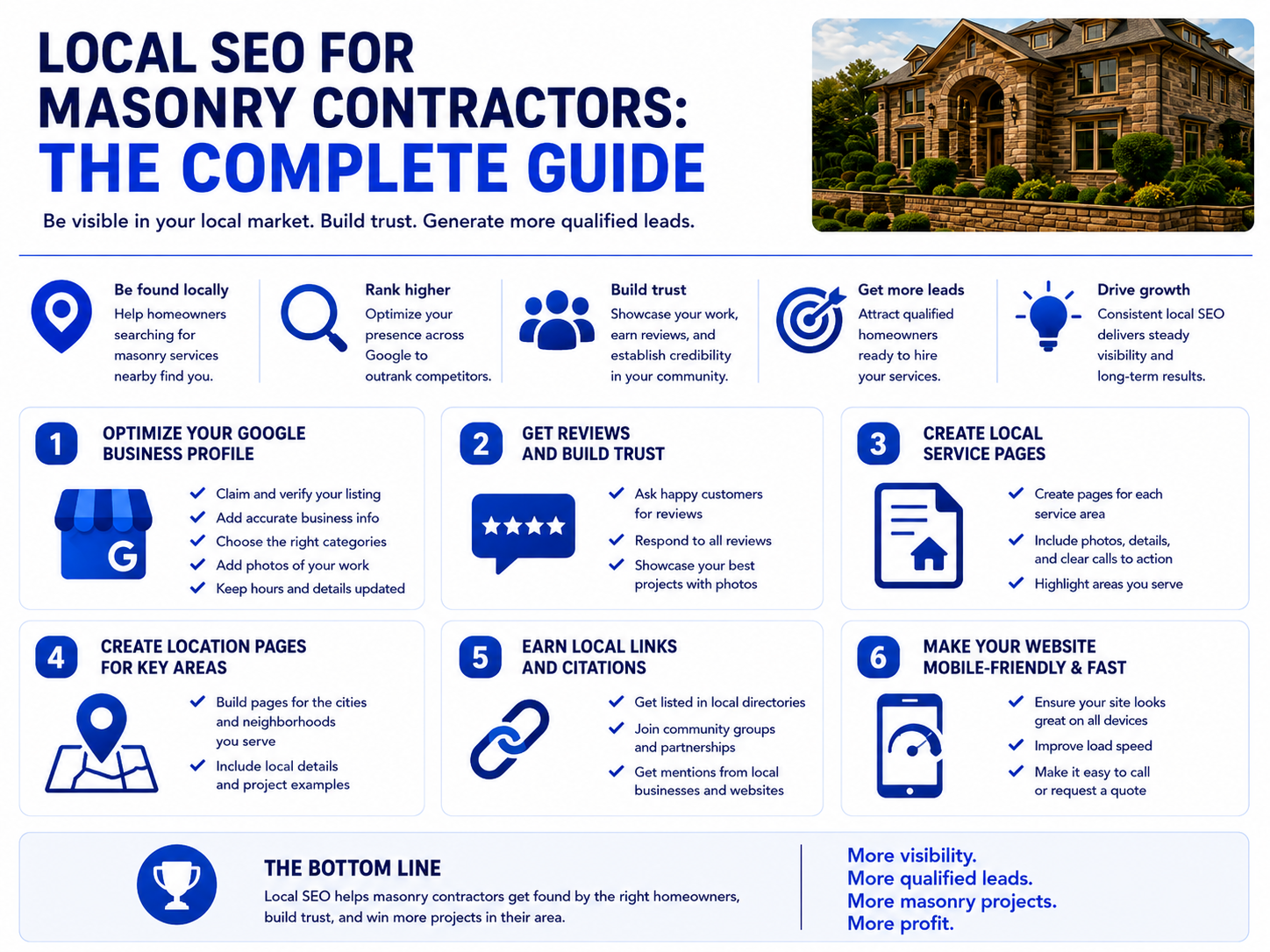
📊 Click the diagram to view a larger version. After opening it, turn your phone sideways for the best viewing experience.
Collect More Google Reviews
Reviews support both reputation and local visibility.
For masonry contractors, reviews are especially important because homeowners want proof before inviting someone onto their property.
They may be comparing several contractors at once.
A strong review can help them feel more comfortable calling you.
Do not wait months to ask.
Ask while the customer is still happy about the finished project.
A simple process can work well.
Complete the project.
Do the final walkthrough.
Confirm the customer is happy.
Send the Google review link.
Respond when the review comes in.
The easier you make the process, the more likely customers are to follow through.
You should never buy fake reviews or pressure people to write something dishonest.
Keep the process simple and authentic.
Ask for the review when the customer is happiest, usually after the final walkthrough or after they compliment the finished work.
Reviews are free publicity. Every real review can help future homeowners trust your company before they ever speak with you.
A masonry contractor finishes 100 projects in a year but asks for reviews randomly.
They only get 8 reviews.
Another contractor finishes the same number of projects but asks consistently after every successful project and sends a direct review link.
They get 35 reviews.
The difference is not only quality of work.
The difference is having a simple review process.
Respond to Reviews
Do not just collect reviews.
Respond to them.
A review response shows homeowners that your company is active, professional, and paying attention.
For positive reviews, keep the response natural and relevant to the project.
Thank the customer.
Mention the service if appropriate.
Keep it professional.
For negative reviews, avoid public arguments.
Stay calm.
Acknowledge the concern.
Explain that you are willing to discuss the issue privately when appropriate.
Future customers are not only reading the review.
They are also watching how the business responds.
A professional response can protect trust even when the review is not perfect.
Keep the response short, specific, and human.
Future customers are watching how you communicate.
Respond to every review with a short, specific, and professional message. Do not copy and paste the exact same response every time.
Review responses are part of your public reputation. They show future customers how your company communicates.
A customer leaves a review saying the crew repaired their chimney, explained the process, and cleaned up the area.
A strong response could thank them for trusting the company with the chimney repair and mention that the team appreciated the opportunity to help.
That response feels more personal than a generic thank you.
Use Real Project Photography
Stock photos are not strong evidence of your craftsmanship.
For masonry contractors, real project photos matter because the work is visual.
Homeowners want to see your brick repair, chimney restoration, stonework, tuckpointing, retaining walls, steps, patios, crews at work, and finished projects.
Real photos help prove that your company actually performs the services you claim.
They also help your Google Business Profile and website feel more trustworthy.
You do not need every photo to look perfect.
But the photos should be clear, honest, and useful.
Show the problem.
Show the process when possible.
Show the finished result.
Over time, your photo library can become one of your strongest marketing assets.
Take photos from the same angle before and after the work. This makes the transformation easier to understand.
Real project photography builds trust because it shows proof that belongs to your company.
A homeowner is comparing two masonry contractors.
One website uses generic stock photos.
The other shows real chimney repairs, tuckpointing projects, retaining walls, and brick restoration from completed jobs.
The second company feels more believable because the proof is real.
Create Helpful Local Content
Not every customer starts by searching masonry contractor near me.
Some homeowners start with a question.
They may search for how much brick repair costs, what causes stair step cracks in brick, when mortar joints should be repointed, whether damaged bricks can be matched, how much chimney repair costs, why a retaining wall is leaning, or how long tuckpointing lasts.
Those questions can become useful website content.
Helpful local content allows you to answer real homeowner concerns before they contact you.
It can also support your service pages, location pages, and overall SEO.
The goal is not to publish random articles only to have more pages.
The goal is to create content that helps homeowners understand their problem and see your company as a helpful local expert.
If customers ask the same question every week, that is usually a strong topic for your website.
Write down the questions homeowners ask during calls and estimates. Turn the best answers into simple, useful content.
Helpful content works because it meets the homeowner before they are ready to call and helps build trust earlier in the decision process.
A homeowner notices mortar falling out between bricks.
They search for what causes mortar joints to crumble.
A helpful article explains the issue, when repointing may be needed, what can happen if the problem is ignored, and when to request an estimate.
That content can turn an early research visitor into a future lead.
Build Local Authority
Local SEO is not only built on your website.
It is also built through the real relationships your masonry company has in the local market.
Masonry contractors can build local authority through relationships with general contractors, builders, architects, structural engineers, home inspectors, roofers, landscapers, suppliers, chambers of commerce, local associations, and community organizations.
These relationships matter because they show that your company is part of the local construction environment.
Do not buy random backlinks just because someone promises SEO authority.
A link from a low quality website that has nothing to do with your business will not build the same kind of trust as a real local mention from a relevant company, supplier, association, or project partner.
Build relationships that make sense.
If you work with a roofer on chimney repair projects, that relationship can support referrals.
If you work with a structural engineer on repair details, that relationship can support trust.
If you buy materials from local masonry suppliers, those relationships can help connect your company to the local building network.
Local authority works best when it comes from real business activity.
Focus on relationships that could help your business even if SEO did not exist. Those are usually the relationships that make the most sense.
Strong local authority is not only about links. It is about becoming known, trusted, and connected in the market you serve.
A masonry contractor buys a cheap backlink package and gets links from random websites that have nothing to do with masonry, construction, or the local market.
Another contractor builds relationships with suppliers, builders, inspectors, roofers, and local organizations.
The second contractor is building a real local network.
That network can support SEO, referrals, credibility, and future opportunities.
Keep Your Business Information Consistent
Your business information should be consistent across the internet.
That includes your business name, phone number, website, address where applicable, hours, and service areas.
If one listing shows an old phone number, another shows a different website, and another has outdated hours, homeowners may get confused.
Search engines may also have a harder time understanding which information is correct.
Consistency builds trust.
Your Google Business Profile, website, directories, social media pages, ads, and online listings should all clearly represent the same company.
This is especially important if your company has changed phone numbers, moved locations, updated branding, or changed services.
Even small details can create doubt.
A homeowner may wonder if the company is still active, if the number works, or if the website belongs to the same business.
Make the experience clean.
Same name.
Same phone number.
Same website.
Same service area.
Same message.
Search your business name online and check the main places where your company appears. Fix old phone numbers, broken links, wrong hours, and outdated service information.
Consistent business information helps homeowners and search engines trust that they are looking at the same real company.
A homeowner finds a masonry contractor on Google Maps.
The phone number on Google is different from the number on the website.
The Facebook page has an old logo.
A directory listing shows outdated hours.
That creates uncertainty.
Another contractor has matching information across Google, the website, social media, and major listings.
That business feels more organized and trustworthy.
Make Your Website Fast and Mobile Friendly
Getting found online is only the first step.
If the homeowner clicks your website and has a bad experience, the ranking does not matter much.
Your website should be fast, mobile friendly, easy to navigate, easy to call from, and easy to submit forms on.
Many local homeowners search from their phone.
They may be standing outside looking at cracked brick, damaged steps, chimney deterioration, or a leaning retaining wall.
They need the page to load quickly.
They need the phone number to be easy to tap.
They need the form to be simple.
They need photos to open properly.
Masonry websites often become slow because of large project photos.
Real photos are important, but uploading full size camera files directly to the page can make the website heavy.
Optimize your images before adding them to the site.
A fast and simple website helps more visitors become leads.
Keep visual proof without slowing the page.
Make the phone action obvious on mobile.
Do not make the homeowner fight the form.
Help visitors move quickly to the right page.
Test your website from your phone, not only from your desktop. Try to call, open the form, view photos, and move between service pages.
Local SEO gets the visitor to the website. Mobile experience helps decide whether that visitor becomes a lead.
A homeowner searches for chimney repair from their phone.
One website loads slowly, has tiny buttons, and makes the form hard to use.
Another website loads quickly, has a clear phone button, simple service pages, and easy project photos.
The second website gives the homeowner fewer reasons to leave.
Make Contact Easy
Every important page should give homeowners an obvious next step.
Do not make them guess what to do.
A masonry service page should clearly guide them toward requesting an estimate, scheduling an evaluation, or calling about their project.
Use clear actions like:
Request a Masonry Estimate
Schedule a Project Evaluation
Call About Your Brick Repair
Keep the phone number visible.
Use tap to call on mobile.
Keep forms short.
For masonry, an optional photo upload can be helpful because homeowners may want to show cracks, chimney deterioration, failed mortar, damaged steps, or retaining wall problems.
But do not make the form feel like homework.
The goal is to start the conversation.
You can collect more details later.
Ranking gets the visitor.
Conversion turns that visitor into an opportunity.
Keep one main call to action across the page. Too many different actions can confuse the homeowner.
The easier it is to contact you, the more likely interested homeowners are to take action.
A homeowner wants help with damaged brick.
One website has no clear phone button and a long form with too many required questions.
Another website has a visible phone number, a simple estimate form, and an optional photo upload.
The second website makes the first step easier.
Connect Google Business Profile to the Right Website Page
Your Google Business Profile and website should reinforce each other.
A homeowner may discover your company in Google Maps.
They see your reviews.
They look at your photos.
They check your services.
Then they click your website.
The website should immediately support the impression your profile created.
If your profile shows chimney repair photos, strong reviews, and masonry services, but your website opens with a vague homepage and no clear proof, trust can drop.
The experience should feel connected.
Google Maps brings attention.
Your website builds proof.
Your contact page or estimate form creates the next step.
For some contractors, linking the profile to the homepage makes sense.
For others, it may be better to link to a strong main service page, location page, or landing page depending on the business strategy.
The key is that the page should clearly explain what the company does, where it works, and how the homeowner can contact you.
Click from your Google Business Profile to your website and look at the page like a homeowner. Does it immediately confirm the service, location, proof, and next step?
Your Google Business Profile can create the first impression, but your website must confirm it.
A homeowner finds a masonry company in Google Maps after searching for brick repair.
The profile has real project photos and good reviews.
They click the website and land on a page that clearly says brick repair, shows real work, explains the process, and has a request estimate button.
That creates a smooth path from Maps to website to lead.
Use Internal Linking
Your website pages should work together.
Internal links help homeowners move from one useful page to another.
They also help search engines understand the structure of your site.
A brick repair page can link to tuckpointing, masonry restoration, relevant project pages, and important location pages.
A chimney project page can link to chimney repair, brick repair, and the estimate page.
A retaining wall page can link to drainage related content, stonework, project examples, and service area pages.
The goal is not to add random links everywhere.
The goal is to guide the visitor toward the next helpful page.
If a homeowner is reading about brick repair and you mention failing mortar, linking to your tuckpointing page makes sense.
If a homeowner is reading a chimney restoration case study, linking to your chimney repair service page makes sense.
Internal linking helps your website feel more organized and useful.
Every major service page should link to related services, project examples, location pages, and the estimate page where it makes sense.
Internal links turn separate pages into a connected Local SEO system.
A homeowner lands on a brick repair page.
The page explains that damaged mortar can sometimes be part of the problem.
The sentence links to the tuckpointing page.
Now the homeowner can learn more about the exact issue they may be seeing instead of going back to Google.
Do Not Build SEO Content Just to Build Pages
Do not create content only because you want more pages on the website.
More pages does not automatically mean better Local SEO.
If the content is generic, copied, thin, or not useful, it can make the website weaker instead of stronger.
A masonry website should publish content because it helps the homeowner understand something important.
The content should answer a real question, explain a service, demonstrate expertise, show a real project, support a location, or help someone make a better decision.
For example, an article about why mortar joints are crumbling can help a homeowner understand when tuckpointing may be needed.
A project page about a chimney restoration can show proof of real work.
A location page with real photos and reviews can help homeowners in that market trust the company.
That type of content has a purpose.
Do not publish random articles just to fill the blog.
Do not mass produce city pages that all say the same thing.
Do not write for search engines only.
SEO should make your website more useful, not more bloated.
Thin copy, repeated city text, and no real proof add little value.
Every page should help a homeowner or support a real business goal.
Before creating a new page, ask what job the page is supposed to do. If it does not help the homeowner or support a real business goal, it may not be worth publishing.
Strong SEO content is not about having the most pages. It is about having the most useful pages for the right searches.
A masonry contractor publishes 50 short pages with generic information and very little proof.
Another contractor publishes 12 strong pages with service details, local examples, project photos, FAQs, and clear calls to action.
The second website may perform better because the pages are more useful, more focused, and more trustworthy.
Track Leads, Not Just Rankings
Rankings are useful, but they are not the final goal.
A keyword moving from position six to position two is encouraging, but the real question is what happened after that.
Did website visits increase?
Did phone calls increase?
Did form submissions increase?
Did qualified leads increase?
Did estimates increase?
Did customers increase?
Did revenue increase?
That is what matters.
Local SEO should eventually connect to customer acquisition, not only ranking reports.
A page that ranks well but creates no calls is not doing enough for the business.
A page that ranks lower but produces serious estimate requests may be more valuable than it looks.
Track the full path.
Organic visibility.
Website visits.
Phone calls.
Forms.
Qualified leads.
Estimates.
Customers.
Revenue.
That is how you understand whether Local SEO is actually helping the masonry business grow.
Do not only check keyword movement. Check which pages create real calls, forms, estimates, and booked jobs.
Rankings show visibility. Leads and customers show business impact.
A masonry contractor ranks higher for a broad keyword and gets more traffic, but the visitors do not become good leads.
Another page ranks for a specific chimney repair search and gets fewer visits, but creates several serious estimate requests.
The second page may be more valuable because the intent is stronger.
Measure Performance by Service
Not every masonry service produces the same business result.
Some services may create more leads.
Other services may create better customers.
That is why you should measure performance by service.
Brick repair, tuckpointing, chimney repair, stone masonry, retaining walls, patios, steps, and restoration may all perform differently.
One service page may bring a lot of traffic but low value jobs.
Another service page may bring fewer leads but higher project value.
Another may close faster because the homeowner has urgent intent.
This information should guide your SEO investment, Google Ads budget, photography, service pages, content, and calls to action.
Do not only ask which service gets the most traffic.
Ask which service creates the best customers.
Track leads, estimates, customers, revenue, and profit by service. This helps you decide which pages deserve more attention.
The best service page is not always the one with the most visits. It is the one that creates the strongest business result.
Brick repair creates 40 leads and 8 customers.
Tuckpointing creates 25 leads and 9 customers.
Chimney repair creates 30 leads and 12 customers.
Stone masonry creates 12 leads and 5 customers.
At first, brick repair looks strongest because it creates the most leads.
But chimney repair may be more valuable because it creates more customers.
That is why service level tracking matters.
Measure Performance by Location
Not every city or service area has the same value.
Some locations may create more traffic.
Other locations may create better customers.
One city may send a lot of small jobs that are far away.
Another city may send fewer leads but higher value projects, better close rates, and stronger revenue.
That is why Local SEO should not only be built around the places generating the most visits.
It should be built around the markets generating the best business.
Track leads, estimates, customers, revenue, close rate, travel time, and project value by location.
This helps you decide where to build stronger location pages, where to take more photos, where to collect reviews, and where to focus your marketing.
Compare cities by business quality, not only lead count. The best market is the one that creates profitable work you actually want more of.
Do not build Local SEO around the cities generating the most traffic. Build it around the markets generating the best customers.
City A creates 35 leads, 5 customers, and 45,000 dollars in revenue.
City B creates 20 leads, 8 customers, and 110,000 dollars in revenue.
City A has more leads.
City B creates more business.
That means City B may deserve stronger Local SEO focus, better project pages, more reviews, and more location specific content.
5 customers and 45,000 dollars in revenue
8 customers and 110,000 dollars in revenue
Combine Local SEO With Google Ads
Local SEO and Google Ads do not need to compete with each other.
They can support each other.
Google Ads can help generate visibility quickly for valuable searches while Local SEO builds Maps and organic visibility over time.
For example, a masonry contractor may use Google Ads to get immediate traffic for chimney repair, brick repair, or retaining wall leads.
At the same time, they can build service pages, collect reviews, upload project photos, create location pages, and improve their Google Business Profile.
Over time, the organic presence can become stronger.
Reviews and project content can also improve trust for people coming from ads.
The system works better when everything supports the same goal.
Google Ads creates immediate demand.
Local SEO builds long term visibility.
Reviews and projects build trust.
The website turns visitors into leads.
Use Google Ads data to learn which services and locations create good leads. Then use that information to improve your Local SEO strategy.
Paid traffic and organic visibility work better when the website, reviews, service pages, and tracking are all connected.
A masonry contractor runs Google Ads for chimney repair and notices that those leads are turning into good customers.
That is a signal.
The contractor can then improve the chimney repair service page, add chimney project photos, request chimney focused reviews, create local chimney repair content, and build stronger organic visibility around that service.
Google Ads gives fast feedback.
Local SEO turns the learning into long term assets.
Useful for fast visibility around valuable services and markets.
Builds Maps, organic visibility, reviews, project proof, and local trust over time.
Local SEO Compounds Over Time
Local SEO becomes stronger when the business keeps adding real proof.
One masonry project creates revenue.
That same project can also create photos, a review, a project page, local content, a Google Business Profile update, a social media post, and maybe a referral.
Those assets strengthen your online presence.
Then another homeowner finds you.
You complete another project.
You collect more proof.
The cycle repeats.
That is how Local SEO compounds.
A competitor can increase their advertising budget tomorrow, but they cannot instantly recreate years of completed projects, genuine reviews, local relationships, documented experience, service pages, project pages, and customer trust.
This is why consistency matters.
Every good project can become part of the marketing system.
Treat every completed project as a future marketing asset. Save the photos, location, service type, customer feedback, and project details.
A competitor can buy traffic quickly, but they cannot instantly buy the trust created by years of real work, real reviews, and real project proof.
A masonry contractor completes 60 projects in a year but does not document them.
At the end of the year, the company has revenue, but very little new marketing proof.
Another contractor completes 60 projects and documents 30 of them with photos, service notes, customer feedback, and locations.
That contractor now has new content for service pages, location pages, Google Business Profile, reviews, social media, case studies, and referral support.
The work was already done.
The difference is that one company turned it into long term visibility.
A Simple Local SEO System for Masonry Contractors
Local SEO works best when it becomes part of how the masonry business operates.
It should not be something the contractor thinks about once every few months.
Every completed project can feed the system.
A simple Local SEO system can look like this.
This is how Local SEO becomes connected to the real business instead of feeling like a separate marketing task.
A chimney repair project can become a Google Business Profile update.
A retaining wall project can become a project page.
A brick repair job can become a review.
A tuckpointing project can become content for a service page.
A happy customer can become a referral.
Over time, these small actions build a stronger online presence.
Build a simple checklist for every completed project. Save photos, request a review, record the service type, record the city, and decide whether the project should become website content.
Local SEO compounds when real work keeps creating real proof.
A masonry contractor completes 50 projects in a year but does not document them.
At the end of the year, the business has revenue, but the website and Google Business Profile barely improved.
Another contractor completes 50 projects and documents 25 of them.
They now have new photos, reviews, service page proof, project pages, social media posts, and local content.
Both contractors did the work.
Only one turned the work into long term visibility.
Local SEO Checklist for Masonry Contractors
A strong Local SEO system has many small pieces working together.
Use this checklist to see where your masonry company may be missing opportunities.
This checklist does not need to be completed in one day.
Start with the highest impact areas.
Fix the Google Business Profile.
Make sure the phone number and website are correct.
Add real project photos.
Ask for more reviews.
Build stronger service pages.
Make contact easy.
Then improve tracking so you can see which pages, services, and locations are creating real business.
Review this checklist once per month. Local SEO improves faster when small updates happen consistently.
The strongest Local SEO systems are not built from one big change. They are built from repeated small improvements that make the business easier to find and easier to trust.
A masonry contractor has a Google Business Profile, but no recent photos, no review process, weak service pages, and no tracking.
Another contractor has a complete profile, recent project photos, steady reviews, dedicated service pages, location pages, and call tracking.
The second company has a stronger system because each piece supports the next one.
Common Local SEO Mistakes
Local SEO is powerful, but many masonry contractors make the same mistakes.
One of the biggest mistakes is ignoring the Google Business Profile.
For many homeowners, that profile is the first impression of the business.
If it has old photos, missing services, weak reviews, or inaccurate information, the company may lose trust before the homeowner ever visits the website.
Another mistake is trying to force keywords everywhere.
Keyword stuffing your business name, service pages, or location pages can make the business look less professional.
Selecting irrelevant categories can also create confusion.
Google and homeowners need to understand what the company actually does.
Fake business locations are another serious problem.
Trying to appear in cities where the company does not have a real presence can damage trust and create problems.
Targeting unrealistic service areas can also waste effort.
A masonry company should focus on the places where it can win profitable work and serve customers well.
Buying fake reviews is another major mistake.
Reviews should be real, honest, and based on actual customer experiences.
Using only stock photos is also weak because masonry is visual.
Homeowners want to see real brick repair, chimney repair, stonework, tuckpointing, retaining walls, and restoration projects.
Other common mistakes include having one generic services page, creating duplicate location pages, publishing generic content with no real experience, buying low quality backlinks, ignoring mobile performance, measuring rankings without measuring customers, and expecting immediate results.
Local SEO is not a shortcut.
It is reputation building translated into digital visibility.
Do not chase shortcuts that make the business look less trustworthy. Build real proof, real reviews, useful pages, and a better customer experience.
Local SEO works best when it reflects a real business doing real work in a real market.
Contractor A creates 30 copied city pages, buys cheap backlinks, uploads stock photos, and gets a few weak rankings but very few real leads.
Contractor B builds 8 strong service pages, 5 useful location pages, collects 40 real reviews, uploads 60 real project photos, and tracks which pages create calls and estimates.
Contractor B may grow slower at first, but the foundation is stronger because it is built on proof, trust, and real customer behavior.
Ignoring Google Business Profile
Keyword stuffing and irrelevant categories
Fake locations or unrealistic service areas
Fake reviews and stock only project proof
Duplicate location pages and generic content
Measuring rankings without measuring customers
Frequently Asked Questions
Does Local SEO work for masonry contractors?
Yes. Masonry is a location dependent service, so Local SEO can help connect contractors with homeowners searching for brick, stone, chimney, tuckpointing, and other masonry services nearby.
What are Google's main local ranking factors?
Local results are generally influenced by relevance, distance, and prominence, along with the strength and completeness of your local business presence.
Do Google reviews help masonry contractors?
Yes. Genuine reviews strengthen homeowner trust and can support a stronger local search presence.
Should masonry contractors create location pages?
Yes, for important markets they genuinely serve. Each page should provide useful, original local information rather than being a copy with only the city name changed.
How many cities should I target?
There is no universal number. Focus on the markets you actually serve and where profitable projects are available.
Should every masonry service have its own page?
Important services with distinct customer intent usually benefit from dedicated pages. Brick repair, tuckpointing, chimney repair, stone masonry, and retaining walls are good examples.
Should masonry contractors blog?
Yes, when the content answers real homeowner questions. Focus on useful topics such as repair costs, cracking, mortar deterioration, chimney problems, and project expectations.
How long does Local SEO take?
There is no guaranteed timeline. Results depend on your market, competition, location, website, content, reviews, authority, and starting position.
Is Local SEO better than Google Ads?
They solve different problems. Google Ads can create visibility quickly, while Local SEO builds longer term organic and Maps visibility. Many masonry companies can benefit from using both.
How should masonry contractors measure Local SEO?
Track visibility, traffic, leads, qualified leads, estimates, customers, and revenue. Rankings are useful, but profitable customers are the real objective.
Final Thoughts
Local SEO for masonry contractors is not about discovering one Google trick.
It is about building a stronger local presence piece by piece.
Optimize your Google Business Profile. Build real service pages. Create useful location pages. Document your projects. Collect genuine reviews. Publish helpful content. Build local relationships. Improve your website. Track the customers that result.
Then keep doing it.
Your masonry company is already creating the raw material.
Every chimney repair, brick restoration, retaining wall, tuckpointing project, and happy customer can become photos, reviews, project pages, local authority, better search visibility, and eventually more qualified masonry leads.
As we have seen, SEO can be improved in many ways, and it is a strong long term investment because it can bring customers later without paying for ads every time.
However, the effort you put in now and continue building over time is the real work that makes SEO pay off later.
The strongest Local SEO strategy does not manufacture authority online. It documents the reputation, craftsmanship, and experience your masonry company is already building in the real world.
Build that digital presence consistently, and each project can make the next customer easier to find.
Ready to Build a Stronger Local SEO System?
GiveMeSomeLeads helps masonry contractors combine Google Business Profile optimization, Local SEO, service pages, location pages, project content, reviews, Google Ads, and conversion tracking into one measurable customer acquisition system.