A masonry contractor can do excellent work and still lose leads because of a weak website.
That happens more often than many contractors realize.
A homeowner searches for masonry, brick repair, chimney repair, tuckpointing, or stonework in their area. They find your website. Then, within a few seconds, they decide whether to stay or return to Google.
If your site is confusing, slow, outdated, difficult to use, or lacking proof, the homeowner may never call.
And the frustrating part is that you may never know the lead existed.
Make it easy for visitors to see and take the action you want. Target the right traffic, people actively looking for your services in your location, to increase conversions. From our experience, keeping things simple, clear, and trustworthy is the most effective approach.
Contractor websites usually do not lose leads because of one catastrophic problem.
They lose them through small mistakes stacked together.
Your website does not need to impress another web designer. It needs to make the right homeowner feel confident enough to contact your masonry company.
Make the service and location obvious.
Show real projects, reviews, and people.
Make calling or requesting an estimate easy.
Your Homepage Does Not Clearly Say What You Do
Your homepage should answer one question immediately.
What does this company actually do?
If a homeowner lands on your website and cannot understand your service within a few seconds, you are already creating friction.
Many masonry websites use headlines that sound professional but do not say enough.
Building Excellence Since 1998
Craftsmanship That Lasts
Those lines are not wrong, but they are too general. They could describe almost any contractor.
A stronger headline should clearly explain the service, location, and main value.
Now the homeowner understands what you do and where you work right away.
That clarity matters because homeowners do not want to investigate your website just to understand the basics. They want to know if you can help with their brick repair, chimney repair, stonework, tuckpointing, retaining wall, or masonry restoration problem.
The homeowner still has to figure out what the company actually does.
The service and location are obvious immediately.
Show your homepage to someone who does not know your business for five seconds. Then ask them what your company does. If they cannot answer clearly, your headline needs work.
A homepage does not need to sound clever first. It needs to make the right homeowner understand the business fast.
A homeowner searches for masonry repair and lands on a website that says Quality You Can Trust. They still do not know if the company repairs chimneys, brick walls, stonework, steps, or retaining walls. Another website says Professional Brick Repair and Chimney Masonry in Boston. That second headline gives the homeowner a clear answer right away.
Your Phone Number Is Hard to Find
Homeowners should not have to search for your phone number.
If someone is ready to call, the website should make that action obvious.
- Visible phone number in the header
- Easy tap to call access on mobile
- Phone option near important calls to action
- Contact details on major service pages
Do not force homeowners to click the contact page, scroll around, and search for basic contact information. Every extra step creates a chance for the lead to leave.
This is especially important for urgent masonry problems such as chimney damage, loose brick, water intrusion, damaged steps, or a failing retaining wall.
Open your website on your phone and see how fast you can call the business. If it takes more than a few seconds, simplify it.
Every extra step between interest and contact creates another opportunity to lose the lead.
A homeowner visits two masonry websites. One has the phone number hidden at the bottom of the contact page. The other has a clear tap to call button near the top. The second website makes the next step easier, so it has a better chance of turning the visit into a lead.
You Are Using Generic Stock Photos
Stock photos can make a website look polished, but they can also weaken trust.
For masonry contractors, real proof matters more than perfect images.
Homeowners want to see your brickwork, stonework, chimney repairs, retaining walls, crew, and finished projects.
Real project photos prove experience. Stock photos only prove that you found nice images.
Masonry is visual. The homeowner wants to know if your company can actually do the work.
You do not need perfect photography to start. Clear real photos from actual projects are usually better than polished images that do not belong to your company.
Replace stock photos with real project photos little by little. Start with your homepage, main service pages, and estimate sections.
Real photos make the business feel local, active, and believable.
A masonry website shows a perfect stock image of a worker holding tools, but none of the company's actual brickwork. Another website shows real chimney repairs, retaining walls, brick restoration, and finished stonework from completed projects. The second website feels more believable because the proof belongs to the company.
You Do Not Show Before and After Projects
Masonry is one of the best trades for before and after proof.
Use that advantage.
- A damaged chimney can become a clean rebuilt chimney
- Failed mortar can become properly repointed masonry
- Cracked brick can become a restored wall
- A leaning retaining wall can become a strong finished structure
Before and after photos help homeowners see the transformation and make your claims easier to believe.
Instead of only saying you do quality work, show the problem, the repair process, and the finished result.
Many masonry contractors already have this content sitting unused in phones, old social posts, text messages, and project folders.
For every good project, save three types of photos: the problem, the repair process, and the finished result.
Before and after proof helps homeowners understand the value of the work before they ever speak with you.
A homeowner has a damaged chimney and compares two contractors. One contractor says they offer chimney repair. The other shows a damaged chimney, progress photos, the finished repair, and a customer review. The second contractor gives the homeowner more proof and more reason to request an estimate.
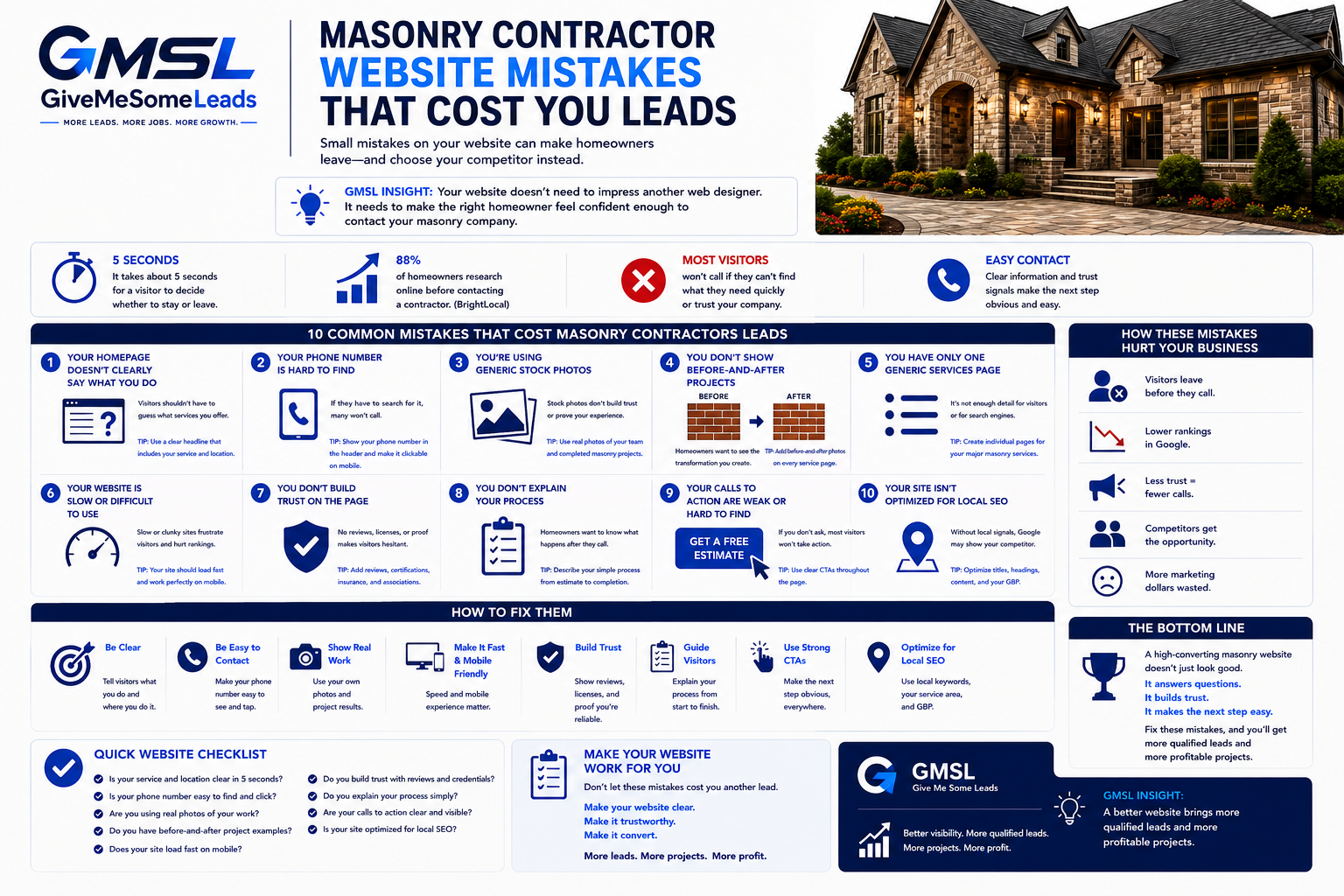
📊 Click the diagram to view a larger version. After opening it, turn your phone sideways for the best viewing experience.
Your Website Has Only One Generic Services Page
A page called Our Services with a short list of everything you do is usually not enough for a serious masonry website.
If your company offers brick repair, tuckpointing, chimney repair, stone masonry, retaining walls, steps, patios, and restoration, each major service may deserve its own page.
A homeowner searching for chimney masonry repair does not want to read one sentence buried inside a general services page. They want a page that speaks directly to chimney problems.
Dedicated service pages help the homeowner find the right information faster and help search engines understand what each page is about.
A focused page can explain the problem, process, project examples, reviews, service area, and next step for one specific service.
Start with the services that matter most to your revenue. Build strong pages for those first instead of trying to create every page at once.
A generic services page tells people what you offer. A strong dedicated service page helps turn a specific search into a real lead.
A homeowner searches for chimney repair and lands on a page that lists ten masonry services with very little detail. Another homeowner lands on a chimney repair page with common chimney problems, real project photos, reviews, pricing factors, and a clear estimate button. The second page is more useful because it matches the exact problem searched.
Your Service Pages Are Too Thin
Creating separate pages is not enough.
A weak service page that says we provide professional brick repair, contact us today does not give the homeowner much reason to trust the company.
A strong service page should answer enough questions that contacting you feels like the next logical step.
- Common problems
- What the service includes
- How your process works
- Where you provide the service
- Real project proof
- Relevant reviews
- Common questions
- A clear estimate request
This does not mean every page has to be extremely long. It means every page should be useful.
Thin pages make the website feel unfinished. Useful pages build confidence.
Before publishing a service page, ask if it would help a homeowner understand the problem, the repair, and the reason to contact your company.
A service page should not just exist for SEO. It should help the homeowner feel informed enough to take action.
Company A has a brick repair page with three short lines and a phone number. Company B has a brick repair page that explains common problems, shows real projects, includes relevant reviews, answers basic questions, and makes the next step clear. Company B gives the homeowner more confidence before the first call.
You Have No Reviews on the Website
A masonry contractor saying we do great work is a claim.
A customer explaining that your crew matched the brick properly, communicated clearly, protected the property, cleaned up, and completed the repair well is evidence.
Reviews should not only live on Google. Use them throughout your website.
- Homepage
- Service pages
- Project pages
- Contact sections
- Landing pages
The best reviews are specific. If the page is about chimney repair, use a chimney repair review. If the page is about tuckpointing, use a tuckpointing review. If the page is about retaining walls, use a retaining wall review.
When asking for reviews, do not tell customers what to write. Simply remind them of the project you completed so their review is more specific and helpful.
Reviews become stronger when they are placed near the service they support.
A homeowner visits a tuckpointing page. One website has no reviews. Another includes a review from a customer who had failing mortar repaired and explains that the finished work matched well and the crew cleaned up properly. The second page feels more trustworthy because the proof matches the service.
Your Website Does Not Build Enough Trust
Before contacting a masonry contractor, homeowners want reassurance.
They may be inviting your crew onto their property and dealing with expensive repairs, water damage, structural concerns, poor previous work, or the fear of choosing the wrong contractor.
- Real reviews
- Years in business
- Project photography
- Team photos
- Insurance information where applicable
- Licenses where applicable
- Certifications
- Warranty information
- Clear service area
- Professional branding
Do not place all trust signals in one small section and forget about them. Use them naturally throughout the page.
The goal is not to brag. The goal is to give homeowners enough confidence to contact you.
Look at your website from the homeowner's point of view and ask what would make you feel safe contacting this company.
Trust is built through proof, consistency, and clarity. The more confident the visitor feels, the easier it is for them to take the next step.
A homeowner compares two masonry websites. One has stock photos, no reviews, no team photos, and very little service information. The other has real projects, customer reviews, clear service pages, a visible phone number, and a simple estimate process. The second website feels safer.
Your Calls to Action Are Too Vague
A call to action should tell the homeowner exactly what to do next.
Buttons like Learn More, Submit, or Click Here are too vague.
Use clear action language.
Schedule a Brick Repair Evaluation
Call About Your Chimney Repair
Get a Masonry Quote
The homeowner should not have to guess whether they are booking an estimate, sending a message, calling the office, or requesting pricing.
Use one clear main action across the page so the path forward stays consistent.
The homeowner does not know what happens next.
The next step is obvious.
Use one main action across the page. Too many different buttons can confuse the visitor.
A good call to action does not pressure the homeowner. It simply makes the next step obvious.
A homeowner visits a brick repair page. One button says Submit. Another says Request a Brick Repair Estimate. The second is stronger because the homeowner knows exactly what they are doing.
Your Contact Form Is Too Long
A contact form should make it easy for homeowners to reach out. It should not feel like paperwork.
If your form asks too many questions before the first conversation, some visitors will leave.
Start with the basics.
- Name
- Phone
- ZIP code
- Service needed
- Short description
- Optional photo upload
For masonry contractors, an optional photo upload can help homeowners show cracks, damaged brick, failing mortar, chimney issues, broken steps, or retaining wall problems before the first visit.
The goal is to start the conversation. You can ask more questions later once the lead is real.
Open your form on your phone and try to complete it like a homeowner. If it feels annoying, shorten it.
Every extra form field creates more friction. A simple form can help more serious homeowners take the first step.
A homeowner wants help with a damaged chimney. One form asks for too many details, budget, timeline, property information, and several required questions. Another asks for contact information, service needed, a short description, and an optional photo. The second form feels easier.
Your Website Does Not Work Well on Mobile
A masonry website can look professional on a desktop computer and still lose leads on mobile.
That is a serious problem because many homeowners search from their phone.
They may be standing outside looking at cracked brick, checking chimney damage, or comparing contractors after seeing your Google Business Profile.
- Phone number
- Navigation
- Forms
- Buttons
- Photo galleries
- Text size
- Page speed
The page should be easy to read, easy to scroll, easy to call from, and easy to submit a form from.
Do not design only for the screen in your office. Design for the device your customer is holding.
Test your website on your own phone. Start from the homepage, visit a service page, tap the phone number, open the form, and view the project photos.
Mobile design is not only about appearance. It directly affects whether the visitor can become a lead.
A homeowner finds two masonry contractors on their phone. One website has tiny text, hard to tap buttons, a confusing menu, and a long form. The other has a clear phone button, simple sections, fast loading photos, and an easy estimate form. The second company makes contacting them easier.
Your Website Is Too Slow
A slow website can cost leads before the homeowner even sees your work.
Masonry websites often become slow because of large project images.
Real photos are important, but huge image files can make the page load too slowly, especially on mobile.
- Large photo files
- Unnecessary scripts
- Too many plugins
- Heavy animations
- Autoplay videos
- Overcomplicated page builders
Compress images, resize photos properly, and remove anything that does not help the homeowner trust you or contact you.
A fast page feels more professional and gives visitors a smoother path to becoming a lead.
Do not upload original large photos straight from your phone or camera. Resize and compress them before adding them to the website.
Project photos help sell the work, but they only help if the page loads fast enough for homeowners to see them.
A chimney repair page has great photos, but each image file is too large and the page loads slowly. Another page uses clear compressed photos and loads faster. The second page gives homeowners the same trust building proof with less friction.
You Are Overdesigning the Website
A masonry website does not need to feel complicated to look professional.
Many contractors think a better website means more animation, movement, effects, videos, and visual tricks.
Homeowners are not visiting your website to be entertained. They are trying to figure out if you can solve their masonry problem.
A strong masonry website should feel simple, solid, trustworthy, and easy to use.
You probably do not need moving backgrounds, animated bricks, complicated transitions, autoplay videos, or text flying across the screen.
Real project photos, clear service pages, strong reviews, simple calls to action, and easy contact options usually matter more.
More movement does not automatically create more trust.
The design supports the homeowner decision.
Before adding a design effect, ask if it helps the homeowner trust you, understand your service, or contact you. If it does not, remove it.
Good design makes the next step easier. Overdesign makes the visitor work harder.
One masonry website opens with animations, moving text, slow videos, and a confusing menu. Another opens with a clear headline, real masonry photos, reviews, service buttons, and a visible phone number. The second website may look simpler, but it gives homeowners what they need faster.
You Do Not Explain Your Process
Homeowners may know they need masonry work, but they may not know what happens after they contact you.
That uncertainty can stop people from reaching out.
- Request an estimate
- Review the project
- Inspect the masonry
- Explain the scope
- Provide a proposal
- Schedule the work
- Complete the project
- Review the finished result
This helps the homeowner understand what to expect before the first call and makes the company feel more organized.
For masonry projects, this matters because homeowners may worry about cost, damage, cleanup, timing, access, and whether the repair will match the existing brick or stone.
Keep the process simple. Use words homeowners understand instead of making it sound technical.
A clear process does not only explain the work. It makes contacting your company feel safer.
A homeowner has damaged brick around the front steps. One website only says to contact the company. Another explains the estimate, site evaluation, proposal, scheduling, repair, cleanup, and final walkthrough. The second company feels more organized before the homeowner even calls.
You Are Missing Local SEO Signals
If you want local masonry leads, your website needs to clearly show where you work.
Homeowners should quickly understand whether your company serves their city, neighborhood, or surrounding area. Search engines also need clear local context.
- Mention your main service areas naturally
- Show real local projects
- Use reviews from customers in those areas
- Create useful location pages for important markets
- Add photos and service details that prove you work there
Do not create dozens of copied city pages where only the city name changes. Local SEO works better when location is supported by real proof.
Add local project examples to your service pages whenever possible. A real project in the area is stronger than repeating a city name over and over.
Do not just tell Google you work in a city. Show evidence that your company actually works there.
A masonry company says it serves Boston, but the website has no local project photos, city specific reviews, or useful location content. Another company shows brick repair, chimney repair, and restoration projects from nearby areas with reviews and clear service pages. The second website gives stronger local trust.
You Have No Project Case Studies
A gallery is useful. A project case study can be even stronger.
A photo gallery shows the finished work, but a case study explains the full story.
A good case study can include:
- Project type
- Location
- Problem
- Work completed
- Before photos
- Progress photos
- After photos
- Customer review when available
You do not need to make every project into a long article. Even a simple project story can build trust.
Use the same format for every case study: problem, work completed, finished result, and customer takeaway.
Project case studies turn your completed work into proof that can support SEO, trust, referrals, and conversions.
A website shows one finished chimney photo with no explanation. Another shows the damaged chimney before the work, explains the repair process, shows the finished result, and includes a customer review. The second page gives homeowners more confidence because they can see both the result and the process.
You Do Not Answer Basic Pricing Questions
Masonry pricing can vary, but ignoring price completely can frustrate homeowners.
A visitor may understand that you cannot give an exact number without seeing the project, but they still want some idea of what affects the cost.
- Project size
- Type of masonry
- Height
- Access
- Material matching
- Damage level
- Structural conditions
- Labor requirements
- Cleanup
- Preparation required
A small brick repair near ground level is different from chimney work that requires roof access. A simple mortar repair is different from a wall with movement, water damage, or hidden deterioration.
Talking about pricing in a helpful way can make the homeowner feel more prepared before they call.
Explain what affects cost instead of giving a fake exact price. This gives homeowners useful context without locking your company into a number too early.
Homeowners do not always need the final price right away. They need enough pricing context to feel comfortable requesting an estimate.
A homeowner has damaged brick around a window. One website says Contact us for pricing. Another explains that cost can depend on the number of damaged bricks, access, brick matching, mortar work, water damage, and whether movement is involved. The second website feels more helpful.
Your Website Looks Abandoned
Homeowners notice when a website looks outdated.
A website does not need to be redesigned every year, but it should feel maintained.
- Old copyright date
- Broken links
- Old phone numbers
- Dead social links
- Missing images
- Outdated service information
- Project galleries that have not been updated in years
These details may seem small, but they can create doubt about whether the company is still active.
Add recent project photos, update service pages, fix broken links, remove outdated information, check forms, and make sure the phone number works.
Review your website every few months. Check the homepage, service pages, contact page, phone buttons, forms, links, photos, and footer information.
An outdated website can make an active company look inactive.
A homeowner visits a masonry website and sees old photos, broken links, a copyright date from years ago, and a disconnected social page. Another website shows recent project photos, current services, clear contact information, and updated pages. The second company feels more active.
Your About Page Says Almost Nothing
A weak About page usually sounds like every other contractor.
It says things like quality, integrity, customer satisfaction, and professional service. Those words are fine, but they are not enough by themselves.
Homeowners want to know who they may be hiring.
- Who owns the company
- How long you have worked in masonry
- Why the business started
- What you specialize in
- What standards matter to the company
- Who is on the team
- What type of work you are proud of
People hire people. A strong About page can make the business feel more real, local, and trustworthy.
Write your About page like you are introducing the business to a homeowner who is deciding whether they can trust you.
A strong About page can turn a company from a name on a screen into a real business with people, standards, and a story.
A weak About page says We are committed to quality workmanship and customer satisfaction. A stronger page explains who started the company, what masonry experience they have, what services they specialize in, what areas they serve, and why they care about doing the work properly.
You Do Not Show Your Team
Team photos can make a masonry company feel more trustworthy.
Homeowners may be inviting your estimator, crew, or project manager onto their property. They want to know there are real people behind the business.
A website with no owner photo, team photo, crew photo, or identifiable people can feel cold. It may even feel like a lead generation site instead of a real local contractor.
You can show the owner, estimator, crew, project manager, office staff, or team at work.
The photos do not need to be perfect. They need to be real and professional.
Use real team photos in clean work clothes, on real jobsites, or in front of completed projects. Keep the photos professional and natural.
Real team photos help homeowners feel like they are contacting a real company, not just filling out a form on a random website.
A homeowner compares two masonry websites. One has no people anywhere. The other shows the owner, crew, real project photos, and a simple company story. The second website feels more personal and trustworthy.
Your Website Does Not Match Your Google Business Profile
Your website and Google Business Profile should feel like the same company.
If a homeowner finds you on Google Maps and sees strong reviews, real project photos, professional branding, and clear services, they expect the website to match that same level of trust.
Consistency matters.
- Business name should match
- Phone number should match
- Services should match
- Photos should feel connected
- Branding should look consistent
- Service area should be clear
This helps the homeowner feel like they are dealing with a real local contractor, not a confusing or outdated business.
Compare your Google Business Profile and your website side by side. Check the phone number, business name, services, photos, logo, service areas, and main message.
Consistency builds trust. If your online presence feels disconnected, homeowners may hesitate before contacting you.
A homeowner finds a masonry company on Google Maps. The profile looks strong, but the website has old images, a different style, missing services, and an outdated phone number. Another company's profile and website feel aligned. The second company feels more trustworthy.
You Are Writing for Google Instead of Homeowners
SEO matters, but homeowners come first.
A page filled with repeated keywords can become hard to read.
Good content should explain the service clearly, answer real questions, show experience, explain problems, process, pricing factors, service areas, project proof, and next steps.
Search engines may help people find the page, but homeowners decide whether to call.
Use simple language and place keywords naturally where they make sense.
Better: If your brick is cracked, loose, or deteriorating, our team can inspect the damage, explain the repair options, and provide a clear estimate for your home.
The writing sounds like it is for a search engine.
The homeowner understands what to do next.
Read the page out loud. If it sounds robotic, forced, or stuffed with repeated phrases, rewrite it for a real homeowner.
The best SEO content does not choose between search engines and customers. It helps both by being clear, useful, and focused.
The stronger version sounds like a real contractor helping a real homeowner, which makes the page easier to trust.
You Have No Internal Linking
Your website pages should not feel disconnected.
Internal links help visitors move from one useful page to another and help search engines understand how your website is organized.
- Brick repair can link to tuckpointing
- Brick repair can link to masonry restoration
- Chimney project pages can link to chimney repair
- Retaining wall pages can link to project examples
- Service pages can link to useful location pages
The key is to link where it helps the homeowner. Do not add random links just for SEO.
Every important service page should link to at least a few related pages that genuinely help the visitor continue their research.
Internal links turn individual pages into a connected website system.
A homeowner lands on a brick repair page. The page explains cracked brick and mentions that failing mortar may also need repair, with a link to the tuckpointing page. Now the homeowner can learn more about the exact issue instead of leaving the website.
You Are Sending Google Ads Traffic to the Homepage
Sending Google Ads traffic to the homepage can waste money.
If someone searches for brick repair contractor near me and clicks your ad, they should not land on a general homepage that talks about every service.
They should land on a focused brick repair page or landing page.
The page should match the search. The ad should match the page. The offer should match the problem.
They searched for brick repair, clicked a brick repair ad, and landed on a brick repair page. Now the page can show brick repair problems, real project photos, reviews, pricing factors, service area, and an estimate request button.
Google Ads can bring attention, but the landing page needs to convert that attention into a lead.
Build landing pages around the service being advertised. Do not send every paid click to the homepage.
Do not make customers search twice. Once on Google and again after they reach your website.
A homeowner searches for chimney repair. Company A sends the visitor to the homepage, where they have to search for the service again. Company B sends them to a chimney repair landing page with photos, reviews, common problems, service area, and a clear estimate button. Company B creates a cleaner path from search to lead.
You Are Measuring Traffic Instead of Customers
More traffic does not automatically mean a better website.
A masonry website can get plenty of visitors and still fail to create real business if those visitors do not become leads, estimates, and customers.
The real question is what happens after someone lands on the website.
- Do they call
- Do they submit a form
- Do they request an estimate
- Are they qualified
- Do they become customers
- Do they create revenue
A website with less traffic can outperform a website with more traffic if it attracts better visitors and converts them more effectively.
Track visitors, leads, qualified leads, estimates, customers, and revenue.
Do not celebrate traffic too early. A page is only valuable if it helps create real opportunities.
Traffic is attention. Customers are the outcome.
Website A gets 2,000 visitors, creates 20 leads, and 4 customers. Website B gets 1,200 visitors, creates 35 leads, and 9 customers. Website A has more traffic, but Website B creates more business.
You Have No Call Tracking or Form Tracking
If you do not know where leads come from, improving marketing becomes much harder.
A homeowner may call from Google. Another may submit a form from a service page. Another may come from Google Ads, Facebook, or a referral.
At minimum, track:
- Phone calls
- Form submissions
- Service page conversions
- Landing page leads
- Organic leads
- Paid leads
- Referral sources
Then connect those leads to estimates and customers whenever possible.
Tracking helps you see that one page may bring more calls while another brings better projects.
Track the source of every serious lead. Even a simple spreadsheet is better than relying on memory.
You cannot improve what you do not measure. Tracking turns marketing from a guessing game into a business system.
A masonry contractor gets 40 calls in one month. With tracking, they discover that 15 came from Google Business Profile, 10 from organic service pages, 8 from Google Ads, 4 from referrals, and 3 from Facebook. Now the contractor can make better decisions about where to invest.
You Are Showing the Wrong Projects
Your website attracts the type of work it showcases.
If you want more high value stonework but your website mostly shows small mortar repairs, you may be sending the wrong message.
- If you want more chimney projects, show chimney work
- If you want more historic restoration, show restoration
- If you want more retaining walls, show retaining walls
- If you want more high value masonry projects, make those projects visible
The projects on your website tell visitors what your company is known for and shape what customers believe you can handle.
Your project photos, case studies, reviews, and service pages should support the direction you want the business to grow.
Review your website photos and ask whether they represent the projects you actually want more of.
Your website should not only prove what you have done. It should help shape the work you want more of.
A masonry contractor wants more large stone projects, but the website mostly shows small patch repairs and basic mortar work. Another contractor shows outdoor fireplaces, stone entrances, retaining walls, veneer work, and custom masonry projects. The second website sends a stronger signal for higher value work.
Your Website Has No Clear Differentiation
Why should a homeowner choose your masonry company instead of another one?
If your website only says quality work, great service, and affordable prices, it may sound like every other contractor.
Real differentiation comes from specific strengths.
- Specialized restoration experience
- Historic brick matching
- Dedicated project management
- Written warranties
- Decades of local experience
- Detailed project documentation
- Strong review history
- Technical masonry expertise
- A clean customer process
The key is to only use claims that are true, then support them with evidence.
Differentiation is not just about sounding different. It is about giving homeowners a real reason to trust you.
Pick three real reasons customers choose your company and make sure your website proves them with photos, reviews, process, case studies, or experience.
A strong website does not only say you are better. It shows why the homeowner should believe it.
Company A says We provide quality masonry at affordable prices. Company B says We specialize in historic brick repair, careful mortar matching, documented restoration work, and clear communication from estimate to final walkthrough. Company B feels more specific and gives the homeowner a clearer reason to choose them.
Real Life Example: Same Traffic, Different Results
Imagine two masonry contractors each receive 1,000 website visitors per month.
At first, it may look like both websites have the same opportunity. But traffic alone does not tell the full story.
Contractor A
Generic headline, stock photos, one broad services page, few reviews, no clear before and after projects, a hidden phone number, and a long contact form.
1,000 visitors → 15 leads
Contractor B
Clear masonry headline, real project photos, dedicated service pages, service focused reviews, before and after proof, simple forms, visible contact options, and strong calls to action.
1,000 visitors → 35 leads
The traffic is the same. The result is different.
That is why more traffic is not always the fastest way to get more leads. Sometimes the better move is to stop wasting the traffic you already have.
Before spending more money on ads or SEO, look at whether your current website is actually turning visitors into calls, form submissions, estimates, and customers.
More traffic can help, but conversion is what turns attention into real business.
Masonry Website Lead Checklist
A masonry website should make it easy for the right homeowner to understand your company, trust your work, and contact you.
Use this checklist to review where your website may be losing leads.
Homepage and Message
- Clear homepage headline
- Service and location explained quickly
- Visible phone number
- Strong main call to action
- Simple navigation
Proof and Trust
- Real masonry photos
- Before and after projects
- Customer reviews
- Team photos
- Years in business
- Insurance and licenses where applicable
- Warranty information where applicable
Service Pages
- Dedicated pages for important services
- Helpful explanations
- Common problems answered
- Real project examples
- Service focused reviews
- Pricing context
- Frequently asked questions
Mobile and Speed
- Mobile friendly layout
- Easy tap to call button
- Short contact form
- Fast loading images
- Simple photo galleries
- No unnecessary effects slowing the page down
SEO and Tracking
- Clear service areas
- Useful location pages
- Internal links between related pages
- Google Business Profile consistency
- Call tracking
- Form tracking
- Lead quality tracking
- Customer tracking
If several of these are missing, the website probably has room to generate more opportunities.
A masonry website is not successful just because it exists. It is successful when the right homeowner finds it, trusts the company, and takes the next step.
Frequently Asked Questions
What is the biggest masonry contractor website mistake?
One of the biggest mistakes is failing to clearly explain what the company does and how a homeowner can contact it. Confusion and friction can quickly reduce conversions.
Should masonry contractors use stock photos?
Real project photography is usually much more persuasive because it demonstrates actual workmanship. Stock photos can supplement a website where necessary, but they should not replace real project proof.
Do masonry contractors need separate service pages?
Important services usually benefit from dedicated pages when homeowners search for them separately. Brick repair, chimney repair, tuckpointing, stonework, retaining walls, and restoration can represent different customer needs.
How important is mobile website design?
Very important. Local service customers frequently browse on phones, so calls, forms, photos, buttons, and navigation should work smoothly on mobile.
Should masonry contractors show pricing?
Exact pricing may not be practical because projects vary. However, explaining the factors that affect price can help homeowners understand why an estimate is needed and feel more comfortable contacting the company.
Do reviews really matter on a contractor website?
Yes. Reviews provide evidence that previous customers have successfully hired and worked with your business. Reviews are especially useful when they match the service the visitor is researching.
Should my website have a project gallery?
Yes, but organize it thoughtfully. Before and after photos and project case studies can be more persuasive than an unstructured gallery because they explain both the problem and the finished result.
Why should I not send all Google Ads traffic to my homepage?
A dedicated landing page can better match the visitor's search, keep the page focused on one service, and make the next action easier to understand.
How do I know whether my masonry website is generating leads?
Track Visitors → Calls and Forms → Qualified Leads → Estimates → Customers → Revenue. Do not evaluate the website based on traffic or appearance alone.
Final Thoughts
Most masonry websites do not need more decoration.
They need more clarity, proof, and purpose.
Your website should make it easy for homeowners to understand what you do, where you work, what your work looks like, why customers trust you, and how to contact you.
Fix the vague headline. Show the actual masonry. Build proper service pages. Add real reviews. Make the phone number obvious. Improve mobile performance. Show your team. Explain your process. Connect your website to your Google Business Profile. Track what happens after the visitor arrives.
Then keep adding proof as your company completes new work.
Just trust the process and stay consistent. Many contractors give up too early on their online presence because they would rather focus on the work itself, which is completely understandable. However, your sales funnel, including your website, is at the core of your lead generation potential.
Every website visitor represents an opportunity you already earned through SEO, advertising, referrals, or reputation. Do not lose that opportunity because your website makes choosing you harder than it needs to be.
Before spending more money generating traffic, make sure your masonry website is doing everything possible to turn the traffic you already have into qualified leads and customers.
Ready to Fix the Website Mistakes Costing You Masonry Leads?
GiveMeSomeLeads helps masonry contractors improve websites, service pages, Local SEO, Google Business Profile visibility, landing pages, conversion tracking, and lead generation systems.