
Many painting companies spend most of their marketing budget trying to generate one homeowner at a time. Google Ads, Local SEO, referrals, social media, and other channels can all produce valuable opportunities, but there is another strategy that can create multiple projects from the same relationship.
That is where preferred contractor programs can become valuable.
Preferred contractor relationships can exist through insurance and restoration networks, property management companies, general contractors, builders, facility managers, manufacturers, supplier networks, and home service platforms.
The exact model varies significantly from one organization to another. Some programs provide direct project assignments. Others maintain approved vendor lists, invite contractors to bid, provide professional resources, or make it easier for customers and business partners to find qualified contractors.
For example, Contractor Connection operates a contractor network connected with property repair assignments from insurers, while Sedgwick operates contractor networks for residential and commercial property repair and restoration opportunities.
Paint manufacturers also offer professional contractor programs, although these should not automatically be confused with lead generation programs. Sherwin Williams PRO+ provides professional pricing, purchasing benefits, business tools, and contractor resources. Benjamin Moore also provides contractor rewards, professional education, and resources for painting professionals.
The opportunity can be valuable, but painting contractors need to approach it with the right mindset.
Do not think:
“Where can I sign up and start receiving free painting leads?”
Instead, think:
“How can we become the type of painting company another organization trusts enough to recommend, approve, or repeatedly assign work to?”
Preferred contractor status is not valuable because you receive a badge or appear on a list. It becomes valuable when your painting company becomes easier for another organization to trust, recommend, and work with repeatedly.
What Is a Preferred Contractor Program?
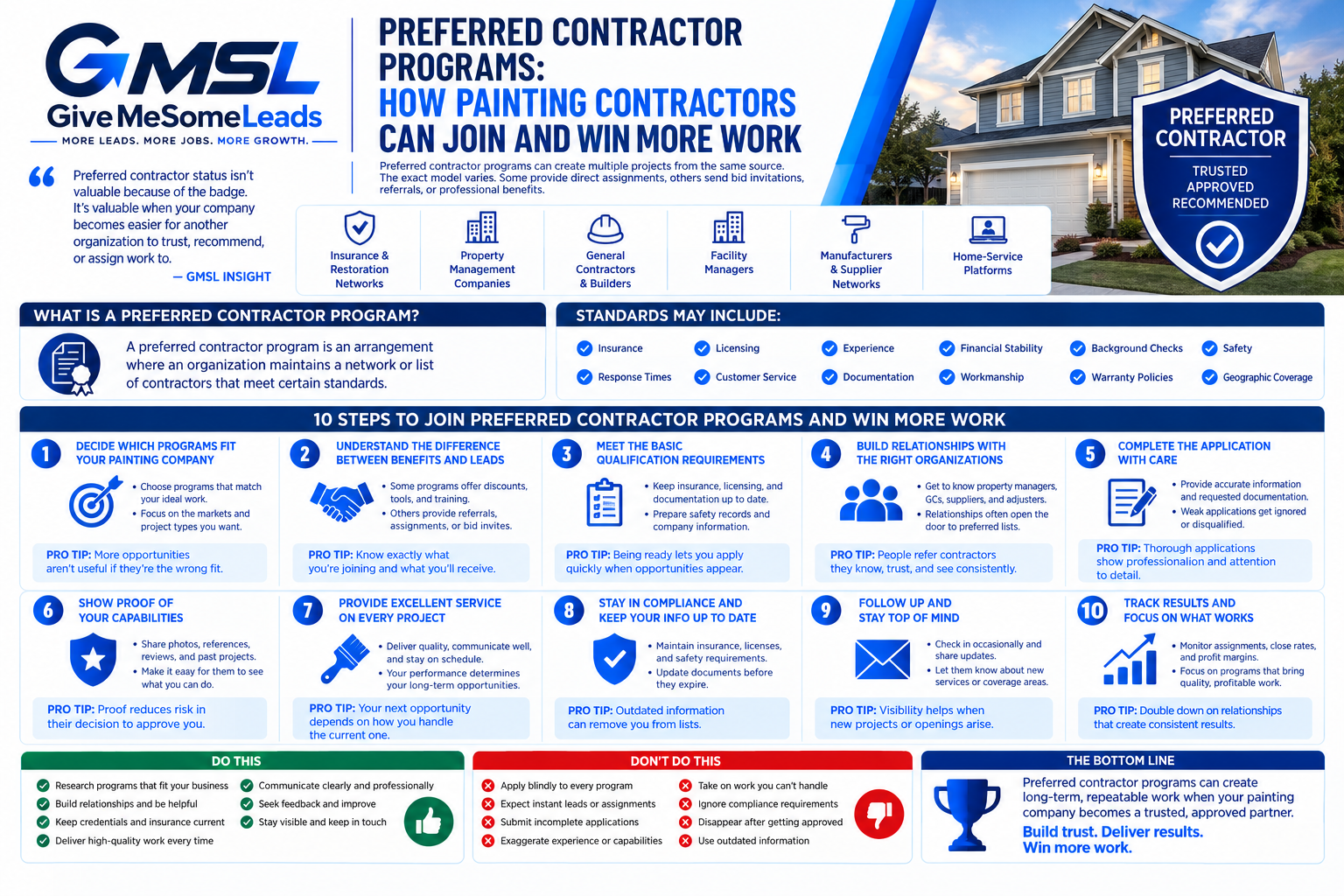
A preferred contractor program is an arrangement where an organization maintains a network or list of contractors that meet certain standards.
Depending on the organization and type of work, those requirements might include appropriate insurance, licensing, experience, financial stability, background checks, safety procedures, response times, customer service standards, documentation, workmanship, warranties, and geographic coverage.
Once accepted, contractors may receive direct assignments, bid invitations, customer referrals, vendor opportunities, professional resources, or simply preferred status that makes them eligible for future work.
The important point is that every program is different.
Before investing time in an application, understand exactly what the relationship provides, what the organization expects from contractors, and whether the potential work fits your painting company.
Decide Which Programs Fit Your Painting Company
Do not apply to every contractor program you can find. Start by deciding what type of painting work you actually want more of.
A residential painting company might look for relationships with insurance repair networks, Realtors, builders, remodeling companies, property managers, and paint suppliers.
A commercial painting company may have better opportunities with general contractors, facility managers, commercial property management companies, multifamily operators, retail maintenance networks, and commercial restoration companies.
Painting companies already involved in restoration work can investigate insurance restoration networks, water and fire restoration companies, claims service providers, and general contractors handling property losses.
The objective is not to join the largest possible number of programs. It is to find programs that produce projects your crews can complete efficiently and profitably.
More opportunities are not automatically better. Twenty projects that do not fit your crews, margins, service area, or capabilities can be less valuable than five projects that perfectly match your business.
Homeowners, Realtors, builders, property managers, and supplier relationships.
General contractors, facility managers, multifamily operators, and maintenance networks.
Insurance repair networks, restoration companies, claims providers, and property loss contractors.
Understand the Difference Between Contractor Benefits and Contractor Leads
Not every professional contractor program is a referral network.
Sherwin Williams PRO+, for example, provides professional pricing and contractor resources, including purchasing tools and other business benefits. Benjamin Moore's Contractor Rewards program primarily rewards qualifying purchases, while the company also provides professional education and contractor resources.
These programs can still provide real value. Better supplier relationships, product knowledge, training, purchasing advantages, and operational resources can help make your painting company more competitive.
But joining one does not necessarily mean homeowners or commercial customers will automatically be sent to your company.
Before joining a program, determine whether it is primarily a professional support program or an actual referral, bidding, or project assignment network.
That distinction matters when deciding how much time and effort the opportunity deserves.
Pricing, training, purchasing tools, product education, and contractor resources.
Assignments, referrals, bid invitations, approved vendor access, or future project eligibility.
Get Your Business Documentation Ready
Organizations running preferred contractor networks usually want evidence that they are dealing with a legitimate and professionally operated company.
Before applying, prepare the documentation commonly requested in your market. This may include general liability insurance, workers' compensation where required, business and contractor licenses where applicable, tax documentation, company information, references, service areas, project portfolios, safety documentation, and financial or banking information when legitimately required by the program.
Insurance and restoration networks may have significantly more detailed prequalification requirements than a local property management company or general contractor.
Create a digital Contractor Qualification Folder for your painting company.
Keep your current insurance certificates, licenses, tax documents, references, company information, safety documents, service areas, and portfolio materials organized in one place.
When a property manager, general contractor, or network administrator says, “Send us your insurance and vendor documents,” you should be able to respond quickly instead of spending two days searching for paperwork.
That small operational improvement also makes your company look more professional.
Build a Strong Project Portfolio
A preferred contractor application becomes much stronger when you can demonstrate that your company has successfully completed the type of work you are asking to receive.
Organize your portfolio around your strongest services.
For interior painting, that might include whole home repaints, apartments, offices, occupied spaces, and multifamily units. Exterior projects could include residential exteriors, multifamily properties, commercial buildings, and larger repainting projects. Specialty work might include cabinets, industrial coatings, high performance coatings, or floor coatings where applicable.
For your strongest projects, document the condition before the work, the scope, preparation process, products or coatings used where relevant, finished result, and customer review when available.
A folder containing random finished photos is better than nothing, but a portfolio that explains what your company actually accomplished is much stronger.
Professional networks want evidence that you can execute.
Homeowners do too.
Build a Website That Supports Your Application
Imagine a property manager receives your vendor application and searches your company name before responding.
What do they find?
Your website should reinforce the claims you made in your application. It should clearly show your painting services, service areas, experience, completed projects, customer reviews, company information, contact information, and appropriate insurance or licensing information where relevant.
There is a strong reason to take this seriously. BrightLocal's 2026 consumer research found that 84% of consumers had searched online for a local business within the previous three months. The same research found that roughly three quarters used more than one channel during their most recent local business search.
That means a referral, preferred contractor relationship, or professional introduction does not necessarily replace online research. Someone can hear about your painting company through one source and then use Google, your website, reviews, social media, or another platform to validate the decision.
Your website should also reflect the work you are trying to win.
If you are pursuing $50,000 commercial repainting contracts but your website only shows three bedroom repaints and a few stock photos, there is a disconnect between your marketing and your business development strategy.
Create service pages and project examples around the markets you want to enter.
If multifamily painting is important, show multifamily work. If commercial repainting is a priority, build a commercial painting page and document commercial projects. If property managers are an important audience, explain how your company handles scheduling, occupied properties, communication, documentation, and recurring work.
Your marketing should not only describe the painting company you have today. It should help support the contracts you want to win tomorrow.
Become Excellent at Response Time
Response time matters because the organization referring a customer is putting part of its own reputation in your hands.
This becomes particularly important with insurance work, property management, turnovers, restoration, and commercial maintenance, where delays can affect tenants, homeowners, schedules, and other trades.
Build a simple internal process for every referred opportunity.
When an assignment or referral arrives, acknowledge it quickly, contact the customer, schedule the evaluation, prepare the estimate, and update the referral source when appropriate.
The goal is to remove uncertainty.
If a property manager sends you a project on Monday, they should not have to contact you Thursday asking whether anyone ever called the tenant.
Fast communication does not mean rushing the actual painting work. It means making sure everyone knows what is happening.
Create a simple response standard for referred opportunities. For example, acknowledge new opportunities the same business day whenever possible, assign responsibility to one person, and record the next action inside your CRM.
A referral should never disappear because everyone assumed someone else was handling it.
Learn to Work Within Their Process
Preferred contractor networks usually have systems, and those systems may be more structured than the process you use for a normal residential repaint.
You may be required to use specific software, estimate formats, photographs, customer signatures, status updates, service timelines, change order procedures, or closeout documentation.
Some contractors resist these requirements because they are accustomed to doing everything their own way.
But when you enter another organization's vendor network, part of the job is learning how that organization operates.
You do not necessarily have to accept every requirement. You should absolutely evaluate whether the process makes financial and operational sense for your company. But once you agree to participate, consistently ignoring the system is a fast way to become difficult to work with.
The contractors who earn repeat opportunities are often the contractors who follow instructions, communicate clearly, submit paperwork correctly, and meet deadlines.
Do Not Assume Preferred Means Guaranteed Work
Getting accepted into a preferred contractor program does not mean your phone will suddenly ring nonstop.
Some networks have many participating contractors, and opportunities may be distributed according to geography, availability, capacity, specialty, performance, pricing, customer choice, or other program specific criteria.
Think of acceptance as opening a door.
Your performance determines whether that door leads to additional opportunities.
Imagine two painting companies are accepted into the same property management vendor network.
The first company takes days to respond, misses estimate deadlines, and forces the property manager to repeatedly follow up for updates.
The second company responds quickly, sends clear estimates, arrives when promised, completes the painting properly, documents the finished work, and communicates when the project is complete.
After several projects, which company is the property manager more likely to call first?
Probably the second one.
Preferred status gets you considered. Performance earns repetition.
Your company is inside the network and can be considered.
Fast response, clear estimates, reliable work, and communication create repeat opportunities.
Make Your Estimates Easy to Approve
Professional buyers often need more information than a homeowner receiving a simple painting estimate.
A proposal that only says “Painting: $8,500” forces the decision maker to figure out what the price actually includes.
Instead, clearly define the areas included, preparation work, coatings, number of coats where appropriate, exclusions, optional work, and total price.
For example, explain whether the project includes walls, ceilings, trim, doors, drywall patching, sanding, caulking, primer, finish coats, major drywall repairs, rotten wood replacement, or other work that could affect the scope.
This becomes especially important when a property manager, facility manager, insurance representative, or general contractor is comparing multiple proposals or managing several properties at once.
A professional estimate should make the decision easier, not create more questions.
Protect the Referral Partner's Reputation
When another organization sends you a customer, your behavior reflects on that organization.
Imagine a property manager recommends your painting company to a building owner. Your estimator does not answer calls, arrives late, communicates poorly with the tenant, leaves the property messy, and eventually submits surprise charges.
The property manager does not only lose confidence in your company. They may also have to explain why they recommended you.
That makes another referral much less likely.
Referred work therefore involves managing two relationships at the same time: the customer receiving the painting service and the organization that trusted you with the opportunity.
Deliver a good experience for both.
Communication, workmanship, cleanliness, schedule, and final result.
Responsiveness, documentation, predictability, and no surprises.
Close the Communication Loop
One of the easiest ways to become more valuable to a referral partner is to keep them informed without making them chase you.
A simple message can be enough:
“Thanks for sending us the Oak Street project. We met the homeowner today and will have the painting proposal submitted tomorrow.”
Once the project is finished:
“The project is complete and the homeowner approved the final walkthrough. Thanks again for the opportunity.”
These updates take very little time, but they remove uncertainty.
The property manager, general contractor, or referral partner knows the opportunity was handled and does not have to wonder what happened after making the introduction.
Use Paint Manufacturer Programs to Strengthen Your Business
Paint manufacturer programs can still be useful even when they do not directly generate painting leads.
Programs such as Sherwin Williams PRO+ and Benjamin Moore's professional contractor resources can potentially provide purchasing advantages, product knowledge, professional education, operational resources, and stronger supplier relationships.
Use those benefits strategically.
Better product knowledge can help your estimators recommend appropriate coatings. Purchasing advantages can affect job margins. Strong relationships with local paint representatives can help when you need technical information, product availability, or support on a larger project.
These benefits may not appear in your CRM as a lead source, but they can still improve your ability to compete for more professional work.
Consider Restoration and Insurance Networks Carefully
Insurance and restoration networks can create substantial opportunities for painting companies with the appropriate capabilities.
Contractor Connection, Sedgwick, and other property repair networks work with contractors performing restoration and repair related services.
That does not automatically make every network a good opportunity for every painting company.
Before joining, investigate payment terms, pricing requirements, estimating systems, documentation requirements, service timelines, expected margins, geographic territory, capacity requirements, and the type of projects actually being assigned.
Capacity is especially important when pursuing larger contractor relationships. The 2026 AGC and NCCER workforce survey found that 87% of participating construction firms reported openings for hourly craft positions, and among firms with craft openings, 88% said those positions were as difficult or more difficult to fill than one year earlier.
The same survey found that 42% of firms experienced project delays because of shortages involving their own workers or subcontractors' workers.
Although this research covers the broader construction industry rather than painting contractors specifically, it highlights an important issue for painting companies pursuing larger contracts: winning more work only helps when you have enough qualified people and operational capacity to deliver it properly.
Do not join a network simply because someone tells you:
“Insurance work is endless.”
Volume means very little when the work does not produce sufficient profit or your company cannot reliably service it.
Evaluate Payment Terms Before Signing
Revenue and cash flow are not the same thing.
A preferred network might provide consistent painting projects while requiring slower payment, more documentation, retainage, or more administrative work than homeowner direct projects.
Before accepting substantial work, understand the payment schedule, invoice requirements, approval process, change order procedures, dispute process, material reimbursement rules where applicable, and exactly which organization is responsible for paying your company.
Consider what happens between starting the project and receiving payment.
A $50,000 commercial painting contract can look excellent on your sales report while creating serious cash flow pressure if your company has to finance payroll, materials, equipment, and other expenses for an extended period.
The best preferred contractor program is not necessarily the one offering the most work. It is the one providing profitable work that your painting company can operationally and financially support.
Calculate the Real Profitability
Do not celebrate because a contractor network “sent us $300,000 in work this year” until you understand what your company actually kept from that revenue.
Track the revenue generated by each network against materials, direct labor, administrative costs, travel, callbacks, warranty work, fees, and other costs associated with servicing those projects.
Then compare the results with your other customer acquisition channels.
One preferred contractor program may generate a large amount of revenue but require extensive administration and produce thinner margins. Another relationship might send fewer projects but generate significantly better economics.
The goal is not maximum revenue from every source.
The goal is profitable growth.
Track Every Program Separately
Do not group every professional relationship under a generic CRM source such as “Referral.”
Create a separate source for each meaningful program or relationship.
For example:
| SourceOpportunitiesJobs WonRevenue | |||
|---|---|---|---|
| Network A | 35 | 18 | $145,000 |
| Property Manager B | 20 | 15 | $120,000 |
| Builder C | 12 | 8 | $96,000 |
These numbers are illustrative, but the principle is important.
Revenue alone is not enough either. Over time, you should also understand close rate, average project value, gross profit, payment speed, administrative workload, callbacks, and repeat opportunities from each relationship.
This allows you to answer a much more useful question:
Which relationships actually deserve more of our attention?
Use unique lead sources inside your CRM and connect those sources with your estimate and revenue data whenever possible. A program producing 40 opportunities can look impressive until you discover that only five became profitable projects.
Build Relationships Beyond the Program
Do not become a faceless vendor number.
When appropriate, develop professional relationships with the people involved in distributing, managing, or influencing the work. Depending on the program, that could include vendor managers, project managers, estimators, property managers, store representatives, facility managers, and general contractors.
You are not trying to constantly ask them for work.
You are trying to become familiar, reliable, and easy to work with.
After enough successful projects, you want someone to see a new painting project and naturally think:
“Send this one to ABC Painting. They're easy to work with.”
That is much more valuable than simply having your company name sitting inside a vendor database.
Ask How to Improve Your Standing
After completing several projects successfully, ask the organization what would make your company even more useful.
A simple question can uncover valuable information:
“Is there anything we could improve to become a stronger contractor for your network?”
You might discover that the organization needs faster estimates, better photo documentation, broader geographic coverage, additional commercial capacity, quicker communication, or another service your company could realistically provide.
That information can help guide operational improvements.
Preferred contractor status should not be static.
Your objective should be to gradually become one of the easiest painting contractors in the network to trust and use.
What would make us more useful?
Speed, photos, territory, capacity, communication.
Turn feedback into operating standards.
Avoid Becoming Dependent on One Program
Preferred contractor programs can create recurring opportunities, but depending too heavily on one organization creates concentration risk.
Imagine that one network eventually generates 70% of your company's revenue.
Then leadership changes. Territories are reorganized. Pricing requirements change. Another contractor receives more assignments. Vendor standards change. The network loses a major customer. Or your company simply loses approved status.
Your pipeline could change almost overnight.
That is why preferred contractor programs should complement your broader customer acquisition strategy rather than replace it.
Continue investing in Google Ads, Local SEO, your Google Business Profile, customer referrals, past customer relationships, professional partnerships, your website, reviews, project photos, and other channels that bring customers directly to your painting company.
A strong painting company does not need every marketing channel to produce the same amount of business. It needs enough strong channels that losing one does not put the entire company at risk.
Keep Building Your Own Brand
A preferred contractor network gives your painting company access to opportunities, but in many cases the organization controls the relationship that originally generated those opportunities.
Your own marketing assets are different.
Your website, reviews, Google visibility, customer database, project portfolio, brand reputation, referral system, Local SEO presence, and follow up process continue building value for your company.
Online reputation deserves particular attention. BrightLocal's 2026 Local Consumer Review Survey found that 97% of consumers read online reviews for local businesses, while 85% said positive reviews make them more likely to use a business.
Even more important for painting contractor websites, 54% of consumers said they visit the business's website after reading positive reviews.
That illustrates how the channels work together. A homeowner may discover your company through a referral, read your Google reviews, visit your website, look through your painting projects, and then request an estimate. The referral may have started the journey, but the rest of your marketing helped reinforce the decision.
Keep investing in these assets even when a preferred contractor relationship is producing plenty of work.
A strong network relationship can help fill your schedule today. Your own customer acquisition system gives you more control over where tomorrow's opportunities come from.
Preferred contractor programs can help fill your pipeline. Your own marketing system helps protect the business when that pipeline changes.
A Simple Preferred Contractor Strategy
The overall strategy is straightforward.
First, identify programs and professional relationships that match the type of painting work you want. Prepare your business documentation and relevant project portfolio, then apply and complete any required prequalification.
Once accepted, learn the organization's process. Respond quickly when opportunities arrive, provide professional estimates, perform excellent work, document the completed project, communicate with both the customer and referral source, and track the profitability of the relationship.
Then use your performance to earn additional trust and repeat opportunities.
The objective is not simply to become approved.
It is to become preferred in practice.
📊 Click the diagram to view a larger version. After opening it, turn your phone sideways for the best viewing experience.
Common Preferred Contractor Program Mistakes
One of the biggest mistakes is treating every contractor program as an automatic source of free leads. Some programs provide assignments, some provide bidding opportunities, some provide professional benefits, and others simply make contractors eligible for future work.
Painting contractors should also avoid applying without the required documentation, presenting an irrelevant portfolio, responding slowly, submitting vague estimates, ignoring program procedures, missing documentation deadlines, accepting unprofitable work simply for volume, overlooking payment terms, failing to communicate project status, and depending too heavily on one network.
Another common mistake is focusing so heavily on preferred contractor relationships that the company stops building its own marketing system.
A painting company can simultaneously develop professional relationships while investing in Google Ads, Local SEO, Google Business Profile optimization, customer reviews, referrals, project photos, website conversion, tracking, and follow up.
Those channels support each other.
A property manager who hears about your company may search your name and find your website. A general contractor may look at your reviews before adding you to a bid list. A homeowner referred through a professional partner may browse your project gallery before requesting an estimate.
Your marketing system helps validate the reputation your professional relationships are creating.
Being accepted into a preferred contractor program is therefore not the finish line.
It is the beginning of the evaluation.
Frequently Asked Questions
What is a preferred contractor program?
It is generally a network or approved vendor system where contractors meeting certain standards may receive assignments, referrals, bid opportunities, resources, or preferred status.
Can painting contractors join insurance contractor networks?
Some contractor networks accept qualified property repair contractors. Contractor Connection, Sedgwick, and Accuserve currently maintain contractor network programs connected to insurance or property repair. Eligibility depends on each network's requirements and your capabilities. (Contractor Connection)
Does Sherwin Williams have a contractor program?
Yes. Sherwin Williams offers PRO+, a professional contractor program with pricing benefits, account tools, purchasing resources, and other contractor oriented services. It should not automatically be treated as a guaranteed lead generation program. (Sherwin Williams)
Does Benjamin Moore have a contractor program?
Yes. Benjamin Moore currently offers Contractor Rewards as well as contractor focused education and business resources. (Benjamin Moore)
What do preferred contractor programs usually require?
Requirements vary, but they may include insurance, licensing, experience, references, project capacity, safety standards, business documentation, background checks, and compliance with program procedures.
Are preferred contractor programs worth it?
They can be when they produce profitable work at acceptable margins and payment terms. Evaluate total revenue, gross profit, administrative workload, payment speed, and repeat opportunity.
Do preferred contractors get guaranteed work?
Usually not. Approval may make you eligible for opportunities, but actual project volume can depend on availability, geography, performance, customer choice, and network rules.
How can painters receive more work after joining?
Respond quickly, submit clear estimates, communicate well, complete projects on time, follow program requirements, document the work, and consistently protect the referral partner's reputation.
Should painting companies depend entirely on preferred contractor programs?
No. Even a profitable program can change. Build your own Local SEO, Google presence, website, reviews, referrals, and other lead sources at the same time.
Preferred Status Is Only the Beginning
Preferred contractor programs can become a valuable source of painting work, but the real opportunity is not simply getting your company approved.
Some programs may create direct assignments. Some may create bid opportunities. Others, including manufacturer contractor programs, may strengthen your business through pricing, training, tools, and professional support rather than directly sending customers.
Evaluate every relationship by the work it creates, how often you win it, how quickly you are paid, the margin it produces, and whether the relationship has long term value.
You can see how often we repeat, both here and in our other articles, how important it is to communicate clearly, respond quickly, and build relationships wherever possible. On top of that, the key is to simply keep going and stay consistent. Your efforts may not work with everyone, but they will work with the right people. Keep showing up, building relationships, and creating opportunities.
Getting onto a preferred contractor list may open the door. Becoming reliable enough that people specifically want your company on the next project is where the real value begins.
Do not aim merely to become an approved painting contractor. Build the kind of company organizations prefer to call again.
Ready to Build a Stronger Painting Customer Acquisition System?
GiveMeSomeLeads helps painting contractors combine preferred contractor programs, professional referrals, Google Business Profile, Local SEO, Google Ads, website conversion, and revenue tracking into one measurable growth strategy.