Good roofing alone does not guarantee a full schedule.
A company can install excellent roofs, use quality materials, communicate well, and still struggle to generate enough profitable projects. The reason is that roofing and customer acquisition are two different parts of the business.
Roofing marketing connects them. It helps the right homeowners discover your company, see evidence that you can do the work, request an estimate, and feel confident enough to hire you.
The strongest strategy is usually not one advertising channel. Google, Local SEO, reviews, referrals, your website, project content, previous customers, and follow up can all support each other.
GMSL Insight: A roofing company should not judge marketing only by how many leads arrive. The better question is how many of those opportunities become qualified estimates, customers, revenue, and profitable roofing projects.
What Is Roofing Marketing?
Roofing marketing includes everything that helps move a homeowner from discovering your company to becoming a customer.
That starts with visibility through Google, Maps, referrals, social media, yard signs, branded vehicles, and other channels. It continues through your website, reviews, estimate process, communication, follow up, and customer experience.
Real homeowner data shows why the entire journey matters. Roofing Contractor reported in its 2026 homeowner research that 74% of homeowners said word of mouth recommendations were a way they find roofers, 62% would contact a roofer they had used before, and 54% used online search engines.
That means your marketing system should not depend entirely on one source.
1. Start With the Roofing Projects You Want
Before spending money on marketing, decide what type of work you actually want more of.
A company focused on full roof replacements should not celebrate every lead equally if most inquiries are for tiny repairs that do not fit the business.
Think about project value, profit, crew capacity, service type, location, and the type of customer your company works best with.
Your marketing should be designed around attracting more of those opportunities.
GMSL Insight: More leads do not automatically mean better marketing. Ten strong replacement opportunities can be more valuable than fifty inquiries your company does not want.
2. Focus on Your Best Service Areas
The same principle applies to geography.
You may technically serve a large radius, but some areas will produce better roofing projects than others. One city may have stronger project values and close rates, while another creates long drive times, smaller projects, and difficult scheduling.
Review where your best customers are actually coming from and concentrate more of your marketing there.
Your Google Ads targeting, Local SEO pages, project content, and Google Business Profile strategy should support the markets you actually want to grow.
3. Build a Website That Helps Homeowners Choose You
Your website often becomes the center of the roofing marketing system.
A homeowner may discover you through Google, a referral, a yard sign, social media, or a branded truck. Before calling, many will still look at your website.
They should quickly understand what roofing services you provide, where you work, why your company is credible, what your previous work looks like, and how to request an estimate.
Roofr surveyed 292 United States homeowners who had roofing work completed during the previous two years. 82% said they checked online reviews before hiring a roofer, while 66% ranked a professional proposal or estimate as a major trust factor.
Your website and sales process should reflect that.
Use real roofing projects, customer reviews, clear service pages, legitimate credentials, visible contact information, and an easy estimate request.
4. Show Real Roofing Projects
Roofing is visual, which gives contractors a major marketing advantage.
Photograph the roof before work starts, important installation stages, problem areas when appropriate, materials, flashing details, crew activity, and the completed project.
Strong projects can then be reused on your website, Google Business Profile, social media, proposals, service pages, and project case studies.
Stock photography can make a site look clean, but it does not prove that your company installed anything.
Real work does.
GMSL Insight: Every completed roof should leave your company with more than an invoice. It should also create photos, proof, a potential review, useful content, and another opportunity to strengthen your reputation.
5. Build Strong Roofing Service Pages
Do not expect one general services page to answer every homeowner question.
Someone searching for roof replacement has different concerns from someone looking for roof repair, commercial roofing, or metal roofing.
Give your important services their own useful pages. Explain the problems you solve, what homeowners can expect, where you provide the service, relevant project examples, common questions, and the next step.
The page should help someone decide whether your company is a good fit, not simply exist because you want to rank for a keyword.
6. Use Google Ads to Capture Existing Demand
Google Ads can work well for roofing because it allows your company to appear when homeowners are actively looking for help.
Someone searching for a roofing contractor, roof replacement company, or roof repair service already has a problem they want solved.
That makes the path simple.
Search → Relevant Ad → Relevant Landing Page → Estimate Request
Avoid measuring success only through clicks.
Track which search terms generate qualified homeowners, which leads receive estimates, which estimates become customers, and what revenue those customers create.
7. Build Local SEO and Google Business Profile Together
Google Ads can generate visibility quickly. Local SEO can strengthen your organic presence over time.
Your website, service pages, location pages, reviews, project content, internal links, Google Business Profile, and local reputation should work together.
Keep your Google Business Profile accurate and active. Add strong project photos, keep business information current, respond to reviews, and make sure homeowners can easily reach your website or phone number.
Roofing Contractor's 2026 research also found that 62% of homeowners rated online reviews as very important or extremely important when choosing a roofer.
Reviews therefore support more than reputation. They can strengthen the entire local decision process.
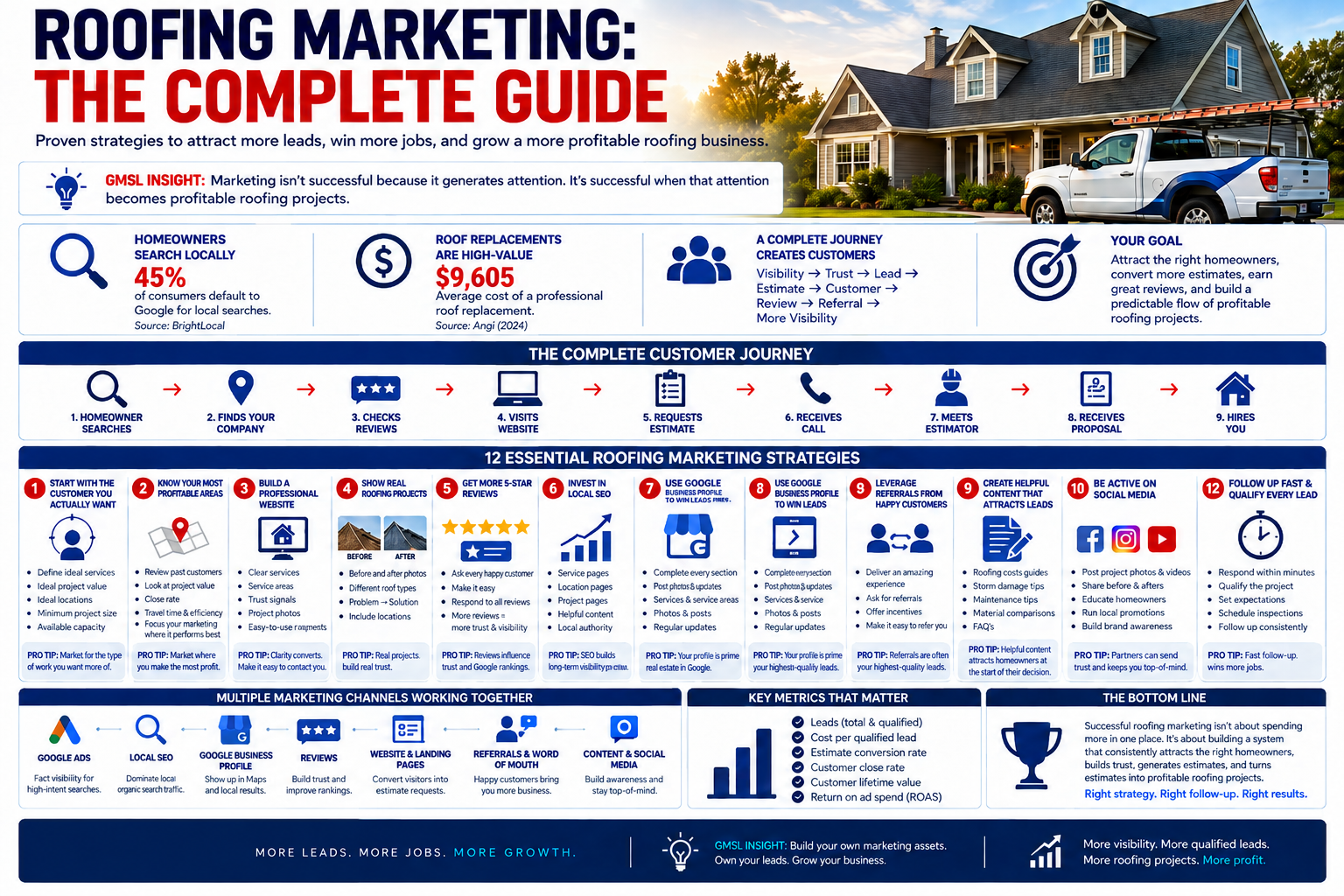
📊 Click the diagram to view a larger version. After opening it, turn your phone sideways for the best viewing experience.
8. Ask for Reviews Consistently
Satisfied customers do not always leave reviews on their own.
Roofr found that 86% of surveyed homeowners said they would leave a review when explicitly asked, while only 39% said they would leave one without being asked.
That is a major difference.
Build the review request into project completion. Confirm the homeowner is satisfied, send the direct review link, and make the process simple.
A strong completed project can help you win the current customer. A strong review from that customer can help you win the next one.
9. Use Pricing Information to Build Trust
Roofing contractors sometimes avoid discussing pricing because every roof is different.
That is understandable, but it does not mean your website has to provide no pricing context at all.
Roofing Contractor reported that 65% of homeowners said they were more likely to call a roofing contractor that provided pricing information on its website. The same research found that about 33% of contractors still provided no pricing information online.
You do not need to promise a fixed price.
Explain what affects cost, such as roof size, pitch, access, roofing system, decking condition, flashing, tear off requirements, and other project variables.
Useful pricing context can help homeowners understand what they are paying for without locking your company into an inaccurate quote.
10. Improve Your Estimate and Follow Up Process
Marketing does not stop when someone submits a form.
Roofing Contractor's 2026 research found that 39% of homeowners expected to hear from a roofer the same day, while another 56% expected a response within one or two days.
That means slow follow up can waste opportunities your marketing already generated.
Respond quickly, qualify the project, schedule the estimate, and continue communicating after the proposal is delivered.
Roofr also found that 74% of homeowners said responsiveness and communication mattered more than price, while 70% preferred receiving estimates and proposals digitally.
A professional proposal and strong follow up can therefore be just as important as generating the original lead.
11. Build Referrals and Local Relationships
Referrals continue to matter enormously in roofing.
That is not surprising when 74% of homeowners in Roofing Contractor's 2026 survey identified recommendations from friends, neighbors, or family as a way they find roofing contractors.
Ask satisfied customers for referrals, but also make your company easy to recommend.
Your website, phone number, Google profile, or contact information should be easy for someone to send to another homeowner.
Professional relationships can also create opportunities. Realtors, home inspectors, general contractors, builders, gutter companies, siding companies, restoration contractors, and other trades may encounter roofing needs regularly.
Become useful and reliable before asking them for business.
12. Turn Every Project Into More Marketing
This is where a roofing marketing system begins to compound.
One customer finds you through Google and hires your company. You complete a strong roofing project. The homeowner leaves a review. You document the project with real photos. Those photos improve your website and Google Business Profile. A neighbor sees your crew and yard sign. The customer recommends your company to a friend.
Now the original marketing investment has created several new marketing assets.
That is much stronger than treating every lead and every project as an isolated event.
Track Marketing Through Revenue and Profit
Do not stop your reporting at leads.
Track the entire journey:
Marketing Source → Qualified Lead → Estimate → Customer → Revenue → Profit
Imagine Google Ads generates 40 leads while Local SEO generates 25. Google Ads appears better until you discover that Local SEO created more qualified estimates, more customers, and stronger profit.
That changes the decision completely.
Cost per lead can be useful, but cost per customer and profit by marketing source tell you much more about the health of the business.
A Simple Roofing Marketing Strategy
Start with a strong website, proper tracking, and an optimized Google Business Profile. Use Google Ads to capture homeowners who are searching now while building Local SEO for stronger organic visibility.
Use real roofing projects, reviews, useful content, and professional proposals to build trust. Improve response time and follow up so fewer opportunities are wasted.
Then add referrals, professional relationships, social media, previous customer communication, and neighborhood visibility where they make sense.
You do not need every marketing channel.
You need several dependable channels that support each other.
Frequently Asked Questions
What is the best marketing strategy for a roofing company?
There is no single channel that works best for every roofer. A strong system often combines Google Ads, Local SEO, Google Business Profile, reviews, referrals, project content, a professional website, and consistent follow up.
Does Google Ads work for roofing contractors?
It can. Google Ads is particularly useful for capturing homeowners already searching for roofing services. Results depend on targeting, competition, search terms, landing pages, lead quality, sales performance, and customer economics.
Is Local SEO worth it for roofers?
It can be especially valuable for companies trying to build stronger long term visibility in their service area. SEO works best when supported by a strong website, reviews, Google Business Profile, project content, and useful service pages.
Should roofing companies buy leads?
Purchased leads can still make sense when they create profitable customers. The important thing is knowing whether the economics work and avoiding complete dependence on someone else for every opportunity.
What should roofing contractors track?
Track the original marketing source through qualified leads, estimates, customers, revenue, and profit. That allows you to see which channels are actually producing valuable roofing projects.
Final GMSL Insight
A strong roofing marketing system should become more valuable every time your company completes a great project.
The roof itself creates revenue, but the project can also create a review, referral, photos, a case study, neighborhood visibility, stronger Google Business Profile content, and another piece of proof for your website.
That is where roofing marketing becomes powerful.
Instead of constantly starting from zero and buying the next opportunity, your company gradually builds a reputation and collection of marketing assets that make the next homeowner easier to reach and easier to convert.
The goal is not simply more leads. The goal is to make every successful roofing project help create the next profitable one.
Ready to Build a Stronger Roofing Marketing System?
GiveMeSomeLeads helps roofing contractors combine Google Ads, Local SEO, Google Business Profile optimization, high converting websites, landing pages, reviews, project content, and conversion tracking into one measurable customer acquisition strategy.
The focus is not simply clicks or form submissions. It is generating more qualified opportunities, estimates, customers, revenue, and profitable roofing projects.
We will review your local market, search visibility, competitors, and customer acquisition opportunities.
📊 Get My Free Local Market Analysis